
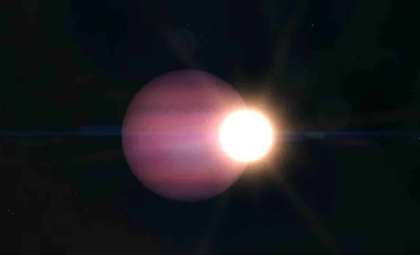
In a breakthrough study revealing the early phases of moon formation, NASA’s James Webb Space Telescope has uncovered a carbon-rich dust and gas disk encircling a young exoplanet situated over 600 light-years from Earth. The planet, known as CT Cha b, orbits a star that remains in its formative stage, allowing researchers to observe planetary assembly as it unfolds. This planetary system could mirror the conditions of our own solar system more than four billion years ago, when moons were beginning to emerge. The findings have been published in The Astrophysical Journal Letters.
CT Cha b’s Carbon-Enriched Disk: A Birthplace for Moons
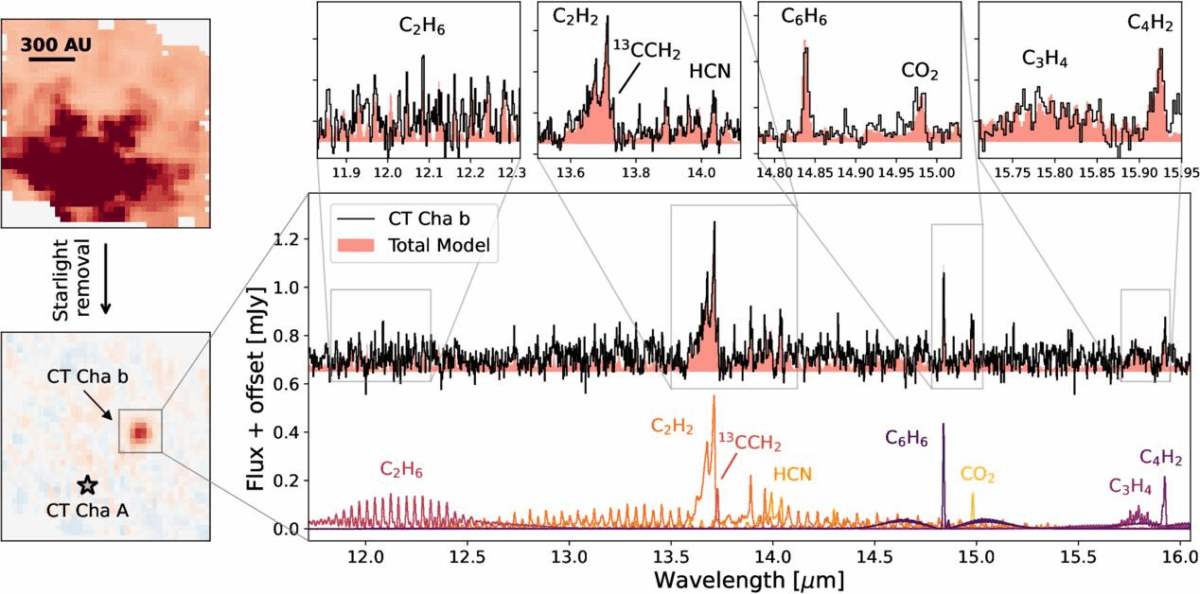
CT Cha b, located roughly 625 light-years away in the Chamaeleon I region known for star formation, was analyzed using Webb’s Mid-Infrared Instrument (MIRI). This powerful instrument enabled scientists to cut through the intense brightness of the host star to detect a unique disk surrounding the planet itself. What stands out is the disk’s distinct chemical composition. Medium-resolution spectroscopy revealed a rich assortment of carbon-based molecules such as acetylene, benzene, diacetylene, ethane, and hydrogen cyanide.
These complex organic compounds are considered potential precursors to moon formation. Sierra Grant, co-lead author from the Carnegie Institution for Science, explained,

“We can see evidence of the disk around the companion, and we can study the chemistry for the first time. We’re not just witnessing moon formation — we’re also witnessing this planet’s formation.”
The chemical makeup of this disk contrasts sharply with the larger circumstellar disk around the host star, which is primarily water-rich and lacks carbon, indicating that the planet’s disk has embarked on its own unique chemical evolution path.
Insights into the Origins of Moons Like Jupiter's
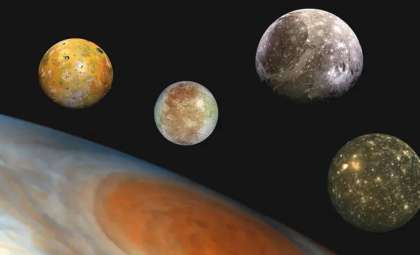
The disk surrounding CT Cha b bears a striking resemblance to the hypothesized circumplanetary disk that once encircled Jupiter early in our solar system’s history—a structure long believed to be where its four prominent Galilean moons were born. Observations such as these offer essential empirical data to support and refine moon formation theoretical models.
“This is the first time we can test our understanding of moon birth beyond the solar system,” said Gabriele Cugno, lead author from the University of Zürich and member of the National Center of Competence in Research PlanetS. “We are seeing what material is accreting to build the planet and moons.”
This commentary highlights the exceptional nature of this discovery: until now, no observatory had the capability to detect such intricate disks around exoplanets. With the aid of Webb’s advanced infrared technology, astronomers can now observe these hidden formations in unprecedented detail.
Detecting Molecules and Unlocking Secrets
Spotting the disk was a formidable challenge. Researchers had to dig through archived datasets and apply state-of-the-art high-contrast imaging methods to separate the faint planetary signal from the overwhelming brightness of the star. After a year of meticulous analysis, the molecular signatures were definitively identified. “We observed molecules precisely where the planet is located, confirming the presence of material worth investigating further. It required tremendous dedication,” noted Grant.
Their efforts yielded success. The study, featured in The Astrophysical Journal Letters, provides the first direct chemical characterization of a planet-encircling disk in formation. Detecting seven distinct carbon molecules points to a complex and evolving environment that may lead to moons with varied compositions. This finding also sparks intriguing questions about the importance of carbon-rich settings in nurturing potentially habitable moons across the cosmos.
Constructing the Foundations of Mini Solar Systems
Research into moon formation extends beyond moon origins; it sheds light on the broader design of planetary systems. With the discovery of many exoplanets, evidence suggests moons likely outnumber planets, some being large enough to sustain atmospheres, plate tectonics, or possibly life.
“We want to learn more about how our solar system formed moons. This means that we need to look at other systems that are still under construction. We’re trying to understand how it all works,” Cugno added. “How do these moons come to be? What are their ingredients? What physical processes are at play, and over what timescales? Webb allows us to witness the drama of moon formation and investigate these questions observationally for the first time.”
By revealing the discrete stages of accretion, chemical differentiation, and disk segmentation, Webb equips astronomers with the tools to chronicle the timeline of planet and moon formation with remarkable precision. The observation that such chemical diversity emerges within just two million years implies that moon-forming disks develop swiftly and may be more prevalent than previously believed.
- Categories:
- Space


0 comments
Sign in to Comment