
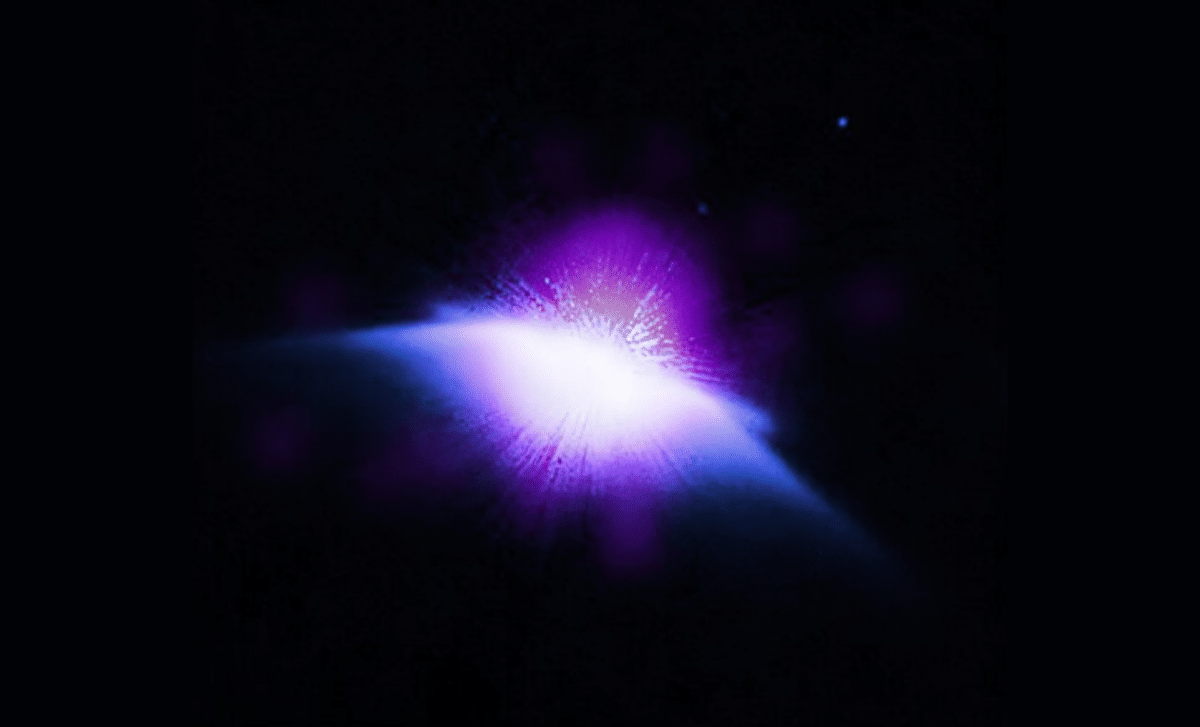
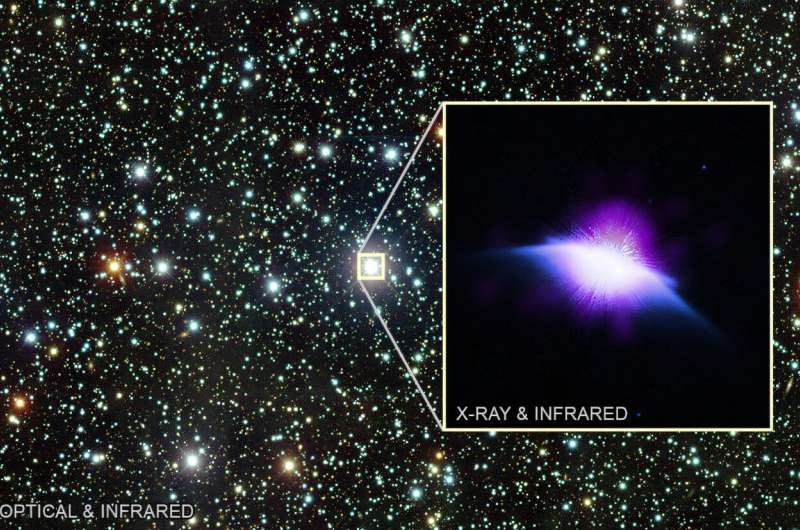
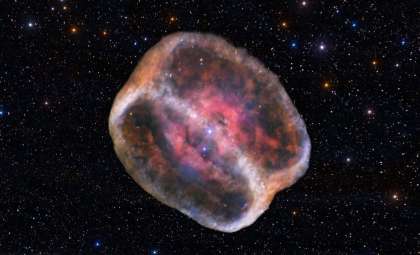
Utilizing the powerful NASA Chandra X-ray Observatory, researchers have obtained a remarkable image depicting a massive stellar bubble enveloping the youthful star HD 61005. This discovery sheds light on the early appearance and dynamics of our Sun’s astrosphere billions of years ago. Released recently on arXiv, the study reveals not only the spongy bubble structure around HD 61005 but also enhances our understanding of the Sun’s astrosphere evolution through time.
Revealing the Astrosphere of HD 61005
For many years, scientists have sought to decode the structure of the Sun’s astrosphere, the bubble of energetic particles generated bysolar wind emissions. Observing this shell externally has proven difficult. “We have been studying our sun’s astrosphere for decades, but we can’t see it from the outside,” stated Carey Lisse of Johns Hopkins University. His team's recent success in imaging a comparable astrosphere surrounding HD 61005, a relatively young star around 120 light-years distant, represents a crucial advance. This finding provides a vital glimpse into the Sun’s developmental history and the changing form and behavior of its protective astrosphere.
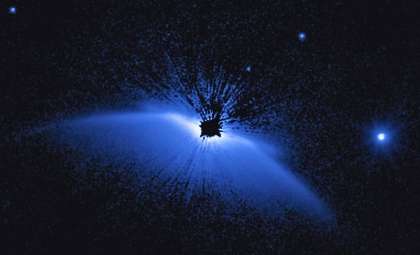
HD 61005’s bubble exhibits an unusual, expansive shape, differing markedly from the singular light point often seen in older stars. The star, about 100 million years old, generates much stronger stellar winds than today’s Sun, intensifying its astrosphere’s creation. Through this star, scientists can infer the early characteristics of the Sun’s own astrosphere.

“This new Chandra result about a similar star’s astrosphere teaches us about the shape of the sun’s, and how it has changed over billions of years as the sun evolves and moves through the galaxy,” added Lisse.
Intense Stellar Winds Reshape HD 61005’s Environment
HD 61005 shares similarities with the Sun in mass and temperature but produces far stronger stellar winds due to its youth. These winds travel approximately three times faster and are nearly 25 times denser than the solar winds of our middle-aged Sun, crafting an astrosphere that is both larger and more forceful. The stellar wind interacts with surrounding interstellar dust and gas, heating the environment and triggering X-ray emissions, which Chandra’s instruments detect with precision.
The implications of this discovery extend to understanding how solar winds influence planetary systems. “We are impacted by the sun every day, not only through the light it gives off, but also by the wind it sends out into space that can affect our satellites and potentially astronauts traveling to the moon or Mars,” explained Scott Wolk, co-author of the report hosted on arXiv. Studying these phenomena aids insights into how the Sun’s early solar wind may have shaped the solar system’s formation and evolution.
The Mysterious “Moth” System: Structure and Significance
The star HD 61005 has earned the nickname “Moth” due to the dust surrounding it, which resembles moth wings when viewed in infrared wavelengths. This dust is a remnant of the star’s formation phase and serves as an important element in the astrosphere’s development. The Moth’s dusty wings consist of interstellar material akin to our solar system’s Kuiper Belt, offering clues about planet-forming regions around young stars.
Surrounding HD 61005 is a dust cloud roughly 1,000 times denser than what encircles our Sun, providing a compelling contrast. The combination of this thick interstellar medium, dense stellar winds, and intense X-ray emissions from their interaction enabled Chandra to clearly reveal the star’s astrosphere. Observing the Moth system grants astronomers a valuable perspective on stellar youth, solar wind dynamics, and how planetary systems emerge.
Insights from HD 61005’s Astrosphere on Solar History
The early Sun likely experienced a similar dense environment of dust and gas during its formative years. This discovery invites researchers to reconsider our star’s ancient surroundings.
“It is amazing to think that our protective heliosphere would only extend out to the orbit of Saturn if we were in the part of the galaxy where the Moth is located, or, conversely, that the Moth would have an astrosphere 10 times wider than the sun’s if it were located here,” said Lisse.
The Sun’s heliosphere, which shields Earth from harmful cosmic particles, is comparatively much smaller than HD 61005’s astrosphere. This difference highlights how the Sun’s galactic environment has transformed as it traveled through various regions. By comparing with the Moth’s vast protective bubble, scientists gain clues about the role early stellar winds played in shaping the initial conditions of our solar system.
- Categories:
- Astronomy



0 comments
Sign in to Comment