
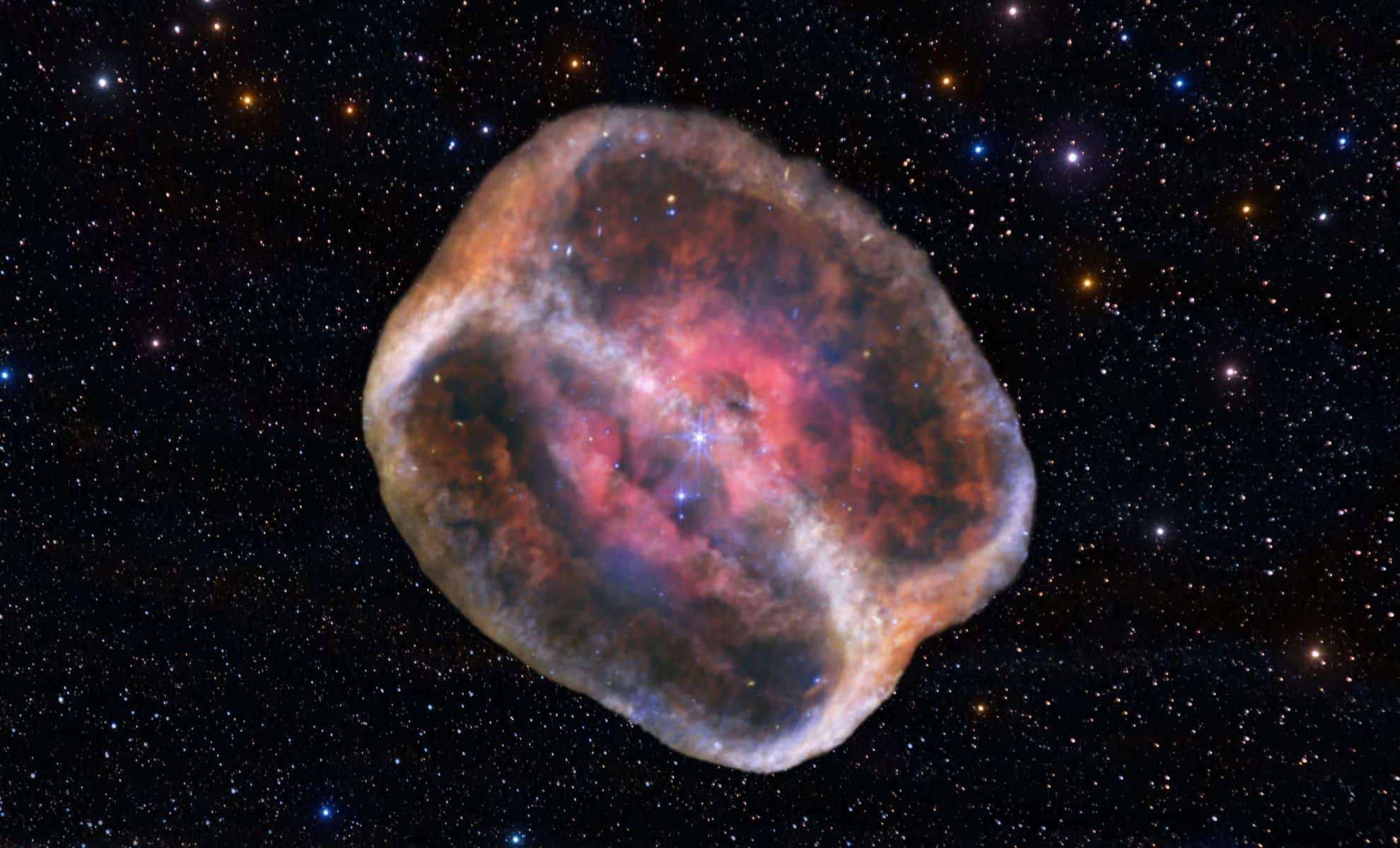
The James Webb Space Telescope (JWST) has captured stunning new infrared images of the planetary nebula NGC 1514, showcasing a pair of unusual, brightly glowing rings encircling a dying star system approximately 1,500 light-years away from Earth.
Detailed in a recent article published in The Astronomical Journal titled “JWST/MIRI Study of the Enigmatic Mid-infrared Rings in the Planetary Nebula NGC 1514”, this discovery allows astronomers to delve into the complex 4,000-year evolution of this fading celestial remnant.
Reexamining a Classic Nebula with Webb’s Advanced Imaging
Leading the research, Michael Ressler from NASA’s Jet Propulsion Laboratory provided an in-depth look at the nebula’s intricate structure, shedding light on the dynamic interactions between the closely locked binary stars at its core.
NGC 1514 was originally discovered in 1790 by William Herschel, who noted its faint glow encircling a solitary star, challenging the prevailing 18th-century interpretations of nebulae.

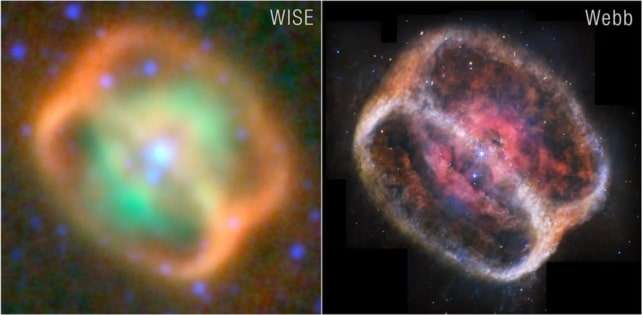
Over the years, repeated observations have revealed ever more complexity. In 2010, NASA’s WISE (Wide-field Infrared Survey Explorer) detected a pair of infrared rings invisible to optical telescopes, though their detailed nature remained unclear—until now.
Employing JWST’s MIRI (Mid-Infrared Instrument), the research team produced the highest-resolution images yet of these rings. The data expose fine clumps, filaments, and turbulent features within the rings, along with faint ejecta extending beyond them.
Contrary to earlier beliefs that the rings formed through shockwaves, the new evidence indicates they arise from thermal emission originating in dust grains.
The Binary Core of NGC 1514 and Its Peculiar Hourglass Geometry
The nebula’s core consists of a binary system: a white dwarf and a giant companion star. The star now a white dwarf was once several times more massive than the Sun, shedding its outer layers during its demise to form the nebula’s luminous shell.
The giant star companion remains in a close orbit and likely influenced the nebula's distinctive hourglass shape through gravitational interactions. JWST’s observations suggest a complex three-dimensional form: a constricted hourglass structure embedding the infrared rings across its center. The rings display uneven dust distributions and asymmetrical features, hinting at dramatic interactions between the binary stars in the past.
Infrared Rings Resulting from Dust Heat, Not Molecular Emission
One remarkable insight from JWST’s MIRI observations is the absence of common molecular signatures seen in other planetary nebulae. Typically, astronomers identify emission from molecules like polycyclic aromatic hydrocarbons (PAHs) or molecular hydrogen, especially in regions where expelled material collides with surrounding space.
However, in NGC 1514, over 98% of the emission from the rings is attributed to thermal radiation from cool dust particles, rather than molecular gases. Despite their brightness in JWST’s infrared images, these fragile ring structures remain enigmatic, with formation processes still not fully understood.
NGC 1514: Unraveling the Mysteries of Stellar Demise
From its initial discovery as a faint, patchy glow centuries ago to becoming a key puzzle piece in modern astrophysics, NGC 1514 continues to captivate scientists. JWST’s mid-infrared insights have peeled back another veil on this fading star system’s secrets, though many questions linger.
The elegant symmetry of the rings and their unusual composition highlight the complexity of stellar death. These observations underscore JWST’s pivotal role in uncovering hidden structures and compositions in the galaxy’s most baffling objects.
- Categories:
- Astronomy







0 comments
Sign in to Comment