
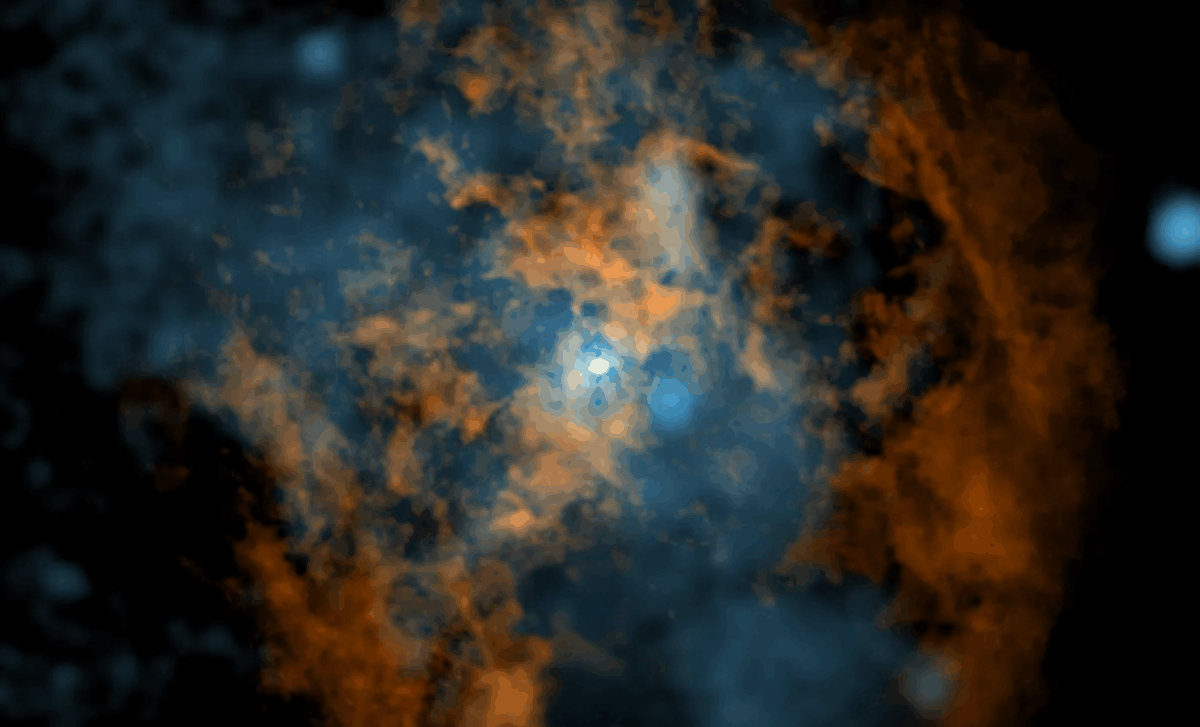
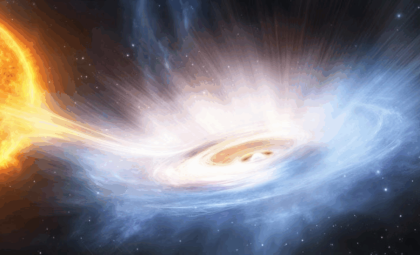
A groundbreaking study has unveiled the first direct observation of scorching winds flowing from Sagittarius A* (Sgr A*), the supermassive black hole at the center of the Milky Way. This pioneering research, led by a team at Northwestern University and detailed in a recent publication, utilized the ALMA radio telescope to create an unprecedented map of the environment surrounding this mysterious cosmic entity. Complementary research adds to our understanding by revealing the behavior and orientation of the inflowing matter towards Sgr A*.
Decoding the Hidden Dynamics of Our Galaxy’s Core
For years, the enigmatic nature of Sagittarius A* puzzled astronomers. Unlike the intensely active black holes seen in other galaxies that emit vibrant jets, Sgr A* has remained relatively subdued. Scientists have long hypothesized that this supermassive black hole should generate powerful outflows of hot gas, influencing its surroundings, but such phenomena remained unconfirmed until now. Led by Mark Gorski and Elena Murchikova, researchers using ALMA have now uncovered compelling observational evidence of these elusive winds.
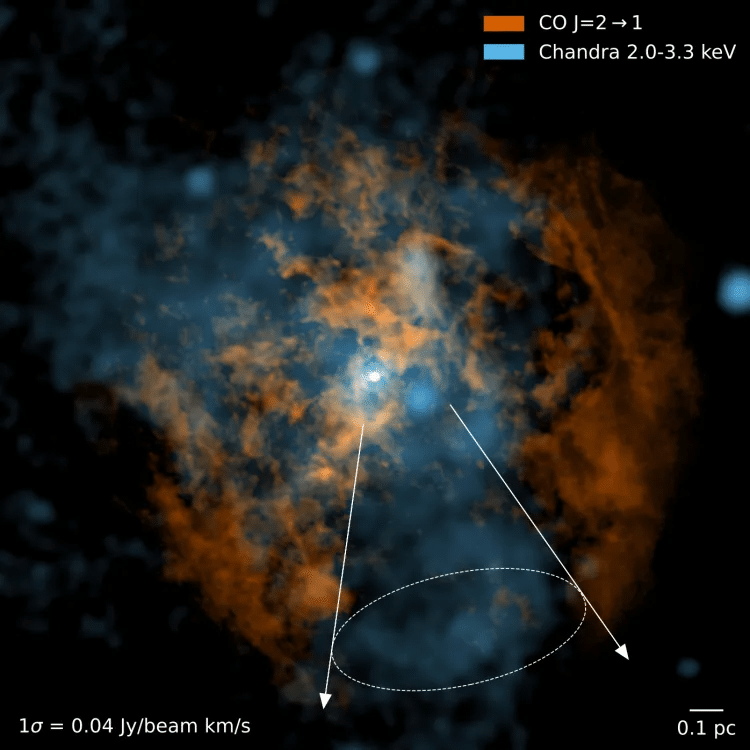
Their findings display a distinctive cone-shaped cavity devoid of cold gas around Sgr A*, replaced instead by hot gas. This wind, previously only theorized, is now verified by concrete data. The energy powering this outflow is colossal—akin to the combined radiance of approximately 25,000 Suns—clearly originating from the black hole itself.

Introducing a Subtle Titan: Why Sgr A* Stands Apart
Although energetic winds from black holes are well-known, Sgr A*’s subdued character distinguishes it. Unlike other supermassive black holes producing luminous jets detectable across cosmic distances, Sgr A* is often described as a “quiet giant.” The colossal Fermi bubbles spanning above and below the Milky Way hint at a more tumultuous, active past, but currently, the black hole exhibits a relatively calm demeanor.
Nonetheless, detecting these hot winds sheds light on the ongoing processes at play. Even in this low-activity phase, Sgr A* remains dynamic. The black hole’s winds influence its immediate vicinity by regulating gas inflow, adjusting pressure and temperature, and thus playing a critical role in the galaxy’s evolution through a complex feedback cycle.
Significance of the Cone: Direct Evidence of Black Hole Winds
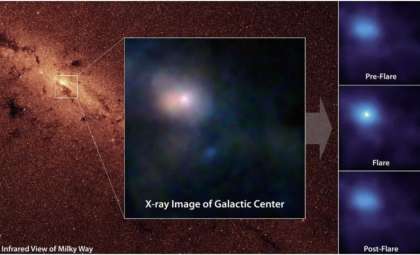
The comprehensive map created by the researchers exposes a unique cone-shaped gap amidst the cold gas, aligning precisely with high-energy X-ray emissions. This remarkable structure is unprecedented and can only be explained by the black hole expelling hot gas, displacing the cooler material around it.
This cone-shaped void definitively confirms that Sgr A* is actively generating hot winds. Though less energetic than many other known black holes, this quieter state still reveals essential activity that affects its surroundings. The discovery offers valuable insight into the low-power phases of supermassive black holes and their cosmic impact.
Astronomer Younsi commented,
“Sagittarius A*’s mass is incredibly well-constrained by observations, but its inclination angle with respect to us is just so poorly constrained it can basically be anything.”
This highlights the challenges in studying Sgr A*, particularly the uncertainty surrounding the angle at which we view it. Yet, the alignment of the cone with X-ray data offers new direction and clarity for future investigations.
Using Winds to Pinpoint Black Hole Orientation
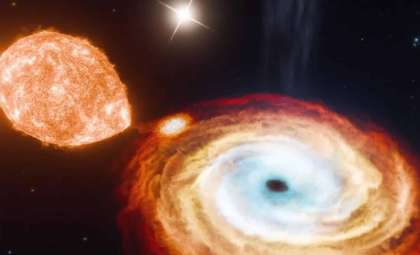
The detection of these heated outflows provides critical information about Sgr A*’s orientation. The direction of gas streaming away from the black hole can serve as a reference to decode its spin and angular momentum, key properties that govern black hole behavior. Understanding these winds helps researchers determine the pathway of matter spiraling into the black hole and clarifies its structural geometry.
Younsi further noted the importance of this finding:
“Understanding maybe where these streams of matter are coming from, if this result is absolutely robust, is really exciting because it gives us some indication as to the direction in which all the matter flowing into the black hole is coming.”
This breakthrough could lead to more accurate predictions about Sgr A*’s tilt, resolving key uncertainties about its nature.
The Unexpected Discovery of Cold Gas Near the Black Hole
An astonishing aspect of this research is the discovery of cold gas close to Sgr A*, contrary to earlier expectations. Typically, the intense radiation and gravitational forces near a black hole create an extremely hostile environment for cold gas to survive. Yet, ALMA found cold gas pockets within several light-years of the black hole.
These cold gas reservoirs might intermittently feed matter to the black hole in spurts and could also be nurseries for new stars, forming through collisions and merging processes before either being absorbed by the black hole or dissipated by its hot winds. This interplay between cold and hot gases is a vital element in the feedback mechanisms shaping galaxy formation and evolution.
- Categories:
- News






0 comments
Sign in to Comment