
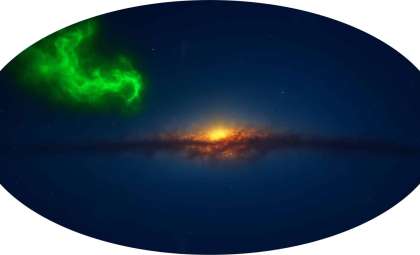
Astronomers have uncovered a massive, previously hidden cloud within our galaxy that could transform current theories about star formation and the movement of matter throughout the Milky Way.
Dubbed the Midpoint cloud, this huge giant molecular cloud stretches across approximately 200 light-years (about 650 trillion miles) and appears to play a crucial role in channeling gas from the galactic disk into the bustling core.
Discovery Through the Green Bank Telescope
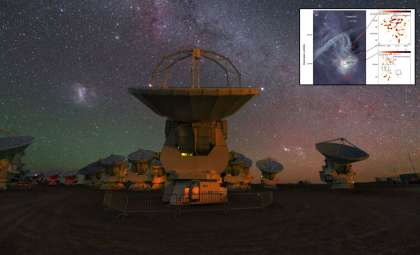
Rude Baguette reports that this discovery was made using the Green Bank Telescope, a leading radio observatory. The team, led by Dr. Natalie Butterfield from the National Radio Astronomy Observatory, detected the Midpoint cloud in a little-studied area of the Milky Way.

With its immense size, substantial mass, and thick gas concentrations, it qualifies as a Giant Molecular Cloud (GMC), known to be stellar nurseries. “Nobody suspected this cloud existed until we examined this region and found dense gas,” explained Dr. Butterfield.
Dust Pathways Fueling the Galactic Core
The Midpoint cloud is especially notable for its active participation in the Milky Way’s internal dynamics. It contains dense dust lanes acting like unseen pipelines, directing gas from the galaxy’s disk to the central bar region, known for intense star formation. These lanes deliver material into the heart of the galaxy, possibly igniting star birth in the most energetic areas.
Scientists also noted turbulent gas motions inside the cloud that resemble conditions at the galactic center. This stirring, caused by gas flowing along dust channels and interactions with adjacent clouds, provides favorable conditions for star formation. This finding brings rare insight into the earliest stages of star and planetary system genesis.
Evidence of Stellar Birth and Lifecycle Processes
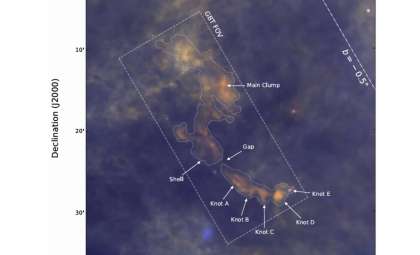
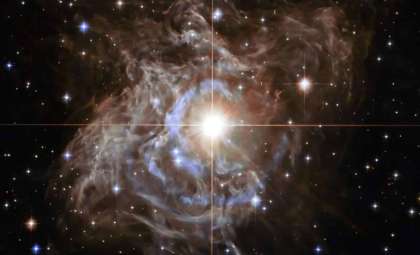
Inside the Midpoint cloud, researchers discovered several dense gas clumps collapsing under gravity—classic indicators of emerging stars. One notable region, called Knot E, is an area where gas is actively being stripped by nearby stellar radiation. These formations, known as free-floating evaporating gas globules or frEGGs, are key to studying the transition from gas cloud to newborn star.
The cloud harbors a maser, a natural source of amplified microwave emission, signaling energetic activity associated with young stars. There’s also a shell-like structure that may be the aftermath of a supernova explosion, implying that the Midpoint cloud not only forms stars but also preserves traces of their explosive deaths.
New Insights into Star Formation in Galactic Bars
The identification of the Midpoint cloud sheds light on how barred spiral galaxies like the Milky Way sustain star formation in their often harsh, dynamic environments. Dr. Larry Morgan from the Green Bank Observatory notes, “Star formation within galactic bars is puzzling because the strong forces there can suppress it. Yet, at the leading edges of these bars—like where the Midpoint cloud lies—dense gas can accumulate, sparking new stars.”
- Categories:
- News


0 comments
Sign in to Comment