

Inside a modest laboratory in Bayreuth, Germany, researchers have reached a pioneering milestone by altering a spider’s genetic code to produce fluorescent silk. Employing the renowned CRISPR-Cas9 genome editing tool, which won a Nobel Prize in Chemistry in 2020, the team genetically modified the common house spider, Parasteatoda tepidariorum, enabling it to generate threads that emit a bright red glow under ultraviolet light.
This glowing silk is more than just a laboratory curiosity; it represents the first successful implementation of CRISPR technology in spiders and may open new avenues in biomaterials science. Published in Angewandte Chemie, the research details how the team inserted a gene coding for a red fluorescent protein directly into the spider’s silk-producing genome.
Editing Spider DNA at the Egg Stage
The project was spearheaded by biochemist Thomas Scheibel at the University of Bayreuth, aiming to decode why spiders had been largely untouched by CRISPR studies so far. “Given the vast potential applications,” Scheibel remarked, “it’s surprising no CRISPR work on spiders existed until now.”

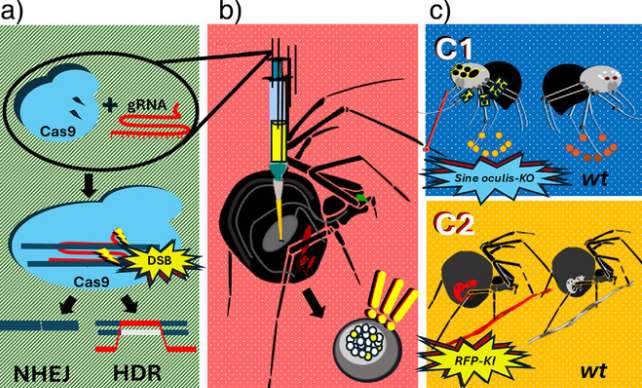
Confronted with the delicate nature and reproductive complexity of spiders, the scientists focused on the unfertilized eggs within immobilized female spiders. By injecting CRISPR materials directly into these oocytes, they edited the spiders’ DNA before fertilization by male genetic material occurred.
Their initial experiment targeted the sine oculis gene, crucial for eye formation. The resulting eyeless spiderlings confirmed that gene disruption is feasible in spiders, validating the gene-editing method before pursuing more ambitious genetic modifications.
From Genetic Tweaks to Radiant Silk
After establishing their technique, the focus shifted to the spider’s silk proteins, called spidroins. The researchers integrated a gene coding for a red fluorescent protein into the gene segment governing silk production to alter the silk’s properties.
When the genetically altered spiders matured, some spun dragline silk that illuminated vividly red under UV light. This experiment offered the first clear proof that CRISPR can modify spider silk proteins’ function. Scheibel declared, “We have globally demonstrated for the first time that CRISPR-Cas9 can insert specific sequences into spider silk genes, enabling the customization of silk fibers.”

Spider Silk: A Unique Natural Material
Spider silk’s allure goes beyond its glowing novelty. It combines a strength comparable to steel and an elasticity similar to rubber, making it a coveted model for both industrial and medical applications. Its natural biodegradability and light weight offer advantages over synthetic materials.
Farming spiders has been impractical due to their solitary nature and cannibalistic tendencies. Though synthetic spider silk alternatives have gradually improved, genetically engineered spiders producing custom silk represent a groundbreaking new path.
While this research mainly showcases technological feasibility, its future impacts could be huge. Manipulating silk’s genetics might let scientists design tailor-made fibers for diverse fields like surgery or aerospace. Today, the vibrant red threads stand both as proof of concept and a glimpse into a promising future.
- Categories:
- News











0 comments
Sign in to Comment