
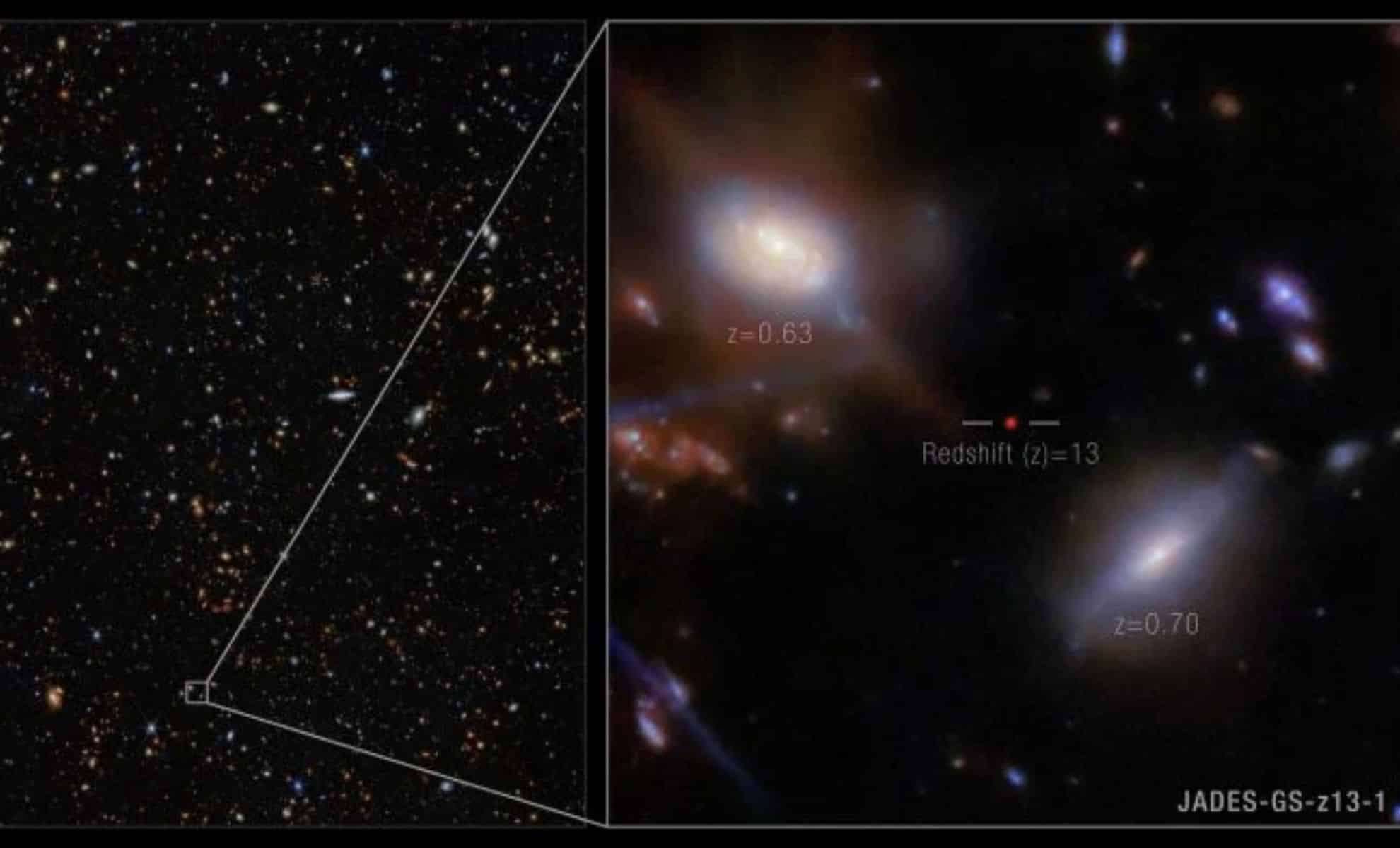
Scientists have made a groundbreaking observation that could transform our comprehension of the Universe's infancy. Leveraging the advanced capabilities of the James Webb Space Telescope (JWST), they identified a remote galaxy named JADES-GS-z13-1 emitting an intense Lyman-α hydrogen emission from only 330 million years after the Big Bang.
This period was traditionally thought to be dominated by neutral hydrogen gas, which should have absorbed such light signals. Yet, the detection of this vivid emission challenges existing views on the epoch of reionization, the time when the first luminous bodies cleared and ionized the cosmic fog.
The study, featured in Nature, posits that the beginning or the complexity of the reionization phase could differ significantly from prior assumptions.

An Unexpected Beacon from the Early Cosmos
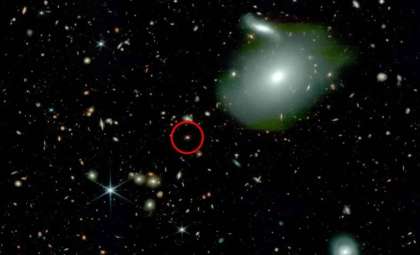
The galaxy was initially discovered through deep images captured by Webb’s Near-Infrared Camera (NIRCam) during the JWST Advanced Deep Extragalactic Survey (JADES). Subsequent observations with the Near-Infrared Spectrograph (NIRSpec) confirmed its extreme distance, with a redshift of z = 13.0, indicating the light reaching us has traveled for over 13.4 billion years.
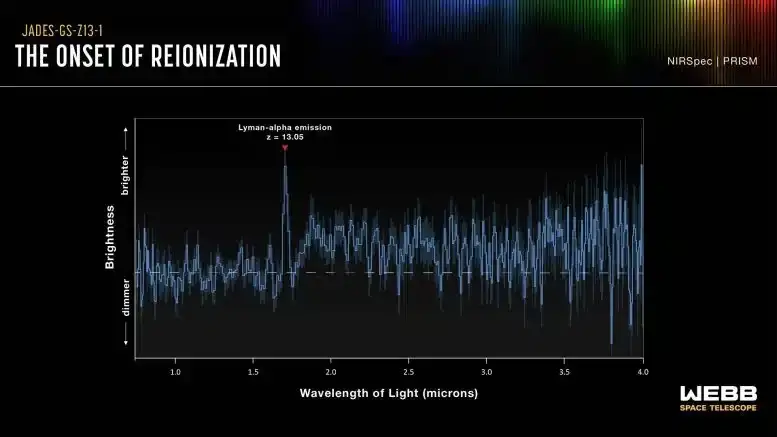
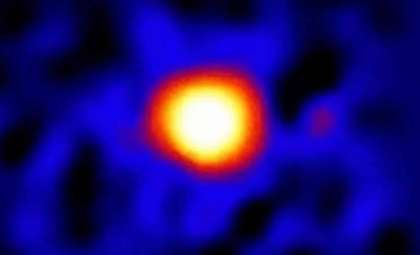
What truly surprised researchers was the detection of a strong Lyman-α emission line, a hallmark of excited hydrogen. Normally, such signals are blocked by the neutral hydrogen fog prevalent in that era.
“The early Universe was bathed in a thick fog of neutral hydrogen,” explained Roberto Maiolino, a team member from the University of Cambridge and University College London. “Most of this haze was lifted in a process called reionization, which was completed about one billion years after the Big Bang. GS-z13-1 is seen when the Universe was only 330 million years old, yet it shows a surprisingly clear, telltale signature of Lyman-α emission that can only be seen once the surrounding fog has fully lifted. This result was totally unexpected by theories of early galaxy formation and has caught astronomers by surprise.”
Published findings in Nature prompt fundamental rethinking about the timeline and nature of reionization. The evidence points toward early formation of ionized hydrogen zones or a patchy process where individual galaxies cleared their own surrounding space.
Illuminating the Cosmic Fog
The sharpness and intensity of the Lyman-α line were surprising not solely due to the galaxy’s ancient origin but because it demonstrates that photons escaped unimpeded by neutral hydrogen. This indicates the galaxy may have sculpted a large ionized bubble, a clearing in the primordial gas caused by intense radiation.
“We really shouldn’t have found a galaxy like this, given our understanding of the way the Universe has evolved,” said Kevin Hainline of the University of Arizona. “We could think of the early Universe as shrouded with a thick fog that would make it exceedingly difficult to find even powerful lighthouses peeking through, yet here we see the beam of light from this galaxy piercing the veil. This fascinating emission line has huge ramifications for how and when the Universe reionized.”
The origin of such powerful radiation is still being explored. It might be generated by Population III stars—the earliest large, metal-free stars—or potentially by an early active galactic nucleus (AGN) fueled by a nascent black hole.
Probing the Earliest Era of Cosmic Evolution
This discovery opens compelling new avenues in understanding. If galaxies like JADES-GS-z13-1 ionized their environments so early, the start of reionization may be far earlier than current theories claim. It also implies reionization was a patchy, uneven process with luminous sources clearing pockets of hydrogen gas at different times.
The extraordinary infrared sensitivity of the James Webb Space Telescope has provided an unprecedented glimpse into the Universe’s first few hundred million years. What was once only hypothesized is now observable — sometimes in startling and unexpected ways. Ongoing investigations aim to determine if this galaxy is unique or the forerunner of many yet-to-be-discovered cosmic anomalies.
- Categories:
- News


0 comments
Sign in to Comment