

The Eye of Africa, known scientifically as the Richat Structure, stands out as one of the planet’s most iconic natural landmarks. Yet, for over fifty years, its origin remained a scientific puzzle. Recent geological research has finally shed light on its complex formation story, offering explanations more fascinating than the old legends.
A Flawlessly Circular Landmark That Sparked Myths
Spanning nearly 50 kilometers in diameter and visible from orbit, the Richat Structure etches a mesmerizing series of concentric circles into Mauritania’s Sahara Desert. Its remarkable shape led to numerous hypotheses ranging from a meteorite impact to connections with Plato’s Atlantis. Some enthusiasts speculated the rings mirrored the ancient city's design, composed of alternating land and water zones. However, no archaeological proof supported these claims, leaving scientific consensus elusive.
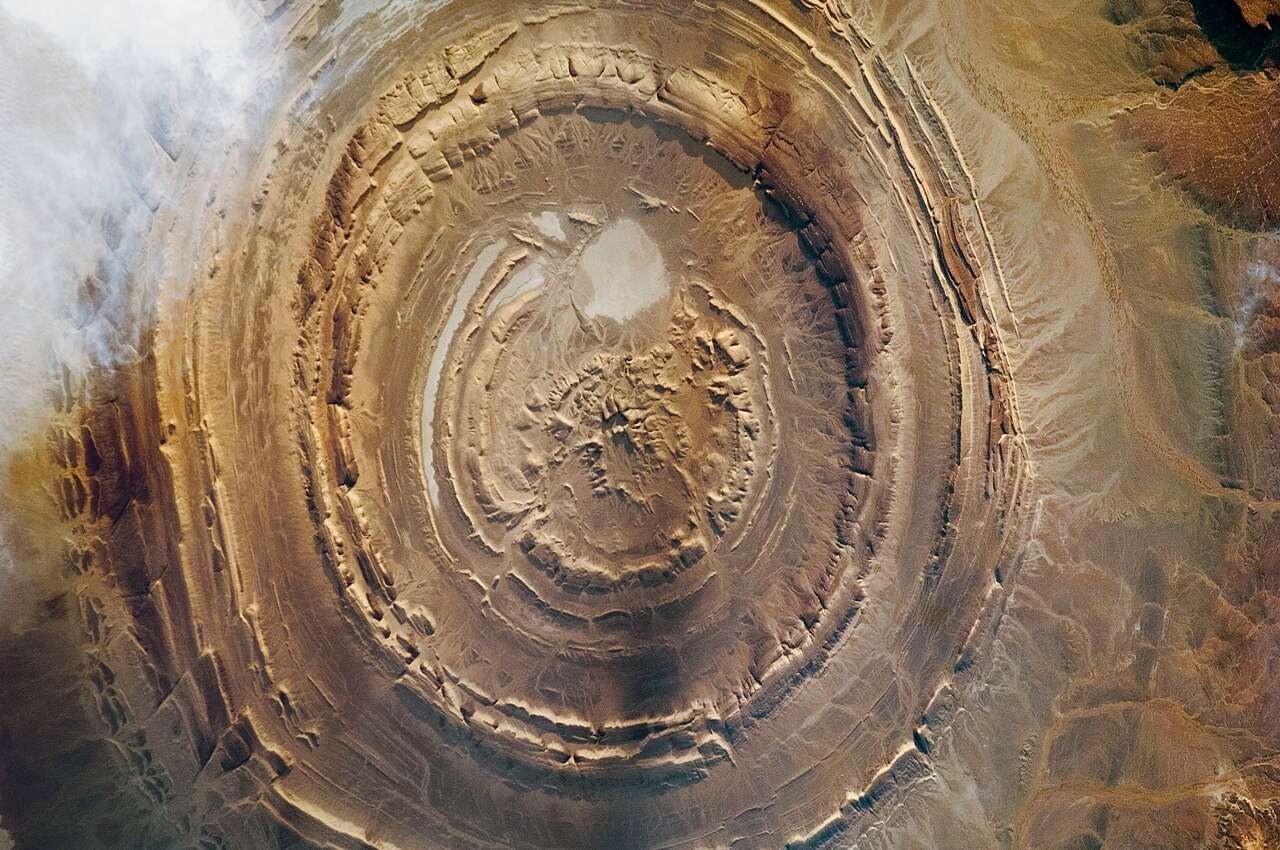
A recent paper in Lithos shows that scientists from Université de Bretagne-Occidentale alongside Curtin University employed advanced radiometric dating and chemical analyses to decode the Eye's origin. Their results indicate it emerged from multiple geological stages over more than 100 million years, not from a singular catastrophic event.

Neither a Meteor Impact Nor a Volcano
For many years, hypotheses oscillated between the Richat Structure being an impact crater or the collapsed remnants of a volcanic caldera, largely due to its circular nature. However, these explanations have been dismissed. The absence of impact indicators such as shocked quartz or melt rocks rules out a meteor strike. Similarly, the lack of surface volcanic materials makes a caldera origin improbable.
Instead, this formation started as a magmatic dome beneath the surface, created during the fragmentation of the supercontinent Pangaea about 100 million years ago. Magma pushed upward, deforming sedimentary layers above into a dome shape. Unlike a volcano, the magma never erupted through the crust.
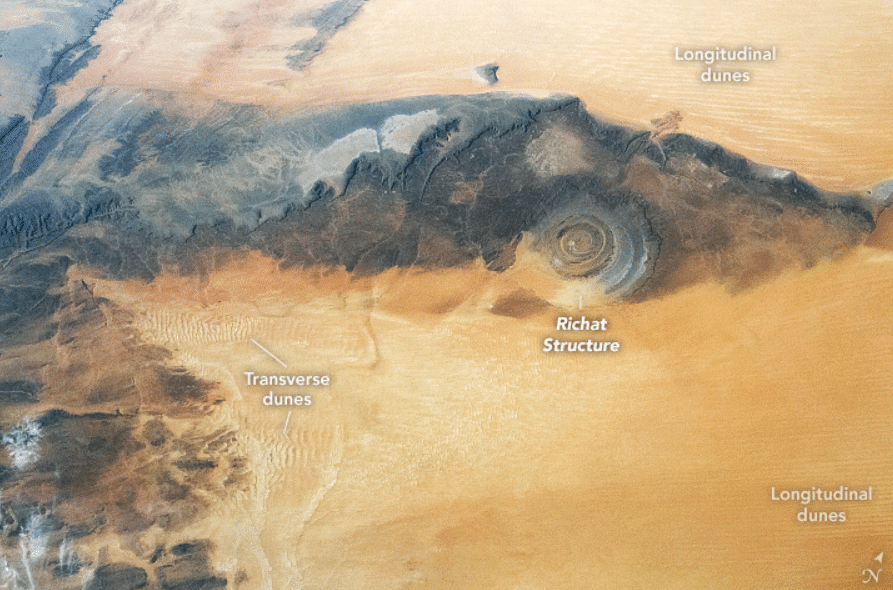
“This formation reflects a process of gradual uplift and extremely slow erosion rather than explosive activity,” explained Dr. Fred Jourdan, the primary geochronologist of the Lithos article. Over millions of years, the gentle forces of wind and water eroded softer rocks, leaving behind durable layers of quartzite and sandstone that create the distinctive ringed pattern visible today.
Time Capsule of Ancient Climates and Rocks
Although located in a present-day desert, the Richat Structure preserves valuable records of Earth’s ancient, wetter climates. The rocks composing the formation date back approximately 2.5 billion years, offering a remarkable archive of Earth’s geological evolution. During the African Humid Period, this area likely supported flowing rivers and lakes, and possibly early life.
In research published in L’Anthropologie, geologist Ousmane Sao and others found evidence of Acheulean tool sites near the outer rings, indicating primitive humans used the site for crafting tools and short-term hunting activities. The artifacts, crafted mainly from local quartzite, suggest early inhabitants exploited the geological features without establishing permanent settlements.
The Structure’s Significance Beyond Earth
More than a terrestrial curiosity, the Eye serves as a distinctive navigation mark for NASA astronauts orbiting Earth. Amid vast desert hues, the symmetrical bullseye pattern sharply stands out, making it an ideal visual reference.
Scientifically, the Richat Structure acts as a key to understanding deep crustal dynamics. Geological findings of carbonatites, gabbros, and alkaline intrusions within the formation reveal unusual mantle-related magmatic processes rarely seen in this region.
As highlighted by geologists El Houssein Abdeina and Gilles Chazot in their 2024 investigation, the Richat Structure is a “polyphase geologic puzzle” that traces a complex series of geological episodes responsible for sculpting this extraordinary natural feature and reshaping its scientific narrative.
- Categories:
- Science












0 comments
Sign in to Comment