
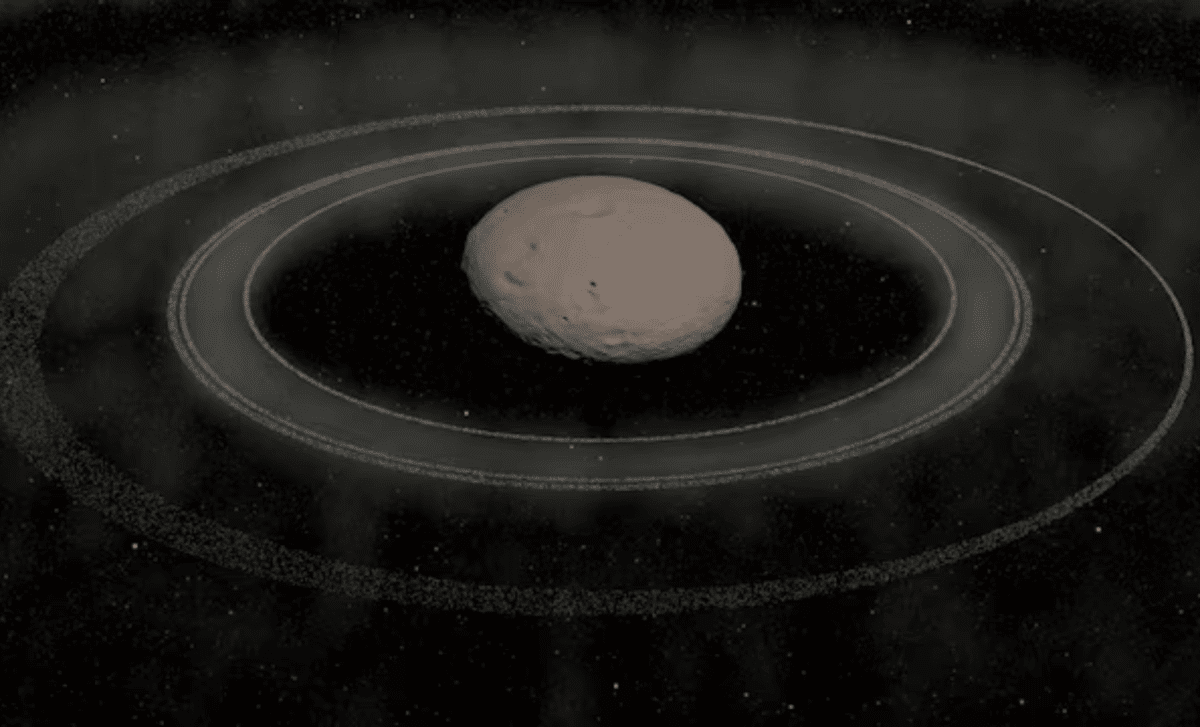
Researchers have unveiled a remarkable find in our solar neighborhood—a forming ring system encircling Chiron, a minor icy object orbiting in the expanse between Saturn and Uranus. This groundbreaking observation enhances our knowledge of Chiron and encourages new perspectives on how ring systems develop around smaller celestial bodies beyond the giant planets.
Revealing Chiron’s Rings: A Breakthrough in Solar System Science
Since its discovery in 1977, Chiron has intrigued astronomers, who long suspected it was enveloped by surrounding material. Contemporary observations, however, have uncovered a much more captivating phenomenon: the presence of a ring system actively assembling around Chiron. Utilizing sophisticated methods such as stellar occultations, scientists captured precise details of the rings as Chiron transited in front of remote stars. In 2023, a team led by Chrystian Luciano Pereira, a postdoctoral scientist affiliated with Brazil’s National Observatory, amassed crucial data revealing that Chiron is encircled by four distinct rings—three dense and one located unusually distant from the nucleus.
“This discovery opens a unique window into how ring structures originate and evolve,” Pereira explained. Beyond its impact on understanding Chiron, the finding signifies a pivotal advancement in exploring the physical conditions and evolutionary processes leading to ring formation. Drawing from observations beginning in 2011, researchers tracked the rings’ transformations, observing dynamic fluctuations that offer fresh insights into the forces responsible for shaping these complex systems and posing questions about analogous rings orbiting other celestial objects.

The Unexpected Nature of Rings Around Small Solar System Bodies
Though modest in size compared to ringed giants like Saturn, Chiron surprises by hosting its own ring set. Classified as a Centaur—objects inhabiting the region between Jupiter and Neptune—Chiron straddles the line between asteroid and comet, consisting of rock, water ice, and organic compounds. While large planets possess expansive, well-studied rings, Chiron’s system presents an alternative model for how rings can assemble around smaller bodies.
“This diversity reminds us that ring formation is not exclusive to large planets. It’s a universal process that can occur wherever the right physical conditions exist,” Pereira said.
This discovery challenges existing assumptions, indicating that ring formation is a phenomenon not restricted to massive planets but occurring under suitable conditions around smaller entities. The rings surrounding Chiron likely comprise a mixture of water ice and rocky material, akin to components of Saturn’s rings, adding layers of intrigue to their developmental origins.
Water Ice: A Crucial Factor in Ring Stability
Water ice appears to play a central role in maintaining the integrity of Chiron’s rings. Ice particles tend to resist clumping, fostering the creation of a stable ring layout and preventing aggregation into a moon. This stabilizing effect is essential for the persistence of the ring structure. Just as with Saturn’s iconic rings, ice likely contributes to the coherence and durability of Chiron’s rings through its physical properties.
Understanding the influence of water ice also sheds light on ring formation phenomena elsewhere in the solar system. Insights gleaned from Chiron’s rings could help elucidate the formation processes of other small-body ring systems, such as those around Centaur Chariklo, discovered to possess rings in 2013. Studying these icy, distant solar system inhabitants informs scientists about the interactions of materials in extreme environments and the role of ice in shaping such celestial features.
Observing Ring Evolution in Real Time
The notable aspect of Chiron’s rings resides in their apparent ongoing development. Scientists observed structural changes over multiple years, affirming that the ring system is dynamic and evolving. According to a publication in the Astrophysical Journal Letters, this finding offers “a rare glimpse into how such structures originate and change.” This represents an exciting opportunity for astronomers to monitor the formation phase of a ring system and deepen our grasp of the forces governing these intricate cosmic features.
“This is an evolving system that will help us understand the dynamical mechanisms governing the creation of rings and satellites around small bodies, with potential implications for various types of disk dynamics in the universe,” said Braga Ribas, an astronomer and study co-author from Brazil’s Federal University of Technology-Parana.
Ribas’ remarks emphasize the wider significance of the research, suggesting this discovery could illuminate how ring systems emerge not only around Chiron but also other minor bodies scattered throughout the cosmos.
- Categories:
- News








0 comments
Sign in to Comment