
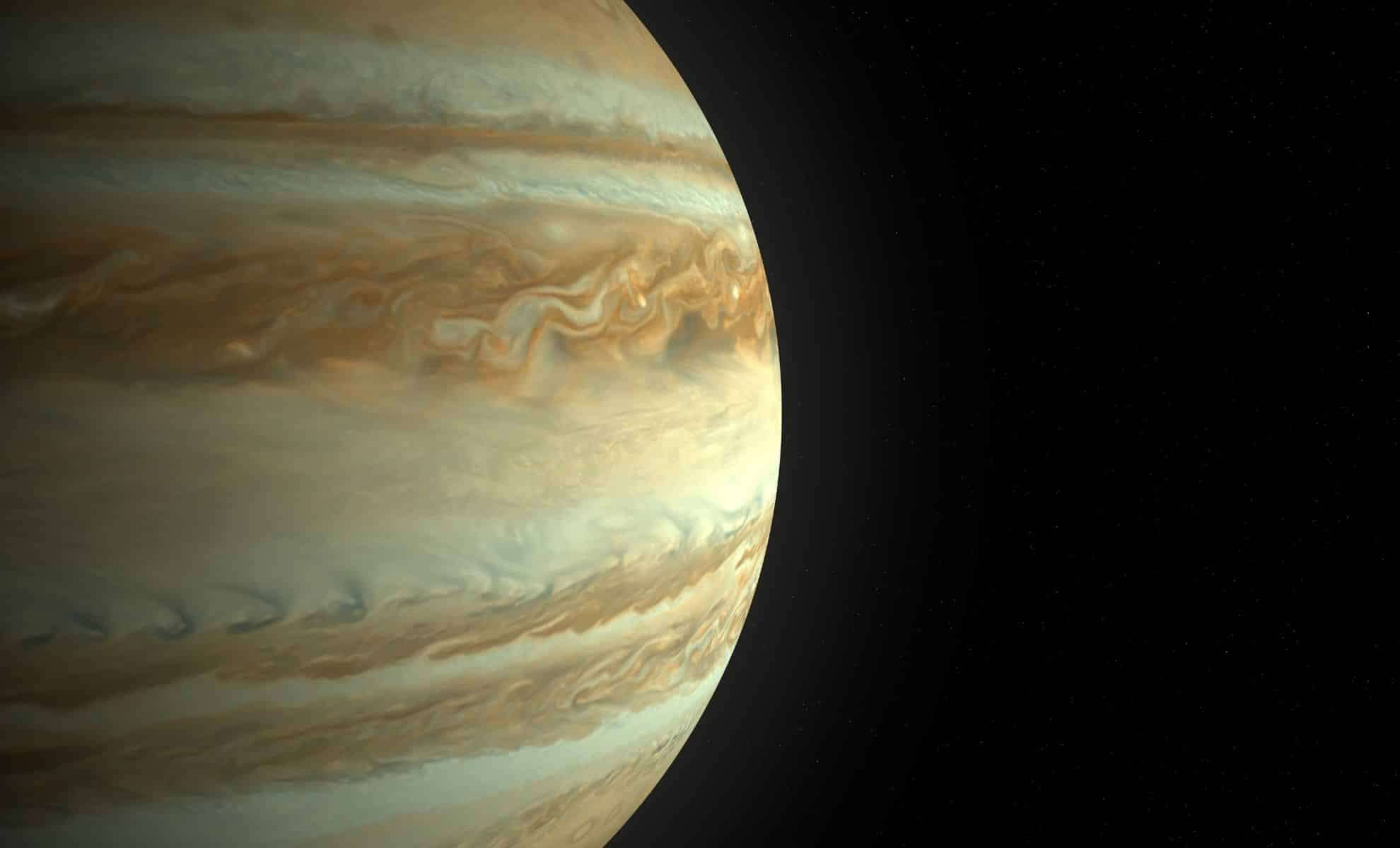
NASA’s Juno spacecraft has identified a novel form of plasma wave emanating from above Jupiter’s northern pole, uncovering an unexpected interaction between charged particles within the planet’s magnetic environment. This remarkable finding, published in Physical Review Letters, represents one of the most extraordinary plasma phenomena observed in our solar neighborhood to date. The insight gained could enhance our comprehension of Jupiter’s intense auroras as well as magnetic fields around other planets and stars far beyond.
Jupiter’s Magnetic Field Synchronizes Plasma Oscillations
Operating since 2016, Juno has been meticulously studying Jupiter’s atmosphere, magnetic characteristics, and polar zones. In this recent advance, teams from the University of Minnesota, University of Iowa, and Southwest Research Institute documented a surprising occurrence: Alfvén waves and Langmuir waves—two fundamentally different plasma oscillations—were discovered to be moving together in harmony within the giant planet’s magnetically intense, low-density polar areas.
Normally, these waves operate separately. Alfvén waves are related to movements of charged ions, whereas Langmuir waves originate from electron oscillations. Due to the significantly lower mass of electrons compared to ions, these waves generally occur at very different frequencies. But near Jupiter’s poles, they were seen oscillating simultaneously, revealing a plasma mechanism previously unseen in the cosmos.

The researchers explain this combined wave activity is unique to Jupiter’s extreme magnetic conditions, where powerful magnetic forces compel different plasma populations to interact in novel ways. Planetary scientist John Leif Jørgensen told New Scientist, “The observed plasma properties are really unusual, not found before and elsewhere in our solar system.”
Exploring Jupiter’s Auroras and Cosmic Implications
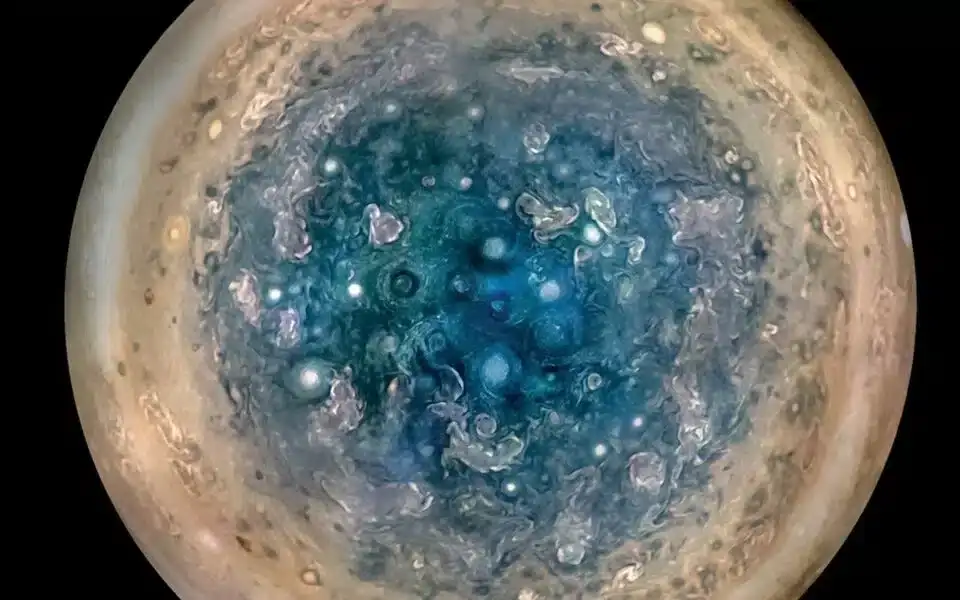
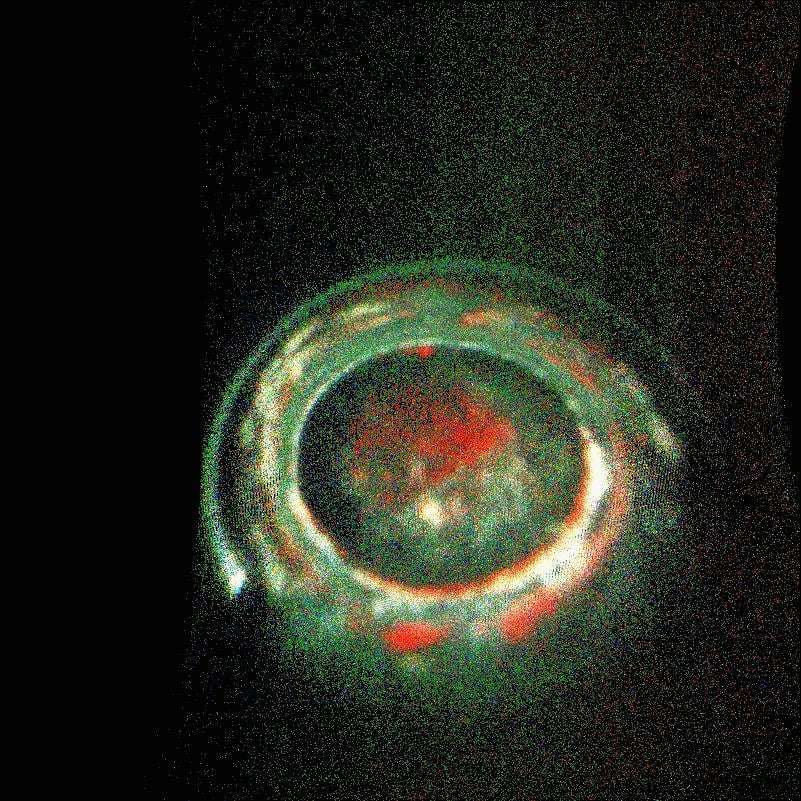
Unlike Earth, where auroras typically stem from solar particle storms, Jupiter’s auroras arise primarily from its massive magnetic field alone. These emissions emit ultraviolet radiation that is hundreds of times more energetic than those on Earth, creating spectacular light displays over the planet’s poles.
The recently discovered plasma waves shed light on how these auroral phenomena operate with such intensity. The study suggests this unique interplay of waves may play a key role in Jupiter’s auroral mechanics, offering a vivid natural laboratory for understanding magnetospheres under extreme conditions.
While this specific plasma environment is not present on Earth, the team believes similar phenomena might occur elsewhere. “These effects may be relevant in the polar zones of other giant planets and possibly magnetized exoplanets or stars,” the researchers noted, opening new pathways for extraterrestrial plasma research.
Juno’s Impact and What Lies Ahead for Jupiter Exploration
Initially, NASA intended to conclude Juno’s journey in 2017 by directing the probe into Jupiter to avoid contaminating its moons. However, after assessing the risk as minimal, mission controllers extended its operation. Since then, Juno has continued to deliver vital observations from its shifting orbit.
Scientists anticipate that by September this year, Juno will succumb to orbital decay and plunge into Jupiter’s atmosphere. Yet, the scientific bounty amassed will continue to enrich our understanding for years to come.
Looking forward, NASA’s exploration infrastructure includes the Europa Clipper, set to reach Jupiter’s moon Europa in 2030, advancing efforts to identify habitable environments beyond Earth.
As Scott Bolton, Juno’s principal investigator, summarized, “Jupiter is the Rosetta Stone of our solar system. Juno is going there as our emissary—to interpret what Jupiter has to say.”
- Categories:
- News




0 comments
Sign in to Comment