
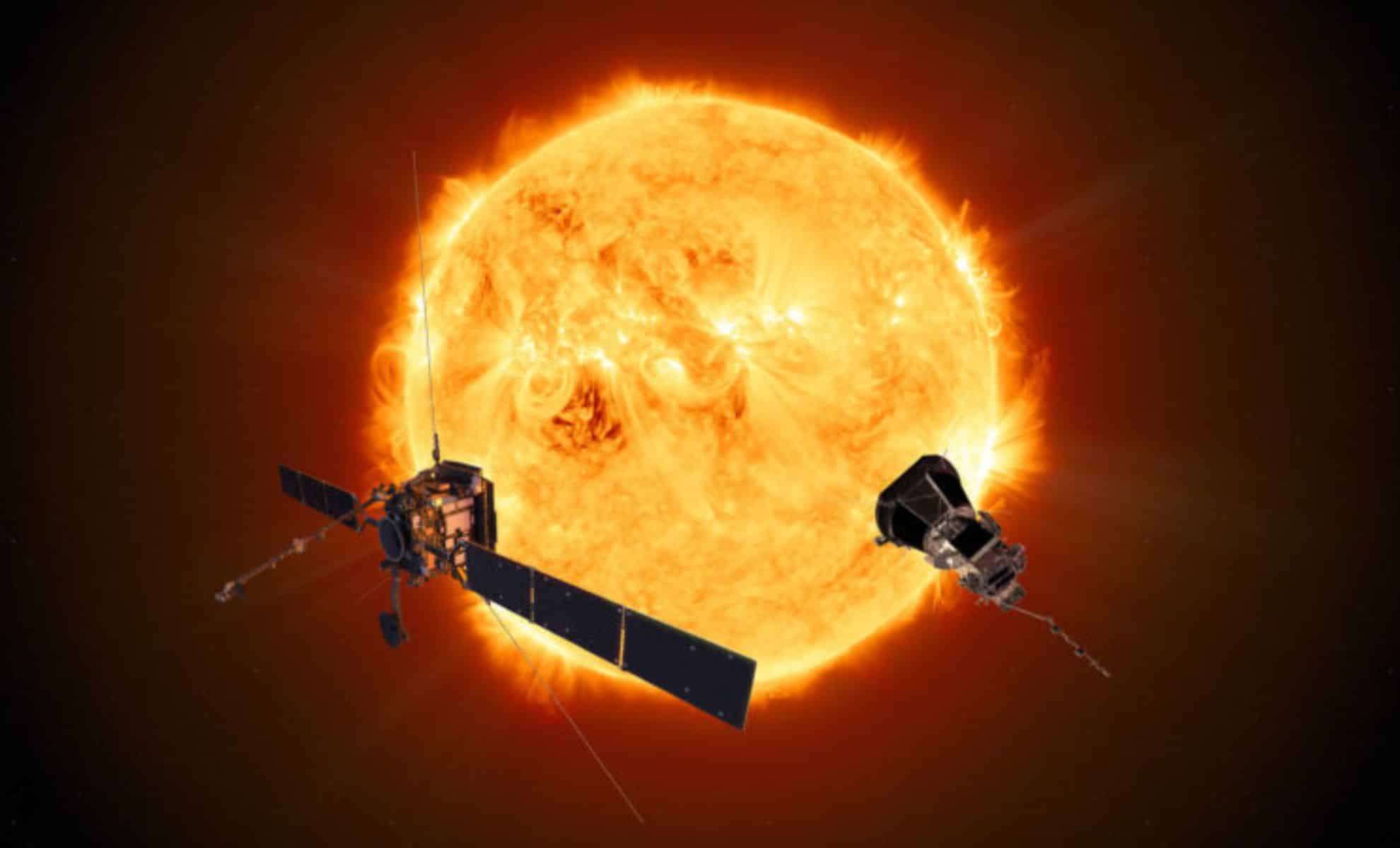
Data collected by NASA’s Parker Solar Probe and the European Space Agency’s Solar Orbiter have unveiled the pivotal influence of Alfvén waves in accelerating and heating the solar wind—a flow of ionized particles streaming from the Sun.
Published in Science, these results shed light on a major puzzle in solar physics and enhance our grasp of the Sun’s impact on its cosmic vicinity, including Earth.
Understanding Alfvén Waves’ Impact on the Solar Wind
For many years, scientists have aimed to decipher how the solar wind, originating in the Sun’s corona, gains speed and maintains its energy through space. While Alfvén waves—plasma-based electromagnetic waves—were suspected of playing a role, direct proof remained out of reach until now.

By analyzing simultaneous measurements from the Parker Solar Probe, which travels near the Sun, and the Solar Orbiter, positioned farther away, researchers tracked the same solar wind stream at different distances from the Sun. This rare alignment allowed them to monitor how the solar wind evolved. Initially, large Alfvén waves were detected near the corona, exerting pressure and modifying the wind’s path. Approximately 40 hours later, the Solar Orbiter encountered the same solar wind, by which time the waves had diminished, while the wind showed increases in velocity and temperature.
Calculations revealed that the energy lost by these Alfvén waves closely matched the energy needed to explain the solar wind’s heating and acceleration. This evidence strongly bolsters the theory that Alfvén waves drive these key processes. As co-lead researcher Yeimy Rivera from the Smithsonian Astrophysical Observatory explained, “Our study addresses a huge open question about how the solar wind is energized and helps us understand how the Sun affects its environment and, ultimately, the Earth.”

Broader Impact on Solar and Stellar Studies
These revelations extend beyond our Sun, offering critical insights into stellar phenomena across the cosmos. The processes observed within the Sun’s corona likely occur in many other stars, shaping their stellar winds and the environments around orbiting planets. This has important implications for exoplanet habitability since stellar wind particles and energy can alter planetary atmospheres and magnetic shields.
The research highlights the significance of multi-spacecraft observations. According to Samuel Badman, the study’s co-leader, “When we connected the two, that was a real eureka moment.” The complementary perspectives from Parker Solar Probe and Solar Orbiter were essential in revealing these dynamics.
Looking Ahead in Solar Investigations
Confirming Alfvén waves as key contributors to the solar wind’s acceleration and heating brings scientists closer to resolving a mystery five decades old in heliophysics. A deeper understanding of these mechanisms promises better forecasting of space weather, which can disrupt satellites, communication systems, and electrical grids on Earth. As Adam Szabo, NASA’s Parker Solar Probe mission science lead, noted, “This discovery is one of the key puzzle pieces to answer the 50-year-old question of how the solar wind is accelerated and heated in the innermost portions of the heliosphere.”
Future analyses will continue to leverage data from the Parker Solar Probe and Solar Orbiter as they provide new observations from diverse solar regions. Together with forthcoming solar missions, these efforts will expand our knowledge of solar phenomena and their effects on the solar system, aiding in protecting technology on Earth and guiding space exploration.
- Categories:
- Astronomy ,
- News ,
- Science ,
- Nasa ,
- Physics








0 comments
Sign in to Comment