
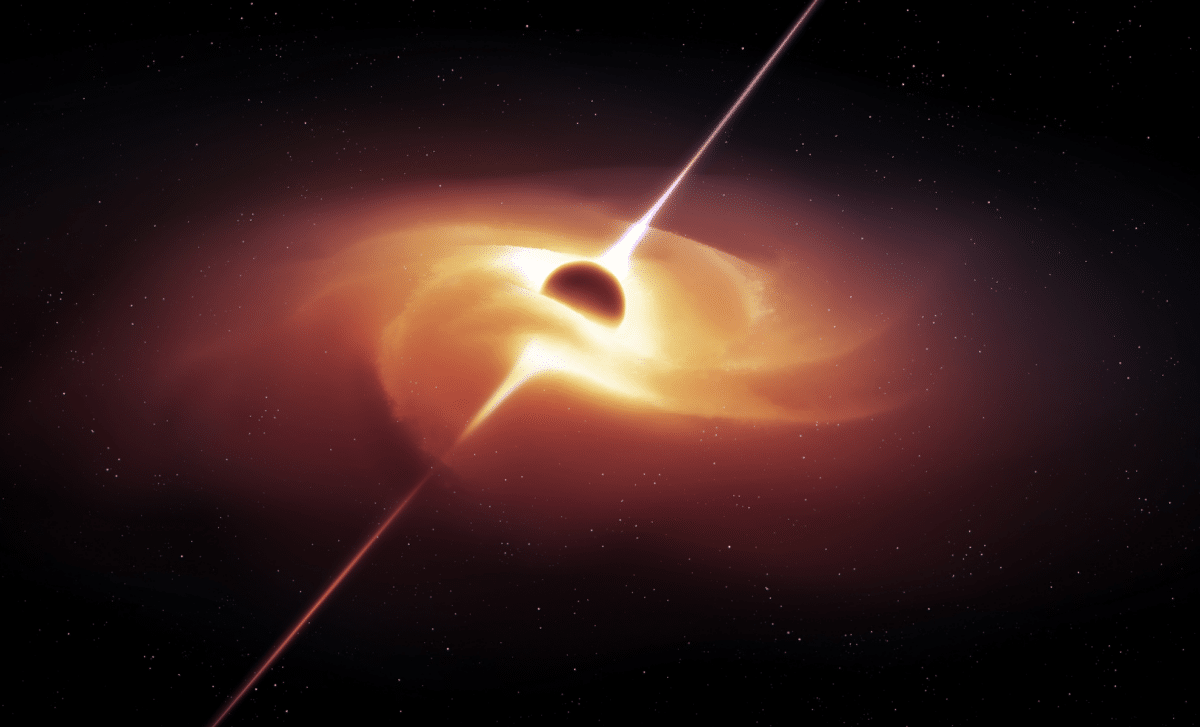
Astronomers have made a groundbreaking observation that reveals the unpredictable behavior of supermassive black holes. Published in Monthly Notices of the Royal Astronomical Society, the research highlights galaxy J1007+3540, where a central black hole has recently revived after nearly 100 million years of dormancy. This event, characterized by scientists as a “cosmic volcano,” emphasizes the episodic nature of black holes, which oscillate between intense activity and long periods of quiescence, profoundly influencing the structure of their host galaxies.
An Intense Revival
The black hole at the heart of galaxy J1007+3540 had remained silent for countless millions of years before erupting unexpectedly. This detection offers one of the clearest cases of a reactivated black hole, shedding light on the on-and-off nature of these enormous objects. Contrary to the idea of continuous growth, this black hole undergoes bursts of energy output followed by extended lulls, revealing the dynamic realities of cosmic evolution.
“It’s like watching a cosmic volcano erupt again after ages of calm—except this one is big enough to carve out structures stretching nearly a million light-years across space,” says Shobha Kumari, lead researcher of the study at Midnapore City College in India.
Add Cosmo Herald as a Preferred Source

Such eruptions have the power to drastically reshape the galaxy by exerting force on the surrounding medium, altering its very composition and form on a massive scale.
Influence of the Galaxy Cluster Environment
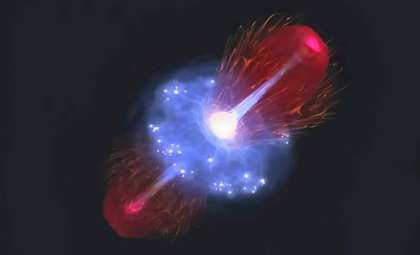
The setting of this discovery adds to its significance. The black hole is nestled within a dense galaxy cluster filled with superheated gas, which plays a major role in twisting and distorting the jets emitted by the black hole. These jets, once freely expanding, now face intense pressure from their surroundings, creating a complex interaction that twists their structure.
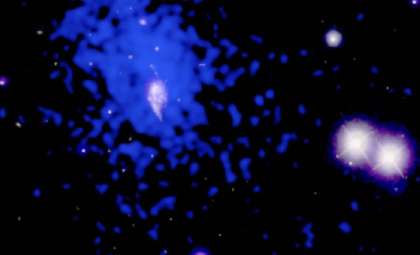
Images taken by the sensitive Low Frequency Array (LOFAR) and India’s enhanced Giant Metrewave Radio Telescope (uGMRT) reveal the jets as compressed and warped as they confront the hot intracluster gas. This interaction produces distinct signatures that provide vital clues to how black holes grow and impact their environments over time.
“This dramatic layering of young jets inside older, exhausted lobes is the signature of an episodic AGN—a galaxy whose central engine keeps turning on and off over cosmic timescales,” Kumari explains.
The black hole’s burst of energy is not an isolated incident but part of a repeated cycle, offering astronomers insight into the mechanisms that drive galaxy evolution.
Environmental Impacts on Jet Morphology
The study, featured in the Monthly Notices of the Royal Astronomical Society, details how the surrounding hot gas actively modifies the black hole’s jets by bending and compressing them, resulting in formations unlike those occurring in less dense settings.
A notable example is the curvature of the northern lobe visible in LOFAR data, where the jet’s plasma flow appears shifted sideways due to intense external pressures. Rather than simple linear streams, these jets contort and deform under the immense forces within the cluster.
Further observations with the uGMRT indicate the older jet segments exhibit an ultra-steep radio spectrum, signifying energy loss over millions of years and interactions with the cluster gas. This evidence allows scientists to trace the long-term evolution of these cosmic jets.
Insights Into Galactic Transformation
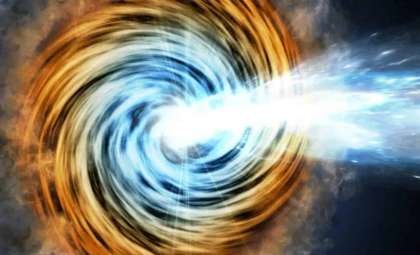
J1007+3540 offers a striking example of how supermassive black holes can shape their galactic homes across vast timescales. The powerful jets emanating from its core don’t just influence their immediate surroundings; they leave enduring imprints on the galaxy's structure and development.
By examining this active galactic nucleus (AGN), researchers gain a better understanding of the cyclical nature of black hole activity and its role in galaxy formation. These findings also illustrate how the immense pressure from hot cluster gas can bend and mold the black hole’s emissions, highlighting the complex interplay between a galaxy’s nucleus and its larger environment.
Dr. Sabyasachi Pal, a co-author from Midnapore City College, remarks, “J1007+3540 is one of the clearest and most spectacular examples of episodic AGN with jet-cluster interaction, where the surrounding hot gas bends, compresses, and distorts the jets.” His statement reinforces the idea that black hole dynamics are intertwined with broader cosmic processes that continuously reshape both galaxies and their environments.
- Categories:
- Astronomy ,
- News



0 comments
Sign in to Comment