
Scientists from Michigan State University have made notable progress toward unraveling the century-old mystery of galactic cosmic rays. Utilizing observations from X-ray satellites and concentrating on a freshly discovered cosmic particle accelerator, their research shines light on the sources of these energetic particles. Their results were unveiled at the 246th American Astronomical Society Meeting and are available in The Astrophysical Journal and Research Notes of the AAS.
Tracing the Source of Cosmic Rays With Powerful Natural Accelerators
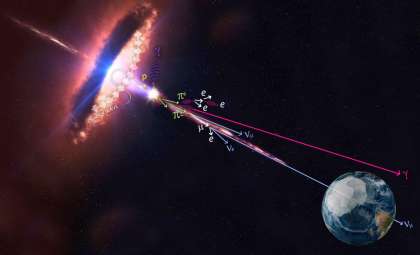
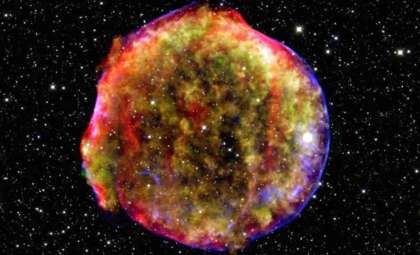
First detected over a hundred years ago, cosmic rays are high-speed particles, primarily protons, that traverse space at velocities approaching light speed. Their specific origins have eluded scientists, though theories have suggested dramatic cosmic phenomena like supernova explosions, jets from black holes, and stellar nurseries as likely birthplaces. These sites are also known for emitting elusive subatomic particles called neutrinos, which can pass unhindered through matter.
Lead investigator Assistant Professor Shuo Zhang and her team focused on a special kind of cosmic accelerator called PeVatrons, which can energize particles to the extreme scale of petaelectronvolts (PeV)—far exceeding human-made accelerator capabilities. Their study centered on a little-understood PeVatron discovered by the Large High Altitude Air Shower Observatory (LHAASO), which, until now, lacked association with any identified celestial object.

Identification of a Pulsar Wind Nebula Unlocks New Clues
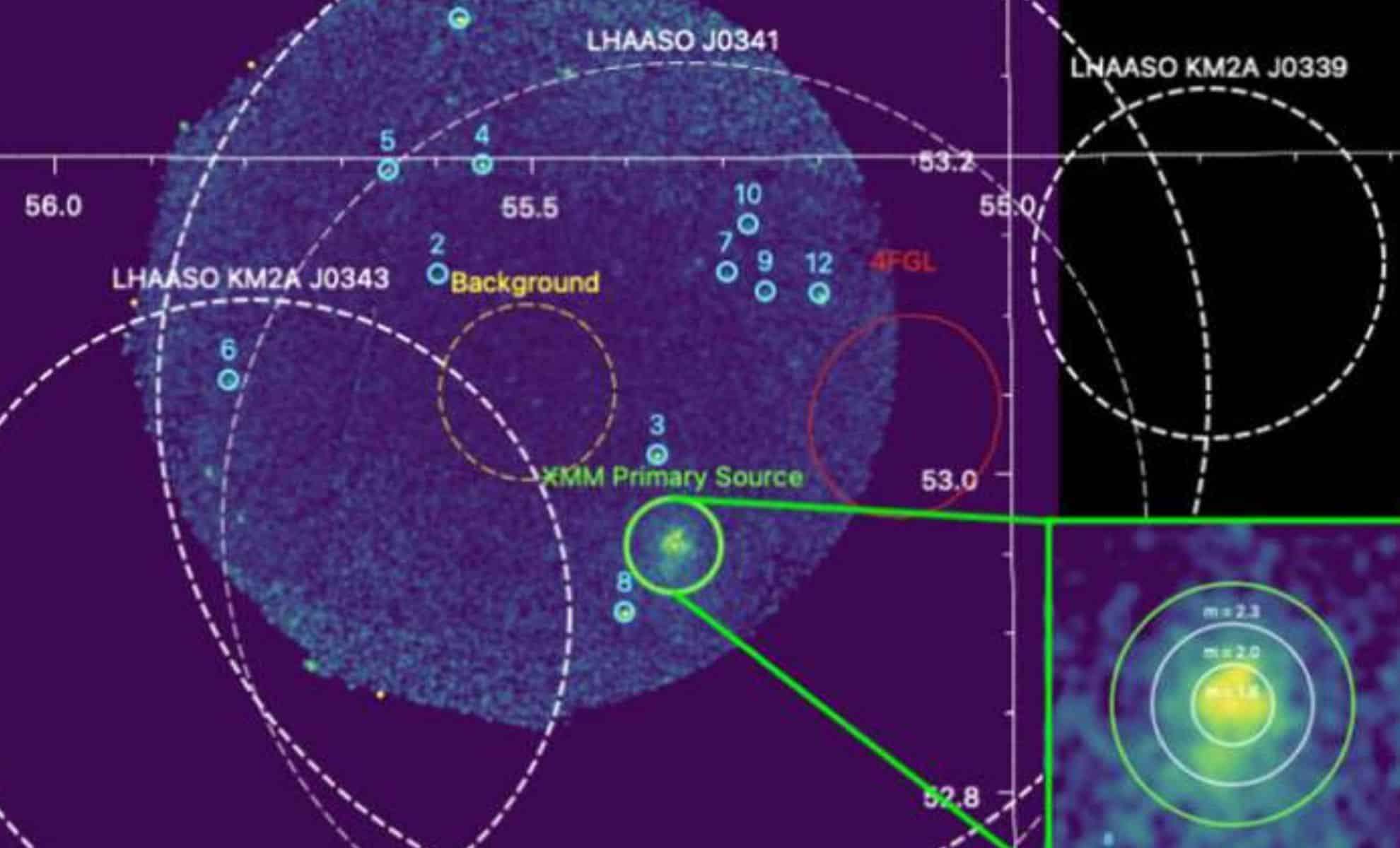
Breakthrough came when postdoctoral researcher Stephen DiKerby analyzed data from the XMM-Newton space telescope and uncovered a pulsar wind nebula linked to the PeVatron candidate 1LHAASO J0343+5254u. Such nebulae are expansive clouds of energetic particles driven by a rapidly rotating neutron star, or pulsar. This connection is a rare example where a PeVatron has been matched to a known astrophysical entity.
“Cosmic rays are a lot more relevant to life on Earth than you might think,” Zhang said. “About 100 trillion cosmic neutrinos from far, far away sources like black holes pass through your body every second. Don’t you want to know where they came from?”
Confirming the nebula’s role provides compelling evidence that pulsar wind nebulae are capable of acting as PeVatrons. This discovery offers a promising avenue to trace cosmic rays and neutrinos back to their energetic origins.
Student-Led X-Ray Surveys Broaden Understanding
In parallel, undergraduate researchers Ella Were, Amiri Walker, and Shaan Karim from Zhang’s team examined further PeVatron candidates through an X-ray survey using NASA’s Swift telescope. Although these sources appeared faint or remained undetected, the team established upper bounds on their X-ray emissions. These constraints refine theories about the emission mechanisms and set the stage for future in-depth investigations, as published in Research Notes of the AAS.
“Through identifying and classifying cosmic ray sources, our effort can hopefully provide a comprehensive catalog of cosmic ray sources with classification,” Zhang said. “That could serve as a legacy for future neutrino observatories and traditional telescopes to perform more in-depth study of particle acceleration mechanisms.”
This work highlights the critical contributions of early-career scientists in high-energy astrophysics and demonstrates a scalable approach to systematically survey the sky by integrating multiwavelength observations from numerous instruments.
Future Directions: Linking Cosmic Rays With Neutrino Emission
The upcoming research phase aims to correlate data from X-ray and gamma-ray observations with neutrino detections obtained from the IceCube Neutrino Observatory located in Antarctica. Scientists hope to understand why certain cosmic ray sources also produce neutrinos, a puzzle requiring collaboration between astronomers and particle physicists.
“This work will call for collaboration between particle physicists and astronomers,” Zhang said. “It’s an ideal project for the MSU high-energy physics group.”
By combining diverse datasets across observatories, the team aims to pinpoint how neutrinos are generated, offering insights into the universe’s most extreme environments. These findings promise to deepen knowledge about phenomena ranging from galactic development to the properties of dark matter.
- Categories:
- News





0 comments
Sign in to Comment