
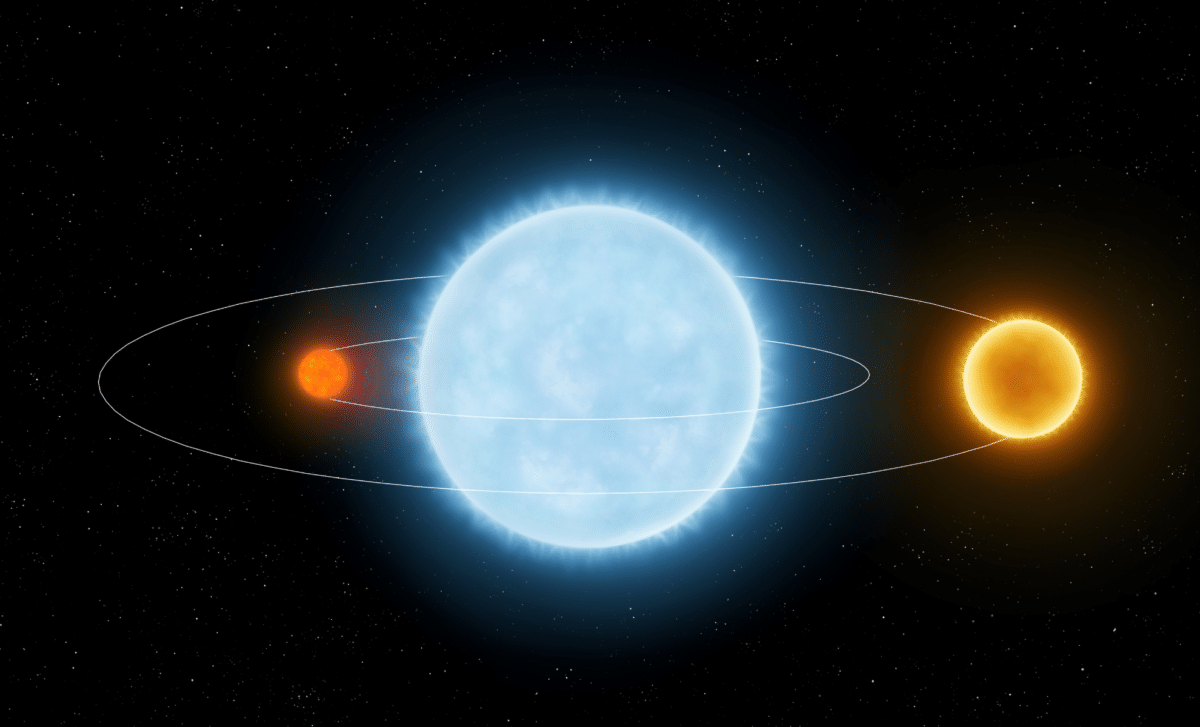
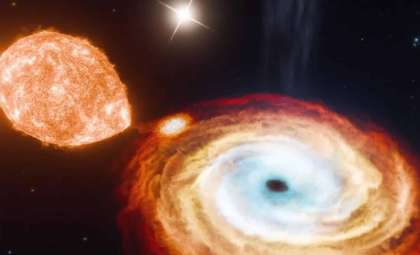
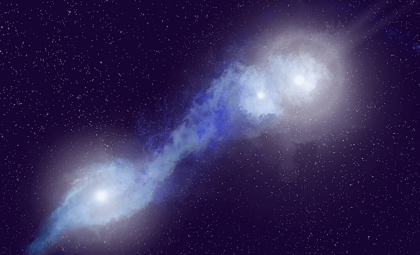
Using data from NASA’s Transiting Exoplanet Survey Satellite (TESS), astronomers have uncovered a captivating triple star system within our galaxy. Known as TIC 295741342, this remarkable system consists of two sun-like stars locked in a close binary orbit, accompanied by a larger third star. Together, they produce a rare phenomenon called a triply-eclipsing event, which has been observed in only a select few star systems. The findings were detailed on arXiv on May 19, shedding light on stellar evolution and the complex dynamics of multi-star arrangements.
Exceptional Stellar Event Captured by TESS
TIC 295741342 underscores TESS’s capability beyond its primary mission of exoplanet hunting. While the satellite scans over 200,000 bright stars for planetary transits, it also captures intricate phenomena in systems with multiple stars. In this case, TESS detected an unusual dip in the star system’s brightness, unveiling the rare triply-eclipsing event.
The researchers described the eclipse pattern as one where the secondary star in the binary moves entirely behind the larger tertiary star (forming the first "shoulder"), followed by both stars together (the "head"), and then the primary star reappearing from behind the tertiary (the second "shoulder"). This distinctive light curve pattern enables precise measurements of the stars’ relative sizes and brightnesses, a task seldom achievable in triple systems. The high precision of TESS’s observations highlights its sensitivity to intricate stellar phenomena.

Characteristics and Composition of the System
The central binary, labeled Aa and Ab, consists of main-sequence stars that closely resemble our Sun, each exhibiting temperatures near 6,400 K, orbiting each other every 4.75 days. The third star, TIC 295741342 B, is a giant star with approximately 1.7 solar masses and a radius more than 10 times larger than the Sun’s. It orbits the inner pair at a distance of about 1.7 astronomical units (AU) over a period of 1.13 years and has a cooler surface temperature of 4,839 K, marking a stark contrast with its companions.
The system’s metallicity is measured at -0.337 dex, and its estimated age is roughly 1.46 billion years. Situated around 3,080 light-years from Earth, the brightness of this triple star system is majorly dominated by the giant tertiary star, contributing close to 95% of the light observed in TESS measurements. The binary and tertiary stars’ orbits are remarkably aligned, with a mutual inclination between 0.25 and 0.33 degrees, making the system an ideal candidate for investigating orbital mechanics.
Formation Clues and Stellar Evolution Insights
The architecture of TIC 295741342 offers valuable information about its origin. The team suggests that the triple system likely emerged through a process called disk fragmentation, where the initial gas and dust disk broke into multiple clumps, followed by inward migration and eventual gas dispersal. This formation mechanism explains the near-perfect alignment and compact orbital layout.
“TIC 295741342 stands out as one of the few known triple star systems with triply-eclipsing events involving a giant tertiary star, possessing the smallest mutual inclination measured so far,” the authors state. This emphasizes the system’s rarity while providing a critical case study for understanding the long-term evolution of multi-star systems. Observing such systems helps refine astrophysical models on mass exchanges, gravitational effects, and orbital interactions.
Ongoing Observations and Scientific Potential
The discovery of the triply-eclipsing event offers astronomers a unique window into the complex interplay among stars in tight multi-body environments. Continued monitoring of TIC 295741342 promises to deepen our comprehension of orbital dynamics, tidal forces, and hierarchical triple system evolution. Additionally, TESS is expected to find more exceptional systems, broadening insights into stellar behavior in intertwined configurations.
This finding highlights the enduring importance of both historical and ongoing TESS data, and the active roles that citizen scientists and professionals play in identifying rare cosmic phenomena. Publishing the results on arXiv ensures swift access for the global astronomy community.
- Categories:
- Astronomy



0 comments
Sign in to Comment