
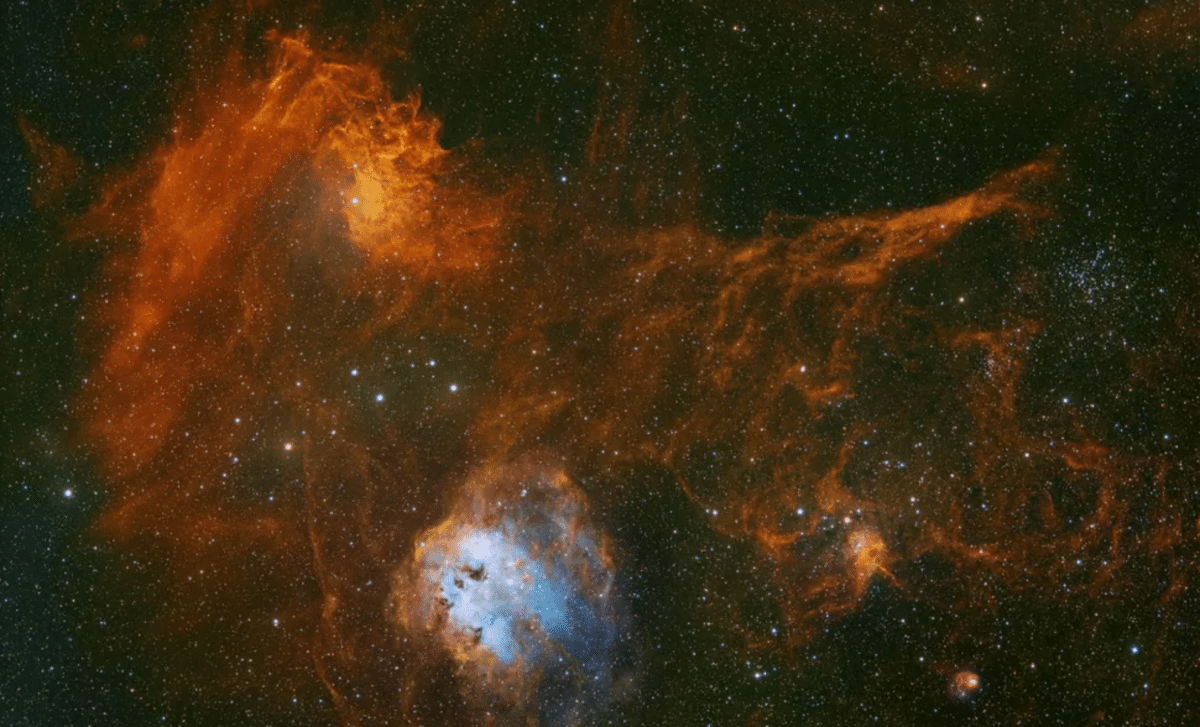
Greg Meyer, an expert in astrophotography, has unveiled a breathtaking image capturing the Flaming Star Nebula, a captivating celestial cloud situated 1,500 light-years away. This remarkable photograph exposes the delicate structures of interstellar gas and dust enveloping the runaway star AE Aurigae, which stands at the heart of this glowing region. Meyer's striking image not only serves as an artistic masterpiece but also enriches our understanding of the cosmos beyond our immediate surroundings.
Exploring the Enchanting Flaming Star Nebula
Known scientifically as IC 405, the Flaming Star Nebula resides within the Auriga constellation approximately 1,500 light-years from Earth. Beyond its visual allure, this nebula holds significant scientific interest. It harbors ionized hydrogen gas that shines due to the intense radiation emitted by the runaway star AE Aurigae. This star’s own journey is fascinating; having been expelled from the dense Trapezium cluster inside the Orion Nebula roughly 1.5 million years ago.
Greg Meyer’s photograph captures the dynamic interplay as AE Aurigae’s powerful stellar winds engage with the surrounding gas clouds. As reported by Space.com, the nebula’s fiery red glow results from hydrogen ionization. This dazzling display offers a glimpse into processes that punctuate star formation and evolution, where stars like AE Aurigae actively sculpt their cosmic environment.

The Remarkable Story of AE Aurigae: A Star on the Move
At the core of the Flaming Star Nebula lies AE Aurigae, a runaway star with a turbulent past. Classified as such due to its expulsion from its native star cluster caused by gravitational disturbances, AE Aurigae originally belonged to the Trapezium cluster, a prolific star nursery within the Orion Nebula. Following a dramatic gravitational encounter with a binary star system, AE Aurigae was flung into space, now illuminating the nebula named after it.
This star’s odyssey epitomizes the volatile and energetic nature of stellar environments. The forces operating in space propel events like AE Aurigae’s ejection, which in turn shape the formation and evolving shapes of the surrounding nebula. The Flaming Star Nebula’s dramatic structures owe their existence largely to the radiative influence of AE Aurigae.
The Astrophotographer Behind the Image: Greg Meyer
Greg Meyer has earned acclaim for his remarkable ability to capture celestial phenomena with extraordinary clarity. In January, under the pristine night skies of Arizona, he employed a Radian Raptor 61 mm telescope paired with a dedicated astronomy camera to photograph the Flaming Star Nebula. Collecting nearly 21 hours of exposure time, Meyer meticulously processed the data using Adobe Lightroom, Photoshop, and the sophisticated PixInsight software.
The final image reveals extraordinary detail: glowing gas formations and subtle features of the Tadpole Nebula appear clearly, emphasizing both the nebula’s grandeur and Meyer’s technical prowess. This accomplishment exemplifies the advancements in astrophotography technologies that enable capturing intricate details of remote space entities.
As highlighted in the article from Space.com, Meyer’s work showcases how modern imaging techniques continue to push the boundaries of space photography, revealing the universe in ways that were once unattainable.
The Tadpole Nebula: A Captivating Celestial Companion
While the Flaming Star Nebula commands attention, Meyer’s photo also features the Tadpole Nebula, IC 410, positioned just beneath IC 405. Offering a striking counterpoint to the Flaming Star's warm tones, IC 410 is a reflection nebula illuminated by nearby stars. Its namesake, the two tadpole-shaped gaseous columns, appear to swim toward the nebula’s luminous core.
These iconic features are shaped by stellar radiation and winds from newborn stars, illustrating the ongoing cosmic interactions that sculpt nebular architectures. Meyer’s image captures these elements with remarkable precision, providing a rare glimpse into the forces molding our galaxy’s stellar nurseries.
- Categories:
- Astronomy



0 comments
Sign in to Comment