

On bright, sunny days, we often witness the sky bathed in a stunning blue shade—a familiar sight that many accept without question. However, the underlying cause of this phenomenon involves fascinating aspects of physics and atmospheric science. Exploring why the sky appears blue offers insight into the behavior of light waves and their interaction with Earth's atmosphere.
The Role of Sunlight and Atmospheric Scattering
To grasp the reason behind the blue sky, it’s essential to know more about sunlight. Although it seems white, sunlight actually comprises a spectrum of colors, each with distinct wavelengths—longer wavelengths like red are more relaxed, while shorter ones like blue and violet are more energetic.
When sunlight passes through Earth’s atmosphere, it collides with tiny molecules of nitrogen and oxygen, which measure roughly 0.4 nanometers. This interaction triggers Rayleigh scattering, an effect named after the 19th-century British scientist Lord Rayleigh.

This scattering phenomenon disproportionately affects shorter light wavelengths like blue, causing them to be deflected in every direction. Consequently, the blue light dominates the sky’s color during the day.
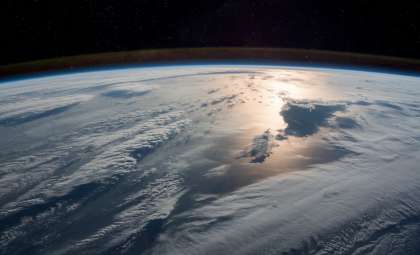
In the absence of an atmosphere to disperse sunlight—for instance, on the Moon—the sky remains pitch black even under direct sunlight. Earth's atmosphere thus transforms the sunlight into the blue canopy we observe.
What Creates Those Vibrant Sunrise and Sunset Colors?
While blue is the daytime staple, sunrises and sunsets captivate with shades of red and orange. This shift is due to the Sun’s position and the length of its light’s path through the atmosphere.
When the Sun lingers near the horizon, its rays travel through a denser atmospheric layer. This extended route scatters away shorter blue and violet wavelengths, leaving behind the longer red and orange colors that paint the sky’s dawn and dusk canvas.
Influences of Atmospheric Conditions on Sky Shades
Though nitrogen and oxygen are chiefly responsible for scattering light, other factors in the atmosphere also tweak sky colors. Events like volcanic eruptions and forest fires release particles that scatter light in ways that can lead to striking red or orange skies during daylight hours.
Pollutants and humidity further affect the sky’s appearance. Urban smog may dim the blue, producing a grayer sky, while high humidity levels cause water vapor to scatter light differently, softening the vibrancy and giving the sky a paler, almost whitish look.
A Deeper Appreciation of Our Daily Sky
For ages, humanity has admired the sky’s colors, inspiring countless creative and cultural works. Artists strive to capture the perfect summer blue or the vivid reds of twilight.
Scientific understanding enriches our wonder by revealing the elegant physical interactions behind these colors. It shows how tiny molecules and sunlight’s journey through the atmosphere converge to craft the brilliant blue that envelops us.
Next time you gaze up on a clear day, take a moment to reflect on the intricate dance of light and molecules producing the sky’s blue glow—a reminder of the fundamental physical laws shaping the natural wonders surrounding us.
- Categories:
- Science











0 comments
Sign in to Comment