
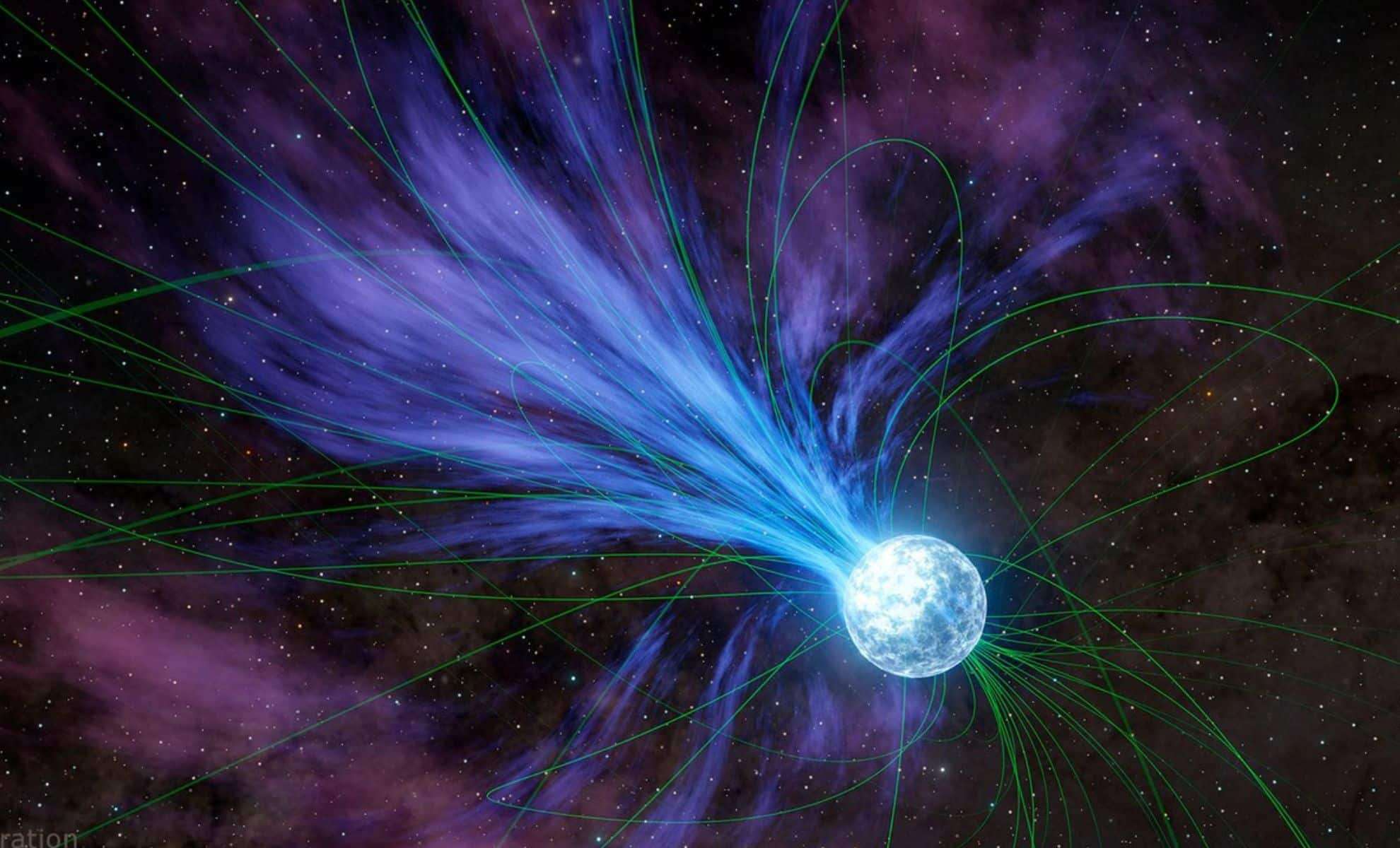
Scientists have achieved a remarkable breakthrough by identifying the long-sought ordinary matter dispersed throughout the cosmos beyond galaxies. Unlike dark matter, which is invisible and detected solely via its gravitational effects, this ordinary matter composes stars, planets, and familiar objects but has largely evaded direct observation. A recent investigation, featured in Nature Astronomy, leverages fast radio bursts (FRBs) to locate and quantify this missing matter, providing valuable clues about the universe’s makeup. Close examination of these intense radio signals has revealed unseen cosmic structures, advancing our knowledge of galaxy formation and evolution.
Fast Radio Bursts: Illuminating the Invisible Cosmic Matter
Fast radio bursts (FRBs) are brief yet extremely energetic pulses of radio waves originating from far-off regions of space. Beyond their intriguing origins, FRBs have become indispensable tools for probing the universe’s elusive matter. By analyzing how these bursts’ signals spread out as they pass through space, scientists can determine the quantity of matter along the signal’s route. Traveling through the intergalactic medium—the diffuse gas and dust filling the voids between galaxies—FRBs allow researchers to measure ordinary matter’s density and distribution with unmatched precision. “The FRBs shine through the fog of the intergalactic medium, and by precisely measuring how the light slows down, we can weigh that fog, even when it’s too faint to see,” said Liam Connor, assistant professor at Harvard and lead author of the study.
Revelation: Majority of Ordinary Matter Found in Cosmic Voids
A pivotal insight from this work is that roughly 76% of the universe’s ordinary matter is hidden within the vast spaces separating galaxies, known as the intergalactic medium. Previously, the whereabouts of much of this matter were hypothesized but lacked concrete evidence—thought to be mostly in galactic halos or cold gas clouds inside galaxies. With FRB analysis, this hypothesis has gained solid validation. The research indicates just 15% of normal matter inhabits galaxy halos, while the rest is concentrated in stars or cold galactic gas. This discovery marks a crucial step in cosmology, confirming theoretical models of cosmic structure with direct observation.

Tracing the Cosmic Web Using FRB Signals
FRBs have become key instruments for charting the cosmos, especially in assessing ordinary matter’s layout. The study scrutinized 69 FRBs, spanning distances from 11.74 million to over 9.1 billion light-years. Studying such a wide range enabled observation of both nearby and the farthest bursts. Among them, FRB 20230521B is the most distant fast radio burst ever documented. Investigating signals from such remote sources is critical for revealing matter across regions too dim for conventional telescopes. The team employed various facilities, including the Deep Synoptic Array-110 (DSA-110)—a network of 110 radio telescopes—as well as the W.M. Keck Observatory in Hawaii and the Palomar Observatory in California.
FRBs: Revealing Hidden Matter via Radio Wave Dispersion
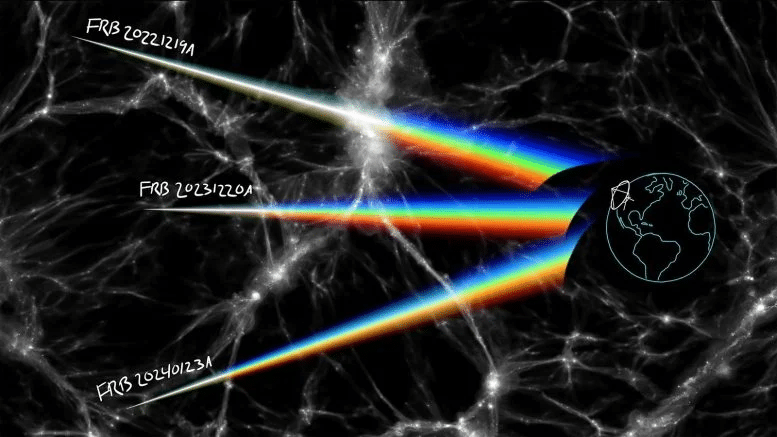
The process by which FRBs help uncover invisible matter is akin to observing shadows rather than the objects themselves. As radio waves from FRBs traverse space, they encounter diverse matter that causes the signals to spread over different wavelengths. The greater the matter encountered, the more the signal disperses. This effect enables astronomers to estimate the quantity of matter encountered, despite its invisibility. “It’s like we’re seeing the shadow of all the baryons, with FRBs as the backlight,” explained Vikram Ravi, assistant professor of astronomy at Caltech. Studying these “shadows” allows researchers to gauge the amount and localization of concealed universal matter.
- Categories:
- News


0 comments
Sign in to Comment