
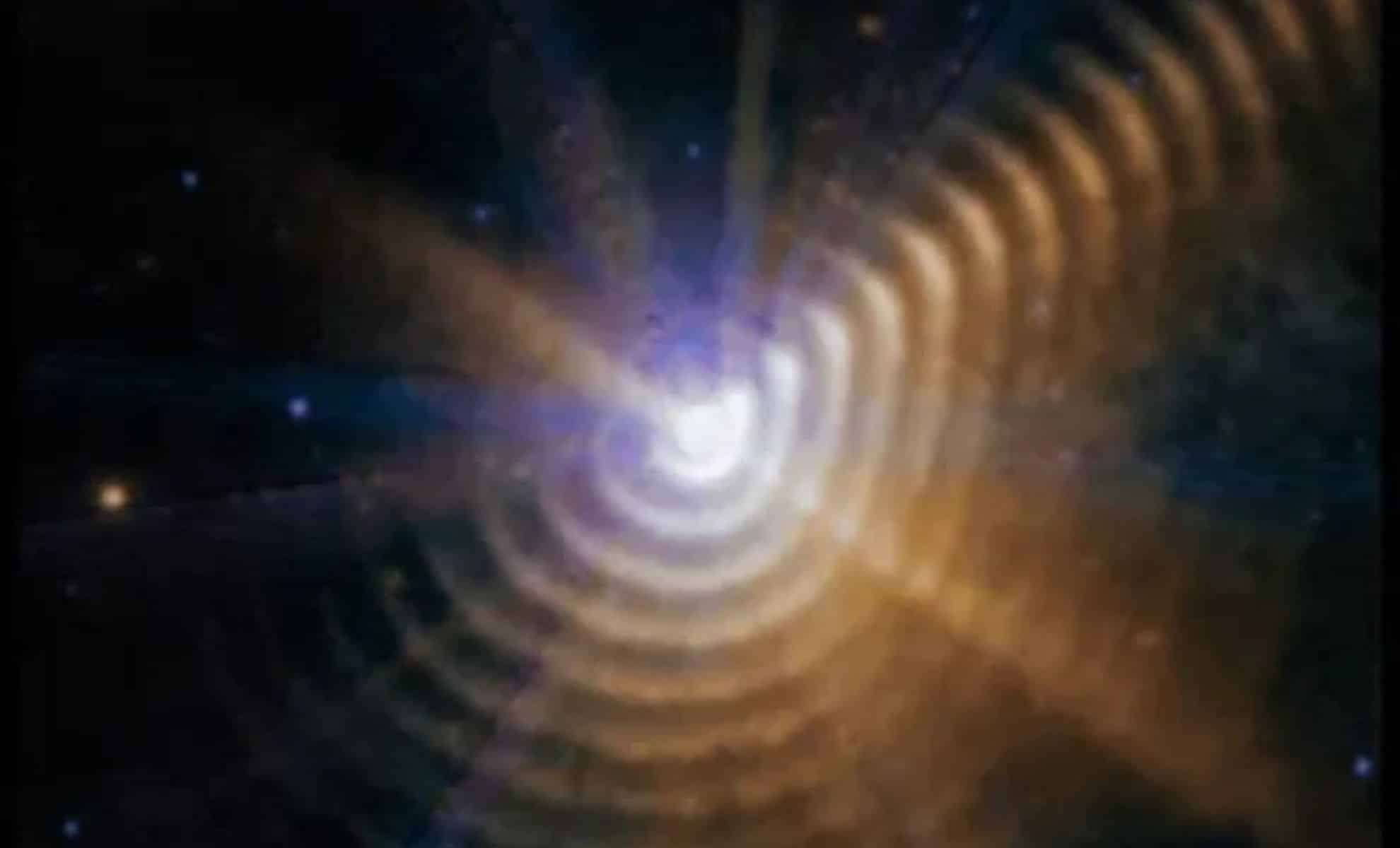
The James Webb Space Telescope (JWST) has once again captured a breathtaking cosmic scene, this time focusing on the dying star system Wolf-Rayet 140, situated about 5,000 light-years away in the Cygnus constellation. The stunning image showcases concentric layers of carbon-rich dust encircling the star system, reminiscent of tree rings but on a grander cosmic scale. These structures provide a unique window into how giant stars shed their outer shells and enrich space with vital elements during their final stages.
The evolving Wolf-Rayet 140 system not only presents a captivating visual but also unlocks clues about how carbon and other elements disperse into the cosmos—elements essential for the formation of planets and life. This observation enhances Webb's reputation as a cutting-edge astronomical instrument. What drives the formation of these dust layers, and what can Wolf-Rayet 140 reveal about stellar death? Webb’s mid-infrared imaging continues to unravel this stellar narrative.
New Research Reveals Details About Star’s Final Phase
The latest insights into Wolf-Rayet 140 were published in The Astrophysical Journal Letters and shared at the 245th meeting of the American Astronomical Society held in National Harbor, Maryland. Scientists explained how the system’s binary nature—featuring a massive Wolf-Rayet star alongside a similarly substantial companion—creates these spectacular dust rings through stellar wind collisions.

Each ring corresponds to one orbital cycle lasting about eight years, during which the stars’ intense winds crash into each other, compressing gas and dust into carbon-enriched layers. These dust shells then expand outward at remarkable speeds.
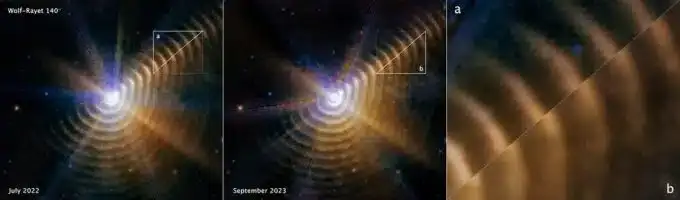
“Webb not only verified that the dust shells exist, but it also demonstrated their steady outward movement, capturing noticeable changes within a very short timeframe,” said Emma Lieb, lead researcher from the University of Denver. The telescope’s precise data enabled astronomers to observe dust shells moving over just 14 months—a breakthrough for studying such transient stellar activities.
Infrared Observations Unlock Hidden Details
One of the highlights of Webb’s study is its capacity to detect cooler cosmic materials, like the dust layers encasing Wolf-Rayet 140, through mid-infrared imaging. Unlike visible or near-infrared light, which captures only regions near the star, Webb’s mid-infrared sensors reveal the full scale and dynamics of the expanding dust shells.
“Mid-infrared data is crucial here, since the dust is relatively cool. Using visible or near-infrared light would show only the dust closest to the stars,” explained Ryan Lau, co-author and astronomer at NSF’s NOIRLab. “Webb’s detailed imaging even lets us determine precisely when the dust forms—down to nearly the exact day.”
This advanced infrared approach propels stellar research forward, enabling scientists to observe phenomena previously out of reach. Pinpointing dust formation timing sheds fresh light on the lifecycle of massive stars and their influence on cosmic chemistry.
The Stellar Role of Wolf-Rayet Stars in Cosmic Chemistry
Wolf-Rayet stars rank among the universe’s most massive and rapidly aging stars. Known for their immense brightness and fierce stellar winds, they lose mass at high velocity as they near death. The Wolf-Rayet star in WR 140 weighs roughly ten times the Sun’s mass and expels material at an extraordinary rate while advancing toward either a spectacular supernova explosion or a quieter collapse into a black hole.
This expelled carbon-rich material is fundamental for cosmic evolution, serving as the foundation for new stars, planets, and possibly life. Observing the detailed dust production in WR 140 gives astronomers a direct look into how these crucial elements cycle through space.
“These dust shells are not only visually breathtaking,” emphasized Lau, “they act like cosmic timekeepers, revealing the timing and mechanisms behind the processes at work in the system.”
Chronicles Written in Cosmic Dust
The dust rings around WR 140 have been likened to a tree's growth rings, each representing an eight-year orbital period, charting the star system’s progression. Mid-infrared images taken by Webb in July 2022 and September 2023 showcase the shells' dramatic outward expansion, highlighting this ongoing cosmic phenomenon.
Traveling at a staggering speed of about 1,600 miles per second (2,600 km/s), the dust’s velocity reveals the powerful forces shaping these stellar interactions. These observations deepen our understanding not only of WR 140 itself but also of how massive stars evolve and release material throughout our galaxy.
What Lies Ahead for WR 140?
Despite continued research, the ultimate destiny of Wolf-Rayet 140 remains uncertain. Should the Wolf-Rayet star undergo a supernova, the ensuing explosion might destroy the surrounding dust rings, leaving only faint remnants. Alternatively, collapsing into a black hole could preserve these cosmic shells as enduring markers of the star's legacy.
The exact timeline and nature of the star’s final stage are still unknown, but ongoing Webb observations aim to clarify this mysterious chapter in stellar evolution. Studying WR 140 offers the chance to uncover new knowledge about how massive stars influence the chemical and structural development of the universe.
- Categories:
- News







0 comments
Sign in to Comment