
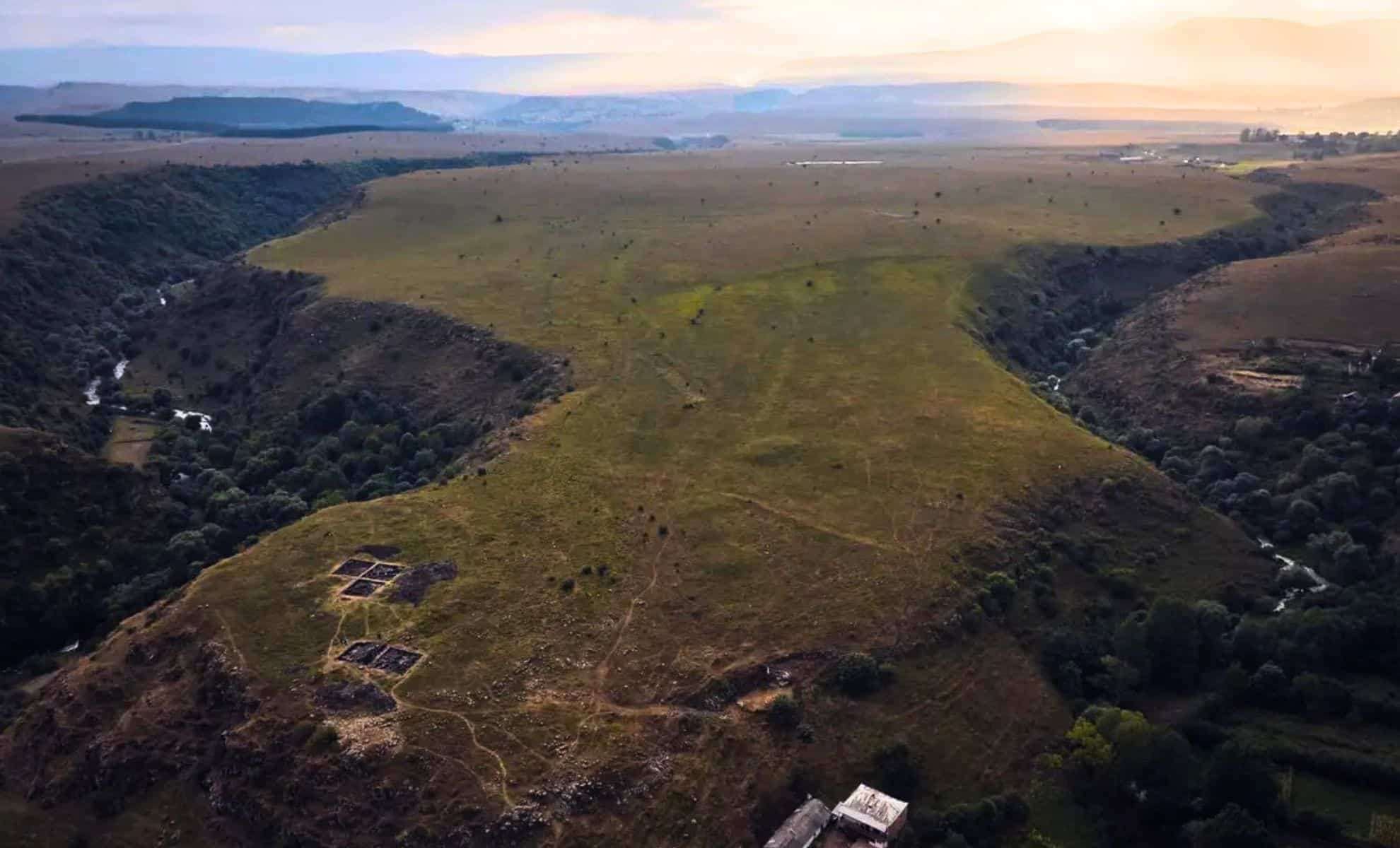
Hidden within the rugged landscape of the Caucasus Mountains, archaeologists have uncovered an enormous ancient stronghold that stands out as one of the most intriguing finds in recent archaeology. Called Dmanisis Gora, this monumental fortress dates back around 3,000 years and surpasses all other known structures in the area. Despite its impressive dimensions, its intended function and the identity of its occupants remain a mystery.
Dmanisis Gora belongs to a series of fortified settlements that emerged in the South Caucasus during the late Bronze Age, between the second and first millennia BCE. Excavations began in 2018, and in 2019, researchers uncovered a second defensive wall system that greatly enlarged the settlement. This startling expansion has fueled extensive discussion about the fortress’s role, its dwellers, and its significance along the ancient crossroads connecting Europe and Asia.
Advanced drone technology has enabled scientists to construct a detailed overview of this Bronze Age enigma. Yet, as a clearer image of Dmanisis Gora emerges, so do the puzzles surrounding its construction. What was the reason behind building such an immense fortress? Who occupied this place, if anyone? And what insights does this provide about the period's cultures?

A Colossal Defensive Complex
The scale of Dmanisis Gora astonished the archaeological community. What started as an initial dig in 2018 soon evolved into a groundbreaking revelation in 2019, when a second fortification wall was discovered. This finding increased the size of the site by more than 40 times its previously understood extent.
Employing drone photography, the team collected over 11,000 aerial photos of the area, subsequently combining them into an intricate map. This mapping exposed an extensive settlement enclosed by a 1-kilometer (0.6-mile) fortified boundary. Dr. Nathaniel Erb-Satullo, a co-author of the research, explained, “The data allowed us to detect subtle landscape features and produce precise maps of the defensive walls, burial grounds, agricultural plots, and other stone constructions throughout the outer complex.”
The fortress's inner and outer walls share a similar construction style, built using large, uncut stones stacked without mortar, resulting in barriers roughly 2 meters (6.6 feet) thick. This design implies the two walls operated together as a combined defense mechanism, with neither sufficient alone to guarantee protection.
An Artifact-Scarce Site
One of the most perplexing elements of Dmanisis Gora is the scarce presence of archaeological artifacts within the outer ramparts. This shortage has led experts to debate whether the fortress was ever heavily occupied or if it was swiftly deserted after being built. Both possibilities are surprising, considering the considerable effort needed to establish such expansive fortifications.
The researchers propose that the fortress might have served a seasonal function, potentially acting as a base camp for pastoralist groups during transitional seasons like spring and autumn. This idea could clarify the site's strategic value despite the apparent lack of a permanent population. “If the inner and outer areas were occupied simultaneously, as we suggest, this would make the settlement one of the largest documented from the late Bronze and early Iron Age in the South Caucasus,” the study states.
Deciphering Dmanisis Gora’s Legacy
Although Dmanisis Gora raises more questions than it answers, it offers a valuable window into past societies. Its enormous scale and advanced craftsmanship indicate a possibly crucial regional role, even if its precise purpose remains elusive.
Dr. Erb-Satullo highlights that ongoing investigations will shed light on issues like population sizes, livestock patterns, and farming activities. As research progresses, Dmanisis Gora could reveal new insights into the ancient history of the Caucasus region and its peoples.
For the moment, this colossal fortress stands as a symbol of a bygone civilization’s architectural prowess and ambition, awaiting discoveries beneath the rugged Georgian mountains.
The findings are detailed in the journal Antiquity.
- Categories:
- News







0 comments
Sign in to Comment