

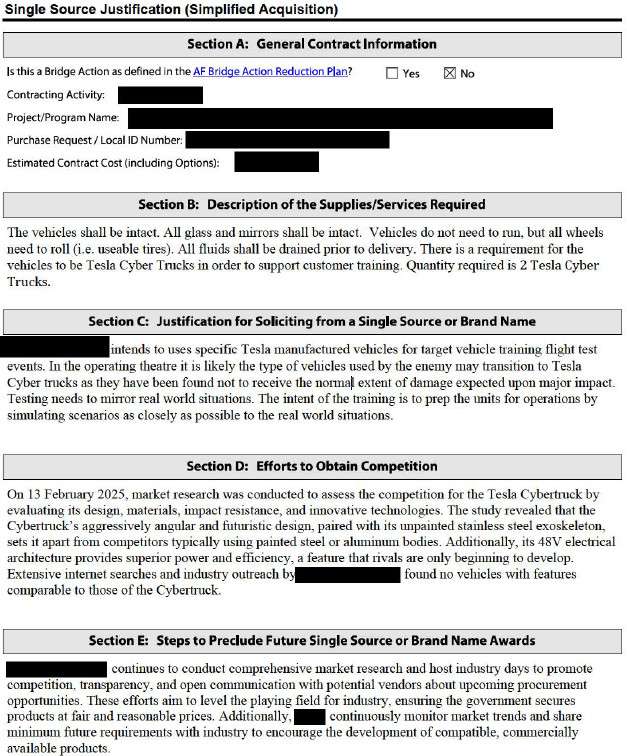
The U.S. Air Force has announced plans to acquire Tesla Cybertrucks for destruction during live-fire weapons exercises, according to procurement documents examined by The War Zone. This initiative stems from concerns that adversaries may employ the Cybertruck’s distinctive armored design and electrical features in combat, prompting the military to train against such threats.
From Consumer EV to Military Training Target
Introduced by Elon Musk in 2019, the Cybertruck was marketed as a highly durable electric pickup truck with an exterior shell of unpainted stainless steel, a 48-volt electrical system, and windows capable of stopping subsonic pistol rounds. Musk described it as virtually “apocalypse-proof.”
Despite the initial excitement, the vehicle has faced numerous challenges including manufacturing defects, product recalls, and failure to meet sales expectations. By mid-2025, total deliveries are projected at roughly 46,000 vehicles, a far cry from the originally forecasted 500,000 units. Tesla's efforts to expand beyond North America continue with upcoming launches planned in Saudi Arabia, the UAE, and Qatar.

However, Tesla’s commercial performance is irrelevant to military planners. A market analysis from February 2025 by the Air Force Test Center (AFTC) highlighted that no civilian vehicle offers the same combination of impact durability, shape, and electrical system. The study noted the truck "does not sustain the typical damage expected after major impacts" and identified it as a potential battlefield threat.
Purpose of Using Cybertrucks as Target Vehicles
The Cybertrucks will be among 33 vehicles procured for the stand-off precision-guided munitions (SOPGM) initiative, overseen in part by U.S. Special Operations Command. The program aims to train personnel to eliminate resilient, unconventional ground vehicles with precision munitions.
The trucks do not need to operate fully but must be capable of being roll-towed to simulate movement. The trials will take place at White Sands Missile Range in New Mexico, a military test site used extensively by the Air Force.
The planned arsenal for these tests includes:
- AGM-114 Hellfire — a widely deployed air-to-ground missile
- AGM-176 Griffin — a smaller missile designed for precision strikes in special operations
- GBU-69/B Small Glide Munition (SGM) — a lightweight guided glide bomb
- GBU-39B/B Laser Small Diameter Bomb (LSDB) — an accurately guided bomb variant
These weapons have seen extensive combat use against mobile targets in the Middle East, Central Asia, and Africa, particularly in counterterrorism campaigns.

Cybertrucks in Military Settings Before
The Cybertruck has already entered military and paramilitary applications, elevating its status as a possible combat asset. In 2024, the Dubai Police incorporated it into their “luxury patrol” fleet. The same year, Ramzan Kadyrov, leader of Russia’s Chechen Republic, showcased several Cybertrucks equipped with 12.7mm heavy machine guns for Ukraine’s conflict, later accusing Tesla of remotely disabling one of them.
The Dubai Police General Command has added the Tesla Cybertruck, the modern electric car with a futuristic design, to its tourist police luxury patrol fleet. pic.twitter.com/eubpvfjVbA
— Dubai Policeشرطة دبي (@DubaiPoliceHQ) June 16, 2024
Commercial outfits like Unplugged Performance have offered armored Cybertruck variants tailored for law enforcement and private security. Models such as the Sting add ballistic reinforcements, reinforcing military concerns that such vehicles—or similar ones—could be adversarial assets in future operations.
From Civilian Tech to Military Target
This procurement highlights a new military perspective on consumer technology. The Cybertruck’s once-promoted ruggedness now positions it as a priority target in training exercises. The AFTC states that authentic training must reflect potential enemy equipment encountered in actual theaters of operation, even if it involves expensive electric trucks.
For Tesla, the optics are surprising: a marquee vehicle touted for toughness set to be shot at by U.S. forces. For the military, this is a practical step—preparing for future battlefields where civilian technology crosses into defense applications.
By selecting Cybertrucks as live targets, the U.S. Air Force signals no judgment on sales performance but rather readies for a combat environment where innovation blurs the lines between civilian and military platforms.











0 comments
Sign in to Comment