
Researchers uncovered ancient human remains in Colombia presenting a puzzling genetic profile that defies connections to any known prehistoric or modern South American groups. The DNA extracted from these 6,000-year-old bones reveals a lineage distinct from all previously identified populations on the continent.
Lost Ancestors Without Modern Genetic Ties
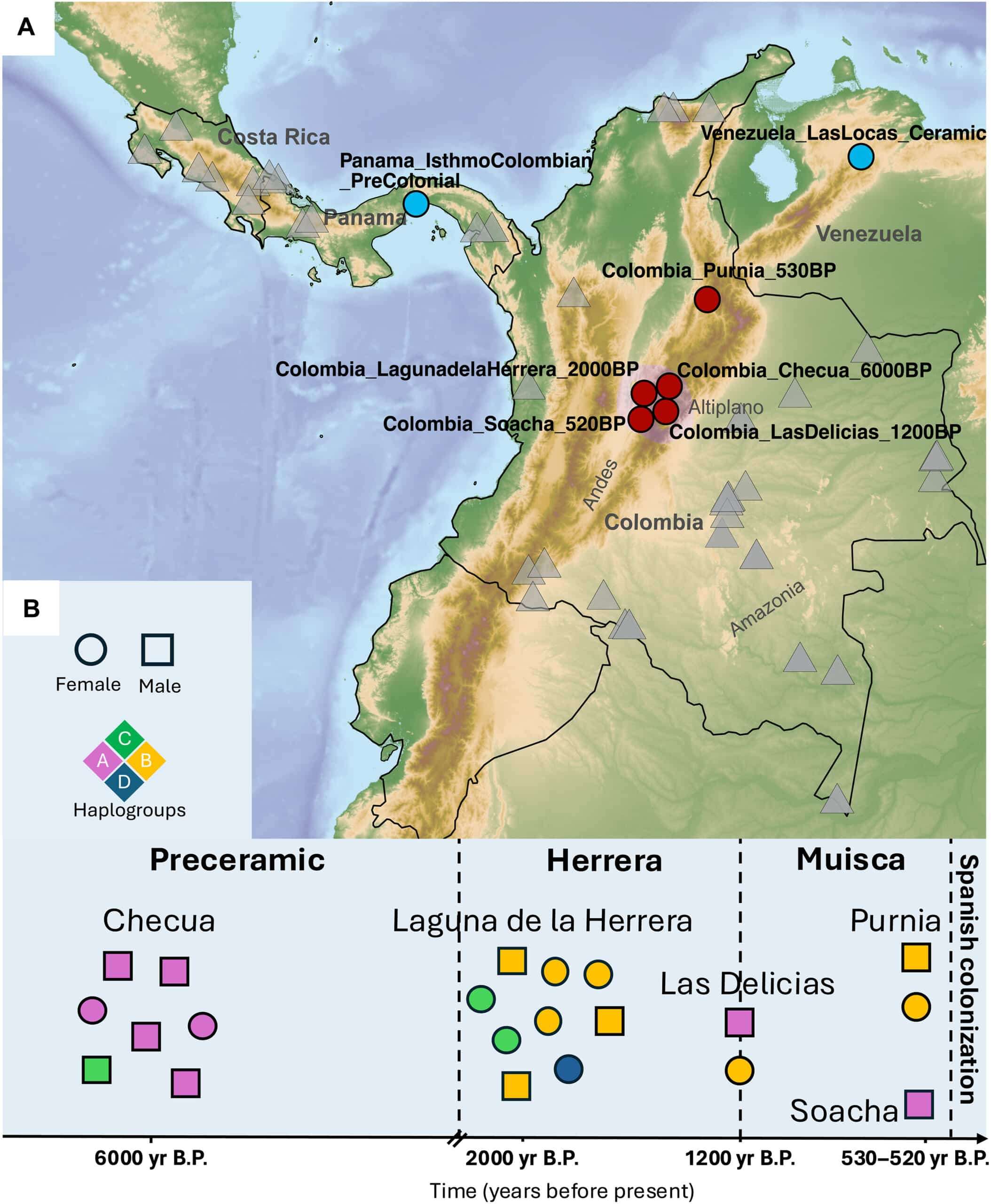
Some 6,000 years ago, hunter-gatherer communities inhabited Colombia’s Bogotá Altiplano plateau. Over the following four millennia, they shifted from roaming gatherers to settled agriculturalists, yet their genetic footprint mysteriously disappears from current records.
In the study, scientists examined fragmented DNA from skeletal samples and found no direct genetic affiliation with either ancient or present-day Indigenous Colombian groups. Remarkably, these ancient individuals share closer genetic affinities with contemporary populations residing on the Isthmus of Panama who speak Chibchan languages.

It’s possible that these early Colombians spread into neighboring regions and interbred extensively with other groups, leading to the dilution of their unique genetic signature. However, the full narrative still eludes resolution.
The authors highlight that “the Isthmo-Colombian area, stretching from the coast of Honduras to the northern Colombian Andes, is critical to understanding the peopling of the Americas.”
Unraveling Native American Ancestry
The roots of American Indigenous peoples extend back to ancient Siberian and East Asian populations who intermixed approximately 20,000 years ago during the Late Paleolithic era. These groups migrated across a land bridge into North America around 16,000 years ago, eventually diverging into northern and southern Native American groups.
While northern Native American ancestors largely remained in the northern regions, three additional ancestral lineages moved further south. One of these is connected to Anzick-1, a 12,700-year-old child discovered in Montana, whose lineage links to modern Indigenous peoples throughout the Americas.
Another lineage traces back to ancient inhabitants of California’s Channel Islands, and a third relates to some of the oldest Central and South American remains found in places like Belize, Brazil, and Chile.
Present-day speakers of Chibchan languages, primarily from southern Central America, share some genetic and cultural traits with these ancient Colombian individuals. Nevertheless, the origins of the ancestral Proto-Chibchan language remain uncertain, with linguistic development believed to have begun thousands of years ago in southern Central America.
New Genetic Insights Rewrite American Prehistory
The research included mitochondrial DNA and genome-wide analyses from 21 ancient individuals living between 6,000 and 500 years ago within this region. Findings show that ancient Panamanian peoples share a closer genetic relationship with contemporary Chibchan speakers compared to their 6,000-year-old Colombian counterparts.
Nonetheless, Indigenous Chibchan speakers in Central America are genetically most similar to Colombians dating from after 2,000 years ago. The scientists note that many contemporaneous groups with related languages have yet to be genetically examined.
They emphasize the need for further genomic research in neighboring areas such as western Colombia, western Venezuela, and Ecuador to clarify the timing and origins of human migrations into South America. These ancient remains serve as a vital reminder of the many secrets still hidden about the continent’s earliest inhabitants.
- Categories:
- News





0 comments
Sign in to Comment