
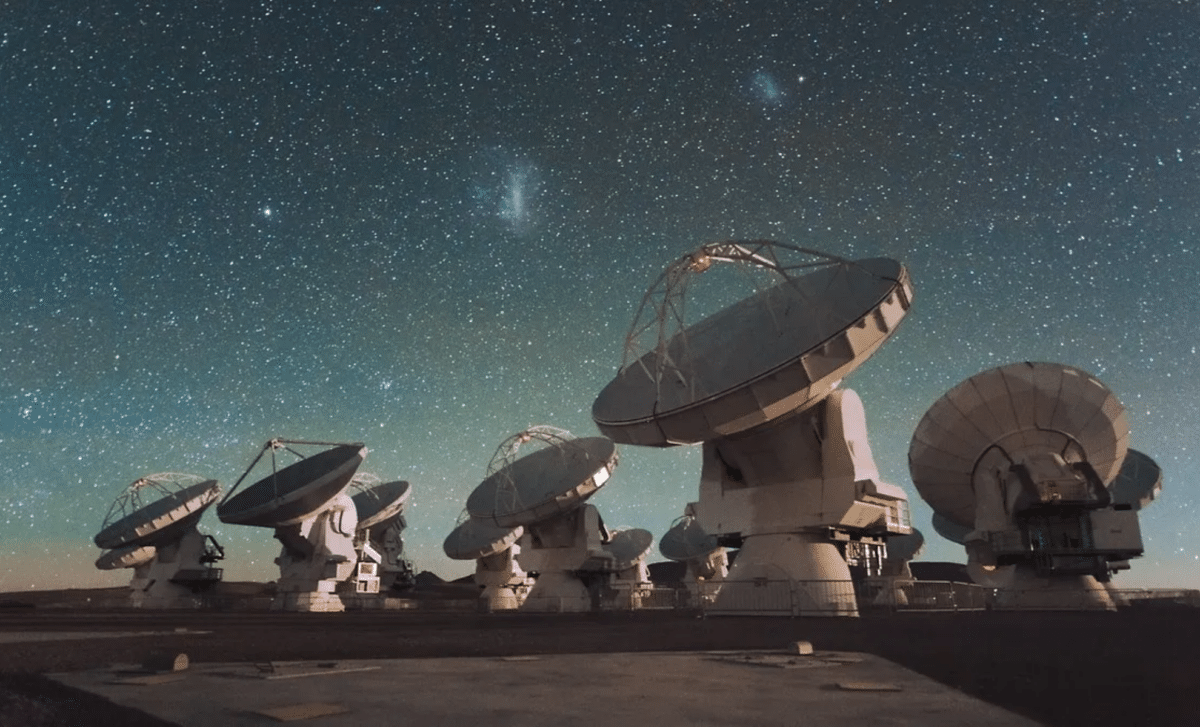
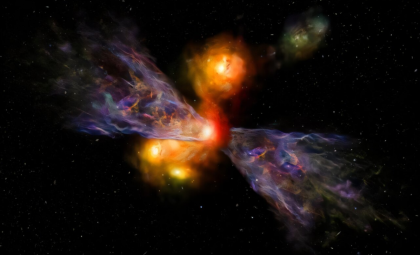
Unexpected findings from the Atacama Large Millimeter/submillimeter Array (ALMA) have unveiled a remarkable star-forming region hosting nine infant stars growing together inside a single elongated gas structure. Documented in a paper posted on arXiv, this discovery offers one of the most detailed glimpses yet into the origin of complex stellar groupings, allowing scientists to observe the early stages of a large multiple-star system in the making.
Serendipitous Find in a Well-Known Star-Forming Complex
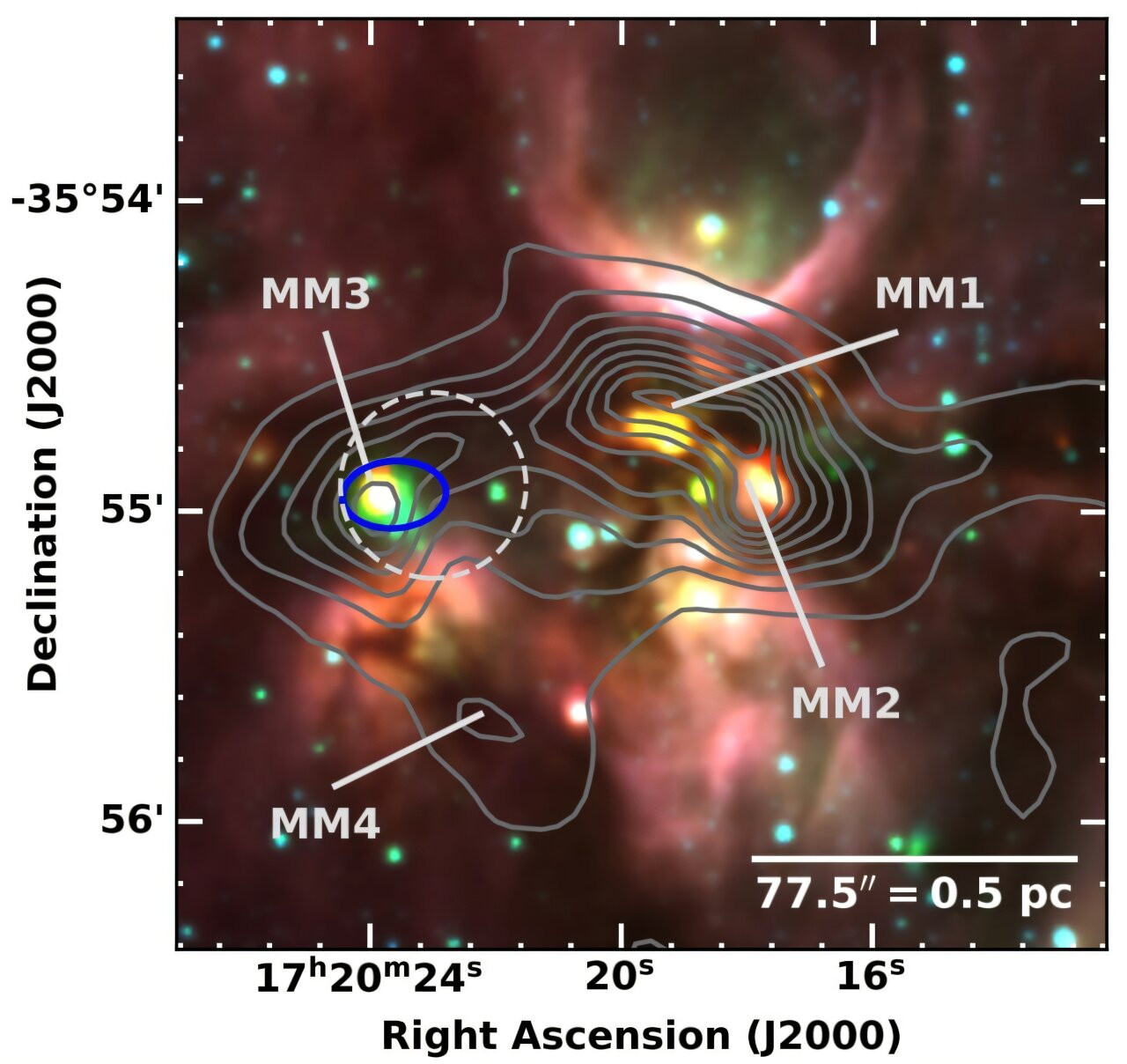
This breakthrough was not the primary objective of the astronomers involved. They were studying data from the CoCCoA survey, an initiative aimed at exploring the chemistry of intricate organic compounds within massive stellar nurseries. One focal point was NGC 6334-43, a hot molecular core situated about 4,340 light-years from Earth amid a larger star formation region. While scrutinizing detailed emissions of dust and gas, the researchers stumbled upon an unexpected feature contained within the observations.
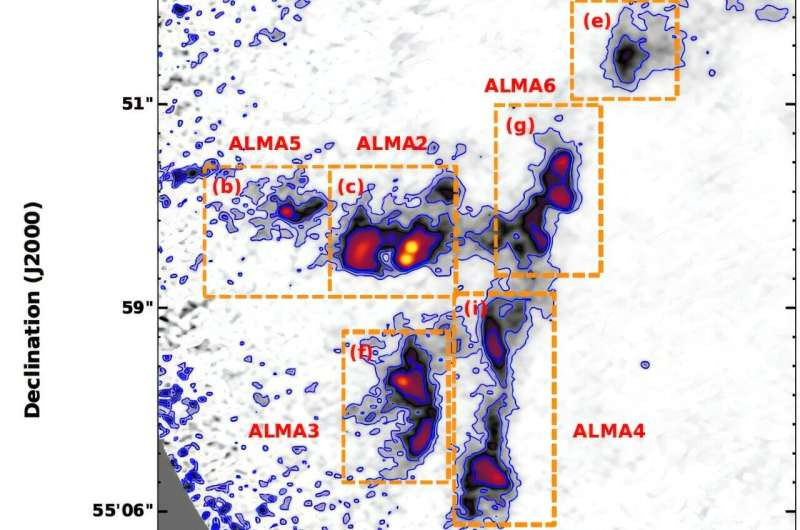
Instead of merely detecting the targeted chemical markers, they discovered nine tightly clustered compact sources arranged along a single filamentary path. The linear distribution stood out because these objects seemed interconnected rather than randomly placed. Follow-up studies indicated that these nine components are gravitationally bound and likely constitute a single young stellar family. This finding, outlined in a study available on arXiv, underscores how significant scientific insights can emerge from data gathered with other aims in mind.

A Gravitationally Linked Stellar Family
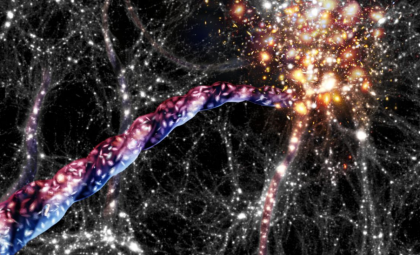
Measurements detailed that the nine stars are distributed along a gaseous filament approximately 24,700 astronomical units in length. The average distance between adjacent stars is about 7,930 astronomical units, indicating a closely packed grouping on astronomical scales. By analyzing the balance between gravitational forces and the stars' motion, researchers found that these objects are likely gravitationally interconnected. This suggests they belong to a shared evolving system instead of being a chance alignment of separate stars.
Such multiple star systems are notoriously difficult to examine since massive stars form swiftly while embedded in dense clouds of dust and gas. Often, by the time these stars become visible, the earliest phases of their development are no longer observable. Capturing nine young stellar objects still within their original environment offers a rare glimpse into a process seldom captured by astronomers, enabling them to investigate how stars coalesce together before feedback mechanisms start altering their surroundings.
Varied Growth Phases Within One Cluster
A particularly fascinating aspect of this stellar assembly is the range of developmental stages its members exhibit. Several stars appear more mature and are already producing powerful outflows, a definitive sign of active star formation. Others remain in a more nascent state. As noted by the research team, "The nine sources considered here display a range of evolutionary signatures." This diversity offers astronomers an excellent natural laboratory to study how stars evolve within the same cosmic neighborhood.
Among these, the ALMA2 subgroup stands out, consisting of a close pair named ALMA2a and ALMA2b, alongside a younger object, ALMA2c. No evidence was found for a common disk encompassing these objects, lending support to the idea that they formed through the fragmentation of a dense gas core. The team also highlighted uncertainties about a strong outflow detected near the pair, noting that it remains unclear whether it originates from one star, the other, or both. Future observations with even finer detail may resolve this mystery.
Smaller Stellar Pairs Provide Key Insights Into Formation Processes
The ALMA6 binary system is another intriguing feature within the larger group. Composed of two stars spaced roughly 1,530 astronomical units apart, they are linked with a distinctive spiral-arm-like structure weaving through the surrounding gas. Researchers believe this pair also emerged via the fragmentation of a dense gas core into multiple collapsing sections before the stars fully formed. Evidence suggests that ALMA6a is further along in its evolution compared to its companion ALMA6b, which may still be in a pre-stellar stage and has yet to complete its collapse into a star.
These smaller systems provide evidence that several star formation mechanisms can operate simultaneously. While the broader filament likely fragmented to produce the ensemble, tighter groupings may have developed from fragmentation within individual cores. This layered formation scenario could shed light on why massive stars frequently appear in binary or higher-order multiple systems throughout our galaxy.
- Categories:
- Astronomy






0 comments
Sign in to Comment