

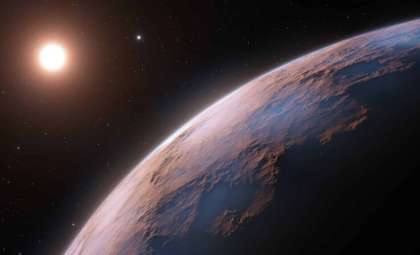
Scientists have long pursued evidence of Planet Nine, a theorized massive planet residing in the distant reaches of our solar system.
Although never directly detected, indirect signs hint at its presence. Observations of the behavior of remote objects in the Kuiper Belt suggest this planet could possess a mass around ten times that of Earth and orbit the Sun at a distance over twenty times farther than Neptune. If confirmed, its orbital period would span between 10,000 and 20,000 years, making it the slowest orbiting planet known.
The Basis for Hypothesizing Planet Nine
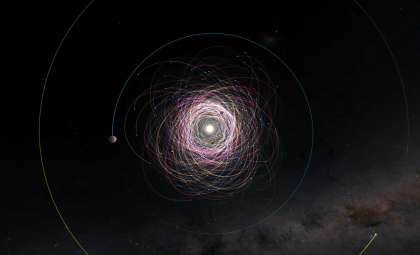
The concept of Planet Nine was put forward in 2016 by Caltech astronomers Konstantin Batygin and Mike Brown, who developed a mathematical framework to explain the peculiar paths of several trans-Neptunian objects (TNOs). Bodies such as Sedna and 2012 VP113 exhibit unusually stretched and tilted orbits that cannot be fully accounted for by the known gravitational forces of the solar system. The team proposed that an unseen massive planet, roughly 10 Earth masses, might be influencing these trajectories.

While their study sparked considerable enthusiasm, skepticism remains due to the lack of direct visual confirmation. Jim Green, who formerly led NASA’s Planetary Science Division, expresses cautious hope: “These early predictions stem from limited data and models. It’s a promising beginning that could lead to exciting discoveries.” As such, Planet Nine is a strong hypothesis pending observational evidence.
Insights from the Kuiper Belt Region
The Kuiper Belt lies beyond Neptune’s orbit and contains icy bodies and dwarf planets like Pluto. This expansive zone spans roughly 30 to 50 AU (astronomical units) from the Sun. The strange orbital characteristics of some Kuiper Belt objects, especially Sedna and 2012 VP113, have captured scientists’ attention. Their highly elongated and tilted orbits imply the influence of a yet undiscovered massive entity residing further out.
For instance, Sedna, discovered in 2003, travels along a path far beyond Neptune’s grasp, prompting theories that Planet Nine might be exerting gravitational influence. These trans-Neptunian objects diverge markedly from typical Kuiper Belt object orbits, hinting at an unseen gravitational source.
“These bodies offer clues, directing us toward Planet Nine,” Batygin remarked. “Their orbital signatures point to a significant gravitational presence shaping their motion.”
The Difficulty of Spotting Planet Nine
Despite increasing indirect evidence, Planet Nine remains undetected through direct observation. Unlike previous planetary discoveries mostly made using standard telescopes, locating Planet Nine is a greater challenge due to its extreme distance. It reflects minimal sunlight, making it exceptionally faint even when viewed with the most advanced instruments.
Efforts using facilities such as the Subaru Telescope in Hawaii continue to scan the sky for signs of this elusive world. The absence of a visual confirmation has led some researchers to explore alternative explanations for the unusual Kuiper Belt dynamics, including collective gravitational effects from multiple smaller objects or interactions with other distant celestial bodies, instead of a single large planet.
Nonetheless, many in the astronomical community remain optimistic that Planet Nine will eventually be located. Current strategies involve refining orbital models and employing increasingly sensitive detection methods to pinpoint potential regions for observation. Batygin emphasized, “Our focus now is on fine-tuning predictions and utilizing better instrumentation to search probable hiding places.”
Potential Impact of Discovering Planet Nine
Should Planet Nine be confirmed, it would represent a milestone in planetary science. Beyond enriching our solar system’s inventory, it could transform our understanding of planetary formation and migration within and beyond our cosmic neighborhood. This distant world might elucidate the peculiarities observed in the outer solar system and even inform studies about planetary systems orbiting other stars.
As Jim Green noted, “Confirming Planet Nine’s existence would mark a monumental breakthrough, opening new avenues to investigate solar system origins and evolution.” Such a discovery could also inspire future missions dedicated to exploring the outer solar system’s mysteries.
Even if the planet stays hidden for some time, ongoing investigations have already deepened knowledge about the Kuiper Belt and its intriguing denizens. Advancements in technology and observation promise that unveiling this long-sought giant planet could happen in the not-so-distant future.
- Categories:
- Astronomy ,
- Space



0 comments
Sign in to Comment