
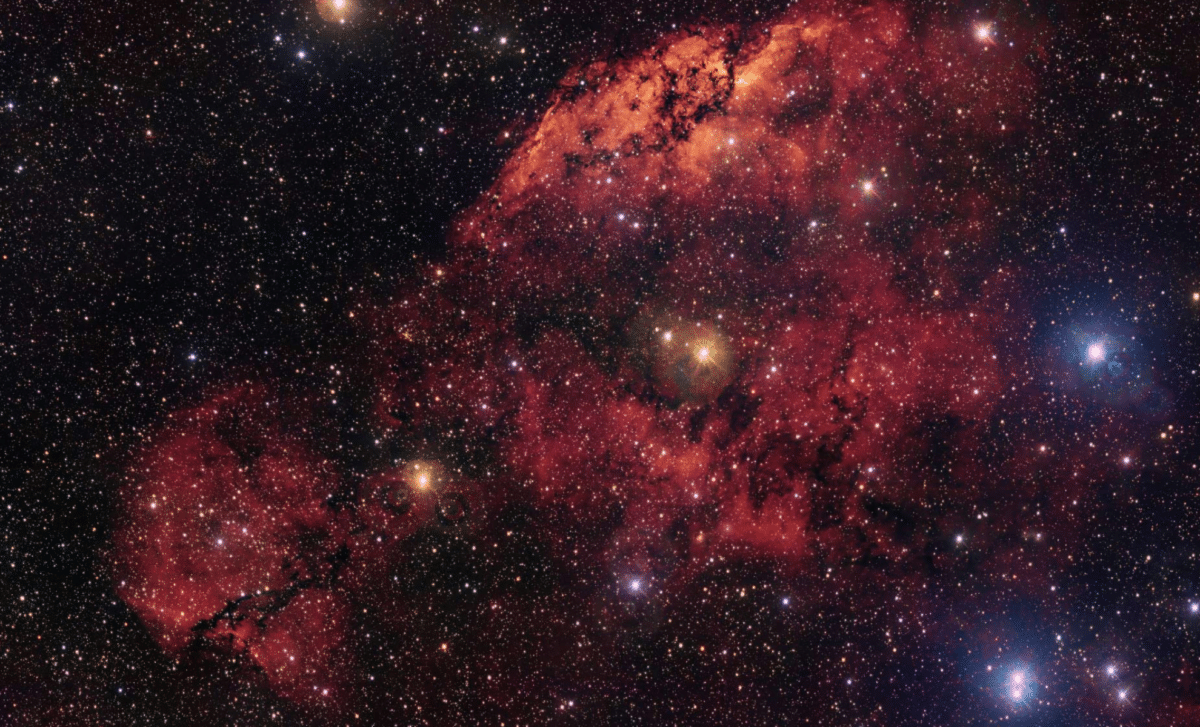
A stunning new image taken by ESO’s VLT Survey Telescope (VST) unveils the spectacular structures of two nebulae known as Gum 10 and Gum 11. Located within the southern constellation Puppis, these star-forming clouds showcase intricate patterns formed by the interaction of dust, gas, and stellar radiation across vast interstellar distances.
Recognizing Familiar Designs in Cosmic Clouds
Scientists from ESO encourage viewers to identify imaginative shapes within these nebulae—perhaps a dragon’s head or a pecking bird—as the clouds exhibit pareidolia phenomena. These formations, consisting of diffuse dust and gas in outer space, are officially cataloged as Gum 10 and Gum 11.
Seen from Earth, these giant nebulae appear as symbolic silhouettes while representing enormous stellar nurseries. Prominently, Gum 10 fills much of the scene with its vibrant glow, while Gum 11 is farther away and less luminous, together illustrating the majestic complexity and natural designs resulting from cosmic turbulence.

The Forces Illuminating the Nebulae
The radiant appearance of these nebulae stems from energetic processes between hydrogen gas and embedded massive stars. Researchers describe the mechanism: ultraviolet light from hot stars ionizes hydrogen atoms in the clouds, producing glowing ions that radiate characteristic red light visible in the VST capture.
Additionally, darker thread-like features throughout the nebulae are caused by dust grains obscuring background light, mapping the fine structures and dynamic conditions that govern star formation in these environments.
Charting Southern Sky Wonders
Gum 10, also listed as RCW 19, is located about 10,760 light-years from Earth and spans near 155 light-years across. Meanwhile, Gum 11, known as NGC 2579, lies closer at roughly 4,000 light-years. Both nebulae are mostly observable from the southern hemisphere and belong to an extensive stellar nursery arrangement.
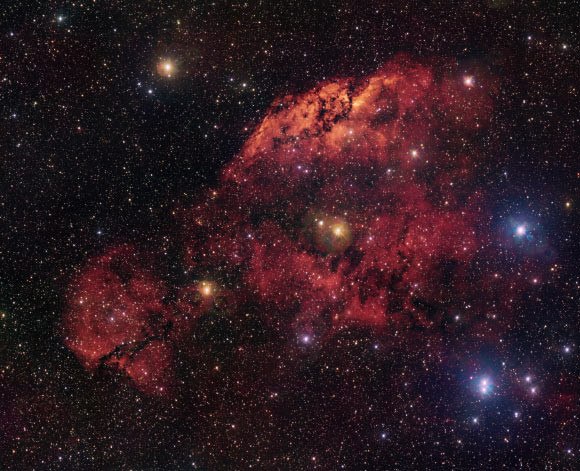
According to astronomers, these nebulae form part of a larger star-forming complex primarily detectable in the southern hemisphere. Examining them is crucial for understanding how massive stars sculpt their cosmic neighborhoods and influence the broader galactic environment.
VST’s Role in Expanding Cosmic Knowledge
This image of Gum 10 and Gum 11 celebrates over 15 years since the VST began operations, highlighting the telescope's ability to capture vast swathes of the sky with remarkable precision.
The VST serves as an essential asset for astronomers, revealing previously hidden features within the Milky Way, and facilitating the study of nebulae, stellar creation, and dynamic galactic phenomena.
Such detailed observations help both researchers and the public immerse themselves in cosmic beauty combined with scientific discovery.
Insight into Stellar Formation
Beyond their visual allure, Gum 10 and Gum 11 provide direct evidence of the turbulent and energetic nature of star birth. Inside these luminous clouds, stars form from contracting clouds of gas and dust under the influence of radiation and stellar winds from nearby massive stars. These nebulae offer an invaluable natural laboratory for advancing understanding of stellar development.
“Gum 10 is the brightest cloud occupying the majority of the image,” the team observes, while “Gum 11 is the smaller, dimmer cloud near the bottom-left,” underscoring the diverse conditions found within a single star-forming region.
- Categories:
- Astronomy




0 comments
Sign in to Comment