
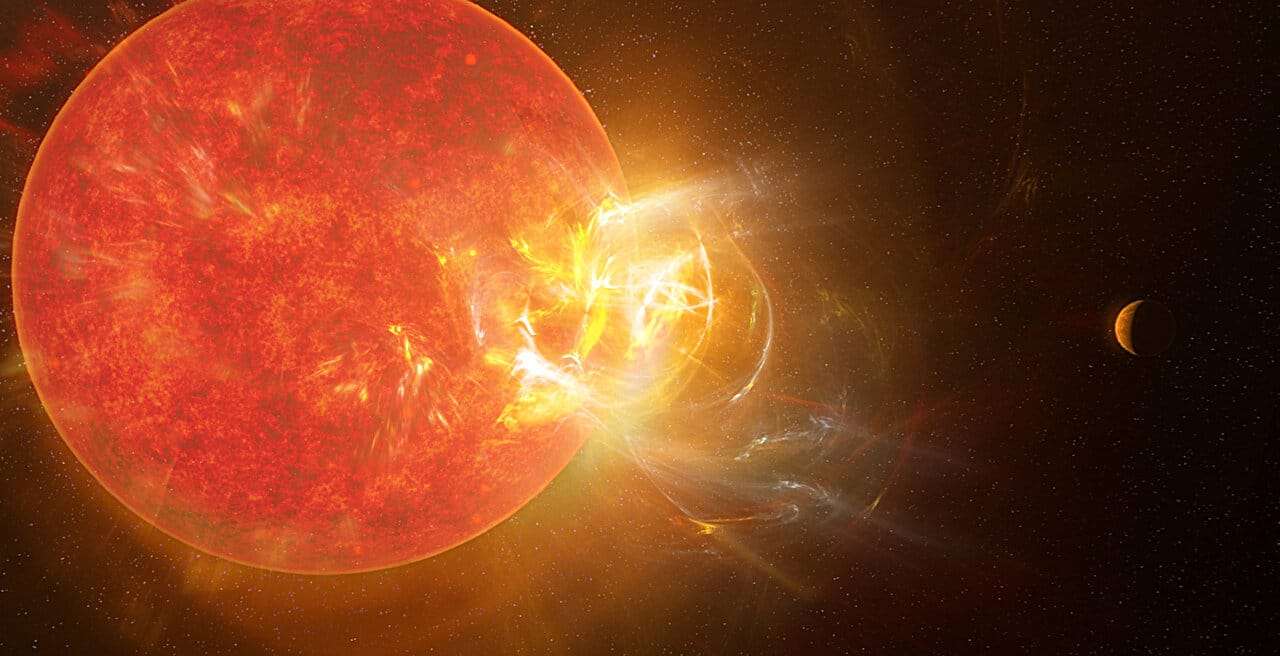
A nearby star, located just over four light-years from Earth, has made a remarkable discovery. Scientists employing the Atacama Large Millimeter/submillimeter Array (ALMA) have captured the strongest flare ever observed from Proxima Centauri, our closest stellar companion. This extraordinary event, detailed in a recent Astrophysical Journal publication, provides unprecedented insight into the intense bursts of energy emitted by small stars.
Though Proxima is classified as a red dwarf—significantly smaller and cooler than the Sun—this recent flare demonstrates a highly energetic and violent phenomenon, prompting new discussions about the potential for life on nearby planets and shedding light on the unpredictable nature of stellar dynamics.
A Volatile Neighbor in Our Stellar Vicinity
Sitting just 4.2 light-years from our solar system, Proxima Centauri has captivated astronomers for years, especially due to its rocky planet located within the star’s habitable zone. However, the presence of intense stellar activity poses significant challenges for such planets.

Recent data reveal that Proxima Centauri frequently releases intense, short-duration flares, discharging energies up to 10²⁷ ergs in seconds. These flares, detected at radio and millimeter wavelengths, possess enough power to dismantle planetary atmospheres, potentially eliminating the possibility of life on the planet’s surface.
“Our Sun’s activity doesn’t strip Earth’s atmosphere because of our protective magnetic field and dense atmosphere,” explained Meredith MacGregor, a co-author at Johns Hopkins University. “But with Proxima Centauri’s far stronger flares and its rocky planets in the habitable zone, we have to ask: how do these bursts impact their atmospheres?”
Invisible Bursts Lighting Up the Sky
Unlike traditional optical observations, ALMA enabled scientists to study Proxima Centauri in radio and millimeter wavelengths, unveiling energetic eruptions unnoticed by visible-light instruments. Gathering over 50 hours of observational data, researchers identified 463 flare events, spanning from minor flickers to powerful bursts that lasted between 3 and 16 seconds.
“Observing flares through ALMA highlights electromagnetic radiation across different wavelengths,” noted MacGregor. “Beyond that, radio flaring allows us to trace the energetic particles streaming from the star.”
The team determined that flares captured at millimeter wavelengths follow a distinct power-law pattern compared to optical flares, indicating that Proxima’s activity is even more pronounced than previously believed.
Challenging Our Understanding of Proxima’s Flares
An unexpected finding was the flare’s asymmetric pattern: the decline phase, where energy tapers off, lasts significantly longer than the initial explosion. This suggests that intricate magnetic interactions within the star govern these events.
Proxima Centauri is fully convective, meaning its interior experiences constant turbulent motion. This movement generates intense magnetic fields that become twisted and tangled until they snap, releasing huge flare events. This internal volatility makes Proxima far more active than our own Sun.
“Millimeter flares occur much more often than we detect in optical wavelengths, so focusing only on visible light means missing vital data,” MacGregor emphasized. “ALMA remains the only millimeter array capable of making these sensitive observations.”
Implications for the Habitability of Proxima b
Proxima b, an Earth-sized world orbiting inside its star’s habitable zone, is a leading candidate in the search for extraterrestrial life. However, the frequent and intense stellar flares raise concerns about its potential habitability.
Continuous exposure to these energetic bursts could erode the planet’s ozone layer, deplete water vapor, and expose the surface to dangerous radiation—unless Proxima b possesses a strong magnetic field and a thick atmosphere to shield itself.
While the findings do not entirely rule out the possibility of life, they significantly alter our understanding of the environment surrounding this nearby star, suggesting it may be far more hostile than once thought.
- Categories:
- Astronomy ,
- News








0 comments
Sign in to Comment