
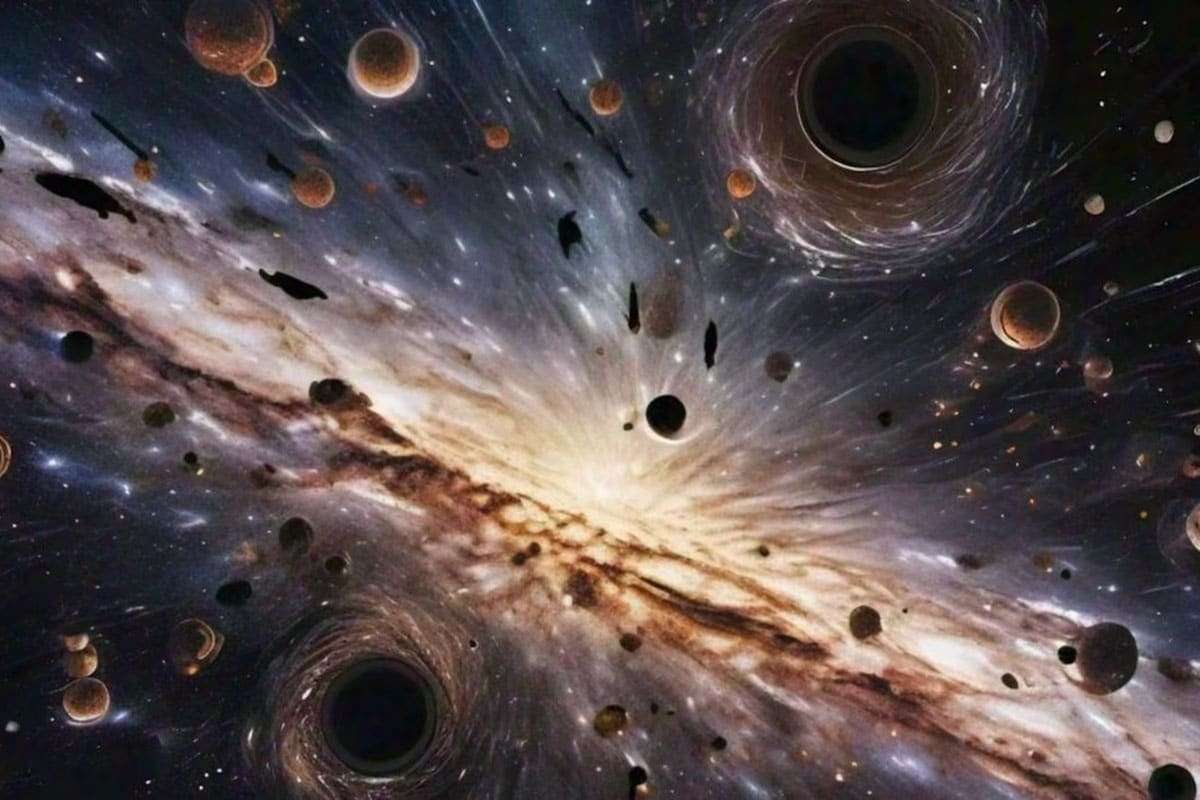
Central to this groundbreaking discovery is Palomar 5, an expansive stellar stream extending over 30,000 light-years. Positioned roughly 80,000 light-years from Earth, this intriguing formation has captivated astronomers around the globe. Unlike conventional globular clusters, Palomar 5 stands out with its extensive, winding trail of stars sweeping across more than 20 degrees of the night sky.
A research team led by astrophysicist Mark Gieles from the University of Barcelona has conducted an in-depth analysis of Palomar 5 with the aid of sophisticated N-body simulations. These simulations meticulously model the orbital paths and evolutionary behaviors of individual stars within the cluster, providing unprecedented insight into their cosmic trajectories. The outcomes have been truly remarkable.
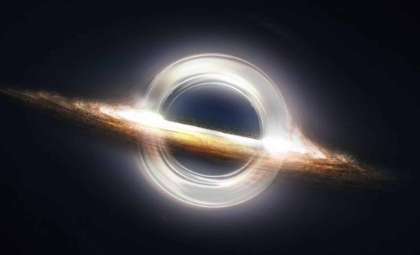
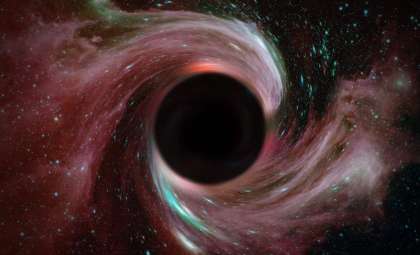
The investigation revealed that Palomar 5 conceals a surprising feature: a dense assembly of over 100 stellar-mass black holes. This finding challenges prior notions about the makeup of globular clusters and paves the way for new perspectives on stellar stream formation.

Black holes as key influencers in stellar stream development
Black holes embedded within Palomar 5 play a vital role in sculpting its distinct formation. Through gravitational interactions, these black holes act like cosmic accelerators, flinging stars outward from the cluster into the surrounding tidal stream. Interestingly, stars are more readily ejected than black holes, slowly transforming the cluster’s internal makeup.
Simulations indicate that black holes constitute more than 20 percent of Palomar 5’s overall mass—a figure triple the previous estimates based on its stellar population. Each black hole weighs about 20 times the mass of our Sun and likely formed from supernova explosions that occurred early in the cluster's history.
This discovery holds significant implications beyond Palomar 5, suggesting other globular clusters might undergo similar transitions, gradually dispersing into stellar streams. Such insights deepen our understanding of these ancient structures and their influence on the Milky Way’s evolution.
Palomar 5 as a cosmic key to stellar stream origins
Palomar 5’s distinct properties make it an essential reference for decoding the birth and transformation of stellar streams. According to Gieles, “Palomar 5 is the only case, making it a Rosetta Stone for understanding stream formation.” This rare astronomical feature provides a unique opportunity to scrutinize the forces shaping these stellar formations.
The team's projections show that in about a billion years, Palomar 5 will completely disintegrate. At this final stage, the cluster will be left with only black holes orbiting quietly around the galaxy’s center.
This discovery adds vital context to previous observations of black hole swarms within ancient Milky Way star clusters, hinting that such clusters could be important hunting grounds for black hole mergers and elusive intermediate-mass black holes.
Expanding the horizons of astronomical research
Uncovering this black hole population in Palomar 5 stimulates several exciting research directions, including:
- Exploring how black holes influence galactic structure formation
- Understanding the dynamics behind stellar stream evolution
- Searching for gravitational waves generated by black hole collisions
- Identifying candidate intermediate-mass black holes
As our grasp of these phenomena strengthens, so does our admiration for the intricate and awe-inspiring universe. The Palomar 5 findings underscore the remarkable capabilities of modern simulations and observations in unraveling cosmic mysteries.
FeaturePalomar 5Typical Globular ClusterConfigurationDiffuse and extendedCompact and sphericalTidal Stream PresenceDetectedNot observedBlack Hole Mass FractionOver 20% of cluster massAround 7% of cluster mass
As we delve deeper into the vastness of the Milky Way, discoveries like the black hole swarm within Palomar 5 inspire awe and curiosity. The intricate interplay of stars and black holes paints a stunning portrait of our galaxy, inviting us to continue exploring its boundless enigmas.
- Categories:
- Astronomy




0 comments
Sign in to Comment