

Scientists have revealed a stunning 520-million-year-old fossilized larva unearthed in China, providing groundbreaking evidence on the origins of arthropods.
This extraordinary find, showcasing exceptionally preserved internal systems, offers new perspectives on the evolutionary roots of insects, arachnids, and crustaceans.
Why This Discovery Matters
The specimen, dubbed Youti yuanshi, was excavated from the Yu’anshan Formation, a hotspot for exceptional fossil finds. Measuring no larger than a sesame seed, this larva belongs to a newly identified genus and species within Euarthropoda. What makes it truly rare is the outstanding preservation of its internal anatomy, including the brain, digestive glands, circulatory system, and nervous components.

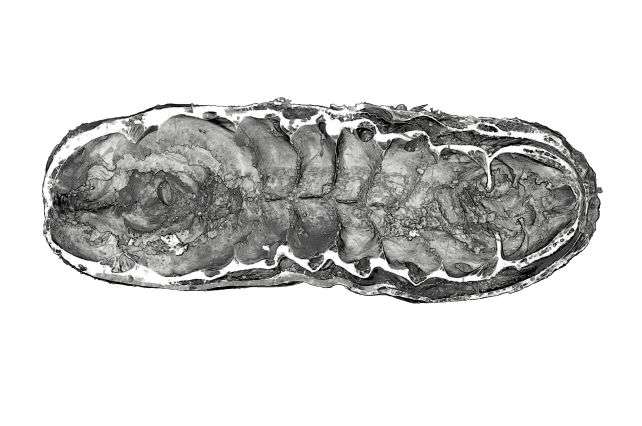
Dr. Martin Smith from Durham University, a key member of the research team, expressed his amazement: “Seeing the intricate structures preserved beneath its exoskeleton was breathtaking.” The fossil’s pristine condition grants scientists an unparalleled window into arthropod evolutionary development, revealing vital biological details usually lost through time. This specimen exemplifies the extraordinary conditions needed to conserve such fragile anatomy over half a billion years.
Revealing Hidden Structures with State-of-the-Art Imaging
By employing advanced technologies like synchrotron X-ray tomography at the UK’s Diamond Light Source, the team reconstructed detailed 3D visualizations of the larva’s interior. These scans exposed complex details of the brain regions, digestive tract, and nerve pathways connected to primitive legs and eyes. This discovery provides an unprecedented anatomical view into the complexity of early arthropods.
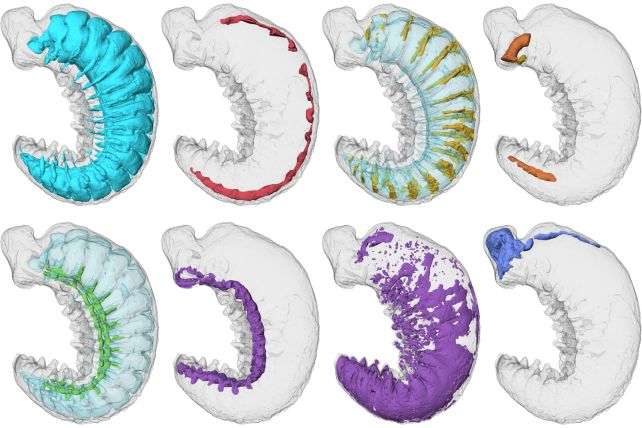
Dr. Katherine Dobson from the University of Strathclyde highlighted the exceptional fossilization, stating, “It’s always fascinating to explore internal features through 3D imaging, but this larva’s near-perfect natural preservation is truly remarkable.”
This high-resolution insight enables researchers to examine the fossil’s anatomy in life-like detail, broadening understanding of early arthropod physiology. Utilizing these modern imaging approaches marks a transformative advancement for paleontology, opening new avenues for fossil analysis.
New Perspectives on Arthropod Evolutionary History
The Y. yuanshi fossil offers critical evidence about the evolutionary innovations that shaped modern arthropods’ complex body designs. A standout feature is the preserved protocerebrum, an ancestral brain region that evolved into the distinct, segmented heads seen in today’s insects, spiders, and crustaceans. This fossil also traces the origins of vital appendages such as antennae, mouthparts, and eyes, which facilitated arthropods’ adaptation to diverse habitats.
This specimen additionally showcases early elements of the circulatory and digestive systems essential for arthropod diversification during the Cambrian Explosion. These anatomical revelations highlight the sophisticated biology that has enabled arthropods to become the most prolific animal group worldwide. Understanding these foundational systems helps illuminate evolutionary breakthroughs behind arthropods’ vast ecological success.
The Importance of Exceptional Fossil Preservation
This find not only bridges a significant gap in arthropod evolutionary knowledge but also exemplifies the rare fossilization conditions necessary for preserving delicate internal features. The Y. yuanshi specimen, curated at Yunnan University in China, stands as compelling evidence of nature’s capacity to protect biological intricacies across immense geological time.
Examining fossils like this allows scientists to reconstruct how major animal groups evolved, shedding light on the transition from simple to complex life forms. The opportunity to analyze such well-preserved remains offers vital insights critical for mapping the deep history of life on Earth.











0 comments
Sign in to Comment