
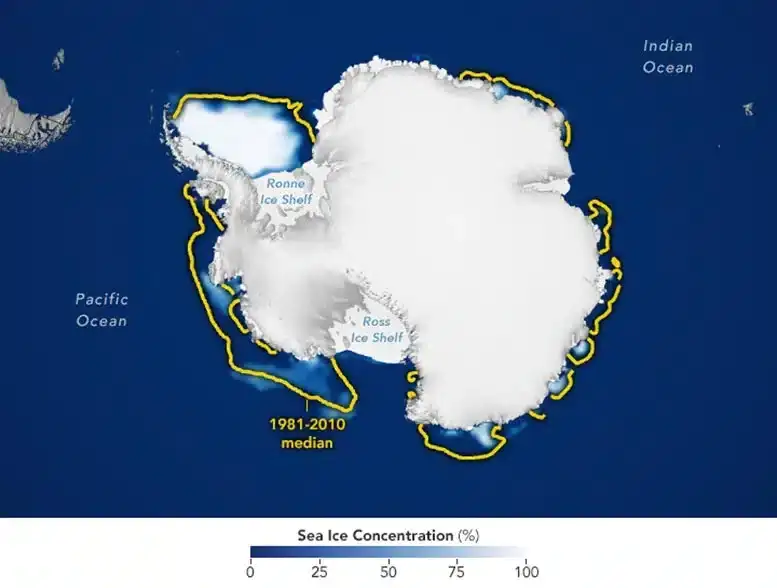
This year, Antarctica experienced a shocking drop in summer sea ice, with coverage dipping to nearly 30% below the long-term average—among the lowest levels ever documented. On March 1, 2025, satellite observations from NASA and the National Snow and Ice Data Center (NSIDC) reported sea ice extent at its second-lowest recorded value in almost 50 years. NASA’s Earth Science News Team detailed these findings in an article featured on the NASA Earth Observatory, raising urgent discussions about whether this event signals a lasting climate transformation or a temporary fluctuation.
Sea Ice Levels Hit Historic Lows
Examining satellite data dating back to 1978, scientists recorded a sea ice extent of merely 1.98 million square kilometers (764,000 square miles) in 2025—significantly lower than the 1981–2010 average of 2.84 million square kilometers. Imagery from satellites clearly shows the ice boundary retracting far beyond the historical median.
The research was conducted using the Defense Meteorological Satellite Program, which leverages microwave radiation signals to accurately distinguish ice from ocean surfaces, regardless of cloud interference. This technology provides a sharp and reliable view of the drastic retreat in Antarctic sea ice.

Polar Ice Losses in Both Hemispheres Intensify
Alongside the record-low summer ice in Antarctica, the Arctic saw winter ice coverage plummet to near-record lows. Collectively, the global sea ice coverage in February 2025 was reduced by more than 2.5 million square kilometers (roughly 1 million square miles) compared to pre-2010 averages—an area comparable in size to the eastern United States.
This concurrent ice loss at both poles raises concerns about potential synchronized destabilization of Earth's climate system.
Temporary Anomaly or Long-Term Climate Shift?
Experts urge caution when interpreting these findings. Despite the alarming ice decline, it's unclear whether this represents a lasting alteration in Antarctic climate or a transient phase.
“Whether the Southern Hemisphere has transitioned into a new state of persistently low ice levels, or if this is a temporary dip that will rebound, remains to be seen,” explained Walt Meier, ice researcher at the NSIDC.
However, with several years of low ice extent accumulating, the possibility of a critical tipping point draws increased attention from climate scientists.
Long-Term Records Reveal Growing Ice Loss Trend
This year’s dramatic ice reduction follows a broader pattern. Satellite microwave observations, including historical data from NASA’s Nimbus-7 satellite (1978–1985), consistently demonstrate accelerating polar ice decline. These datasets highlight thinner ice layers, shorter freezing intervals, and shifting boundaries, all symptomatic of global warming.
The same instruments that once detected subtle changes are now documenting profound ice losses, underscoring worries that Antarctica’s sea ice system may be approaching a point of no return.
Climate Challenges at Earth’s Southern Frontier
The 2025 sea ice collapse in Antarctica is compelling scientists to revisit assumptions regarding Southern Hemisphere climate stability. Although it remains uncertain if this event signals a new climate baseline or a temporary anomaly, the message from the ice is unmistakable.
The transformations occurring at our planet’s coldest reaches could have far-reaching effects on global climate patterns. In an already vulnerable world, Antarctica’s receding ice edges could become the next pivotal arena in climate change impacts.
- Categories:
- News










0 comments
Sign in to Comment