
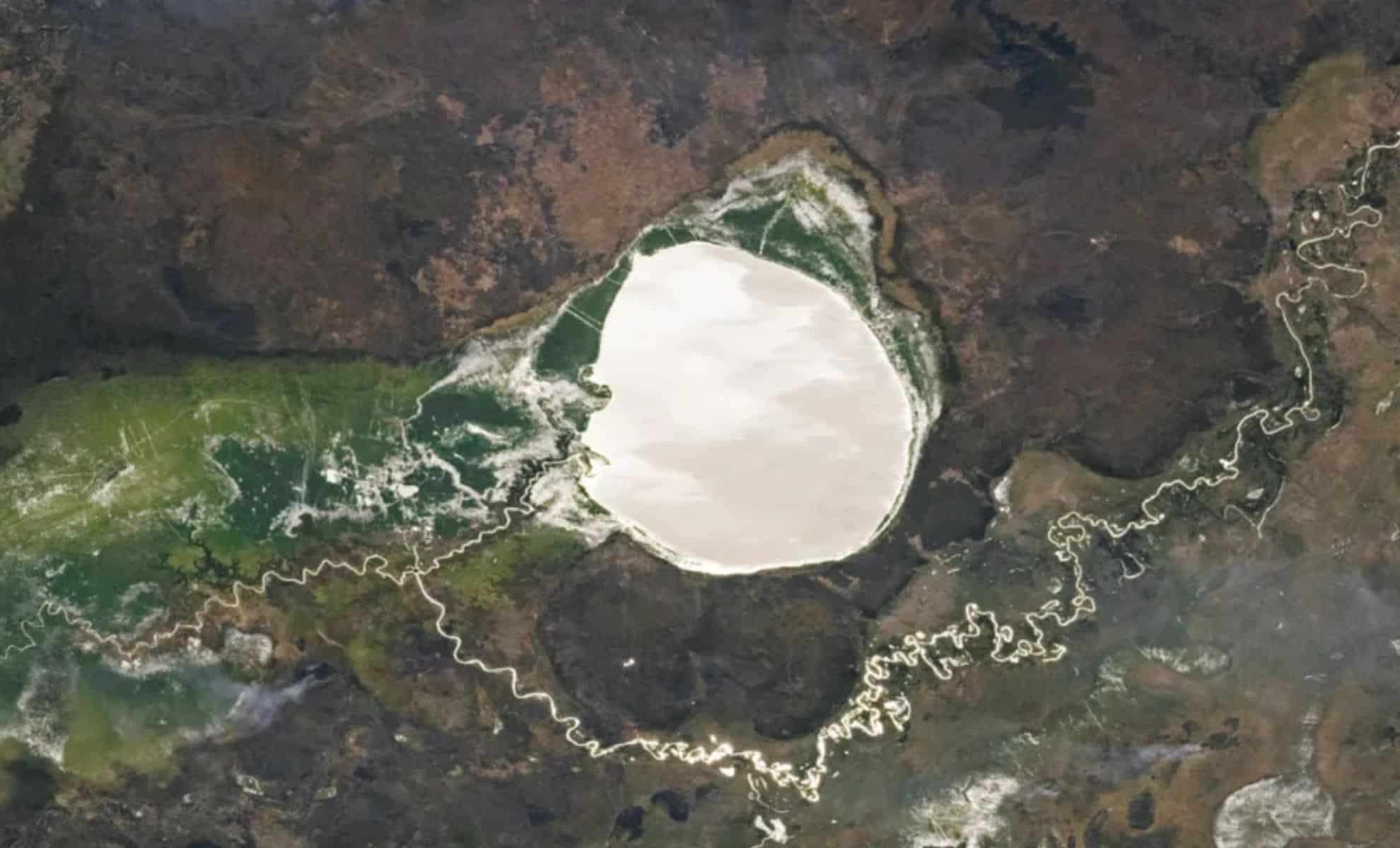
A stunning image taken by an astronaut aboard the International Space Station (ISS) in December 2024 showcases Lake Iro in Chad transformed into a giant, gleaming silver surface. This remarkable visual effect is caused by a rare natural occurrence called sunglint, where sunlight reflects off water at a precise angle, producing a mirror-like glare.
Understanding the Sunglint Effect
According to NASA’s Earth Observatory, this photo captured on December 21, 2024, highlights Lake Iro, situated roughly 60 miles (100 km) north of Chad’s border with the Central African Republic. The lake spans approximately 7 miles (12 kilometers) across and rests within the Sahel zone—a sprawling savannah that forms a natural border between the Sahara Desert and Central Africa’s rainforests. Enveloping the lake is the Bahr Salamat river, which stretches about 125 miles (200 km) and is famed for its highly twisting branches, especially where it curves around the lake's southern edge.
In the astronaut’s photograph, the intense sunlight bounces off both the lake’s surface and the winding river, casting a shiny, metallic glow. Interesting to note, some areas of the lake appear brighter due to sunlight reflecting off cloud cover overhead.

The breathtaking spectacle not only captivates but also offers scientific insight: sunglint only occurs under the perfect alignment of the sun, water surface, and viewer, making it primarily observable from space rather than from terrestrial vantage points.
Why Astronauts Excel at Capturing Sunglint
Crew members aboard the ISS hold a unique advantage in photographing sunglint phenomena because they can adjust their viewing angles relative to the reflective body of water. Unlike satellites fixed in orbit, astronauts can maneuver their perspective to achieve ideal sunlight reflection angles.
This flexibility has enabled the capture of several compelling sunglint images, including one over the Greek islands revealing uncommon ocean features, and another showcasing a volcanic lake in Russia accompanied by a large cloud formation.
Such views are exceptionally rare and provide a distinct window into Earth’s natural processes as seen from space, thanks to the ISS’s orbital position and astronaut adaptability.
Could Lake Iro Be the Remnant of a Meteor Impact?
There is a compelling hypothesis about Lake Iro’s formation suggesting it might be situated inside an ancient meteor impact crater. This idea took shape in the 1980s when geologists uncovered fragments of precambrian crystals in the surrounding rocks. A study conducted in 2024 further explored this possibility by examining the region’s geological structures.
Scientific analysis indicates that a massive extraterrestrial collision millions of years ago could have notably reshaped the landscape, including the highly sinuous course of the Bahr Salamat river, which some experts believe was altered by the impact’s force.
Moreover, Lake Iro shows a cyclical pattern of water levels, often fluctuating dramatically and sometimes drying out completely during severe droughts. This behavior is characteristic of other lakes formed in meteor craters.
Further Studies Essential to Confirm Origins
The idea that Lake Iro may be a meteor crater remains under scientific scrutiny. Researchers emphasize that in-depth geological surveys and ecosystem studies are needed to validate this theory. Discovering firm evidence for an impact would shed light on Earth’s geologic past and improve understanding of how meteoric events influence planetary surfaces.
- Categories:
- News








0 comments
Sign in to Comment