
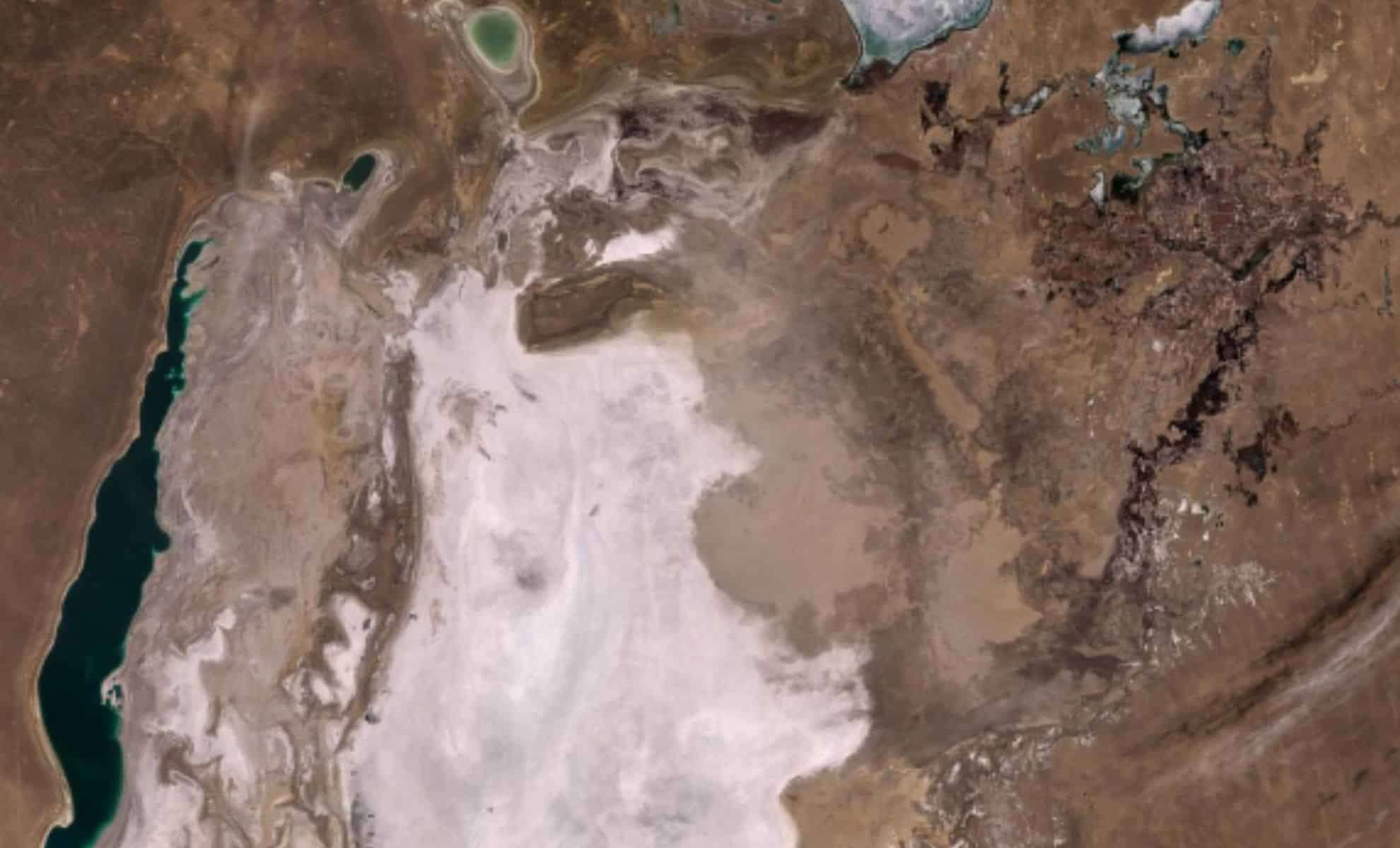
The European Space Agency (ESA) unveiled a powerful new satellite image on April 4, 2025, showcasing the accelerating depletion of the Aral Sea, which once ranked as the world’s fourth-largest lake. Taken by the Copernicus Sentinel-2 mission, the photo vividly captures how this extensive Central Asian water body has morphed into the expanding Aralkum Desert, highlighting decades of ecological damage caused by human diversion of natural water sources. This image is part of ESA’s Earth from Space collection, offering a current view of one of the most significant environmental catastrophes of recent times.
Once a Great Inland Lake Now a Desert
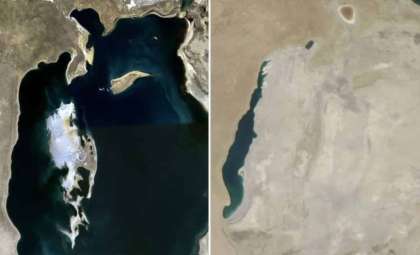
Situated along the border of Kazakhstan and Uzbekistan, the Aral Sea covered roughly 68,000 square kilometers in 1960—about twice the size of Belgium. Fed by the Syr Darya and Amu Darya rivers originating from distant mountain ranges, it supported a thriving ecosystem in an otherwise dry region.
From the 1960s onward, extensive Soviet irrigation initiatives redirected these rivers to irrigate cotton fields across Central Asia. This caused the sea to shrink drastically, and by the late 1980s, it split into two distinct sections: the Large Aral Sea and the Small Aral Sea.

ESA’s imagery from March 18, 2025, reveals the western portion of the Large Aral retreating further, while what was once the eastern section, still visible in 2006 satellite images, has nearly vanished. Instead, a pale, salty landscape has taken its place—the newly created Aralkum Desert, considered the Earth’s youngest desert.
Severe Environmental and Societal Impacts
The vanishing Aral Sea devastated local fisheries, once a vital part of the regional economy. Towns like Moynaq and Aralsk, previously bustling ports, are now dry and stranded many kilometers from the water’s edge.
The exposed lakebed produces highly saline dust, resulting in hazardous sandstorms. These winds spread salt, toxins, and chemical residues from agricultural runoff over hundreds of kilometers, severely affecting air quality and causing health problems, including respiratory and cardiovascular diseases, among local residents.
The disappearance of this large water body has also altered the regional climate, eliminating the lake's moderating influence. This leads to hotter summers, colder winters, and decreased rainfall, exacerbating challenges for agriculture and freshwater supplies.
Signs of Recovery in the Northern Section
Despite bleak conditions across much of the Aral basin, there are encouraging signs in the north. The Small Aral Sea, located in northern Kazakhstan and partially frozen in the satellite image, has benefitted from restoration measures. Chief among them is the Kok-Aral Dam, completed in 2005, which isolates the Small Aral from the southern remnants.
By halting downstream water loss, the dam has raised water levels in the northern basin by about 4 meters. This has lowered salinity and allowed fish populations to recover, supporting some revival of local fishing communities. The dam’s impact is visible in the image as two straight brown lines at the southeastern edge of the Small Aral.
Lessons on Human Influence and Satellite Monitoring
The desiccation of the Aral Sea stands as a stark example of the severe environmental damage caused by improper water management. It underscores the necessity for sustainable water use and regional planning.
High-resolution satellite data from missions like Copernicus Sentinel-2 play an invaluable role in tracking environmental shifts, informing policy decisions, and fostering global cooperation for ecological restoration.
The unfolding story of the Aral Sea’s disintegration is both a warning and a testament to how spaceborne observations can aid humanity in confronting and potentially reversing environmental crises on a planetary scale.
- Categories:
- News









0 comments
Sign in to Comment