
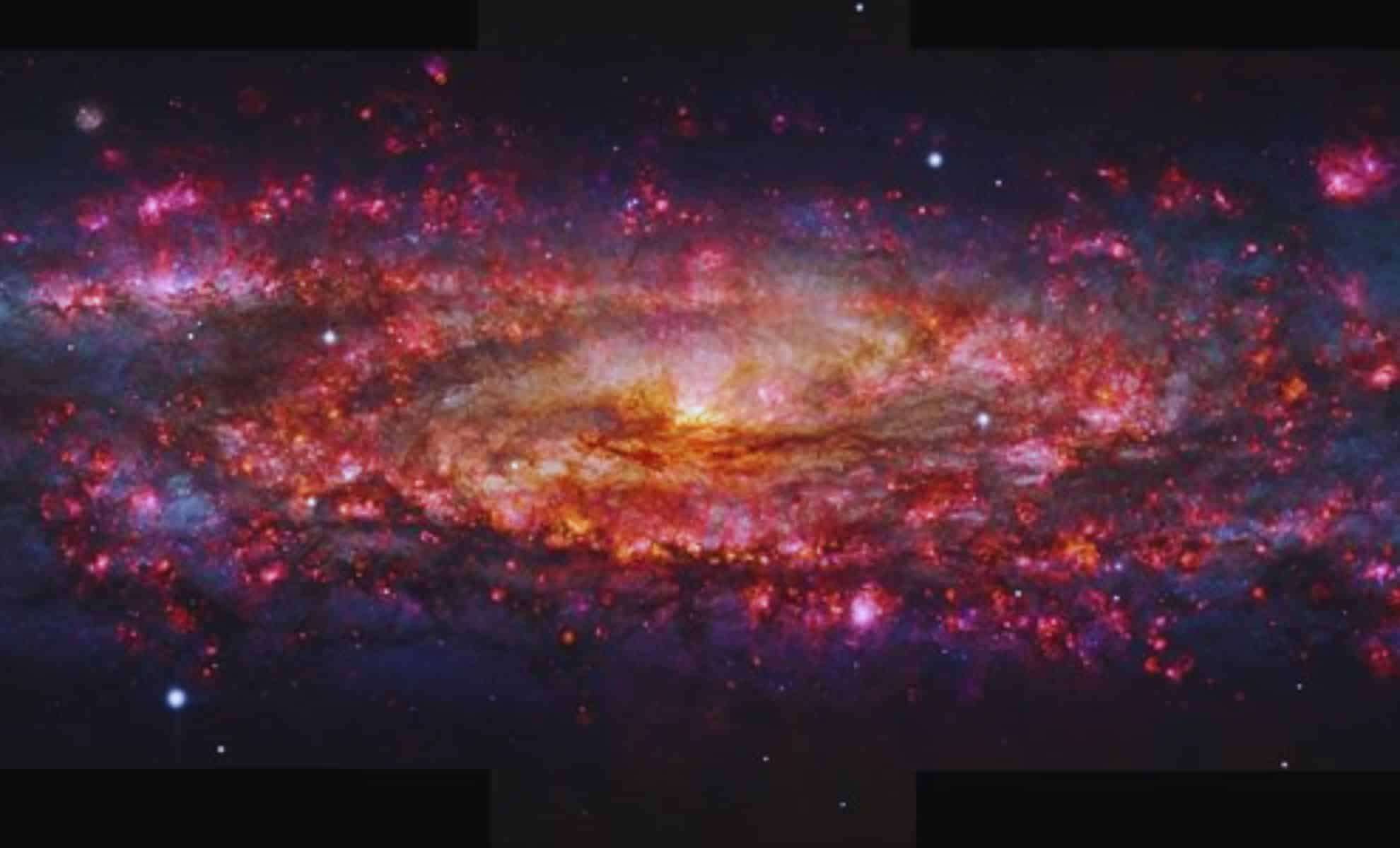
Researchers have unveiled an extraordinary image of the Sculptor Galaxy, showcasing an unprecedented spectrum featuring over one thousand unique hues. Published in Astronomy & Astrophysics, this vivid spectral map was produced using the MUSE instrument on the Very Large Telescope (VLT), managed by the European Southern Observatory (ESO). The image offers an incredible look into the structure of a galaxy located 11 million light-years from Earth.
This comprehensive portrait of the galaxy, also known as NGC 253, reveals subtle and previously unseen features, providing new insights into how detailed processes shape vast cosmic environments.
Unveiling Stellar Details Through Spectral Imaging
Unlike conventional astronomical photographs that capture just a few color bands, this new depiction of the Sculptor Galaxy incorporates thousands of spectral channels. Every color represents a specific light wavelength, uncovering complex information about the galaxy’s stars, gases, and cosmic dust—including their chemical makeup, movements, and life cycles.

The team, led by ESO scientist Enrico Congiu, conducted observations spanning over 50 hours, combining data from more than 100 separate exposures. The resulting image covers a vast region around 65,000 light-years across, encompassing much of the galaxy’s visible features.
“Galaxies are incredibly complex systems that we are still struggling to understand,” Congiu remarked. This method, using a thousand-color technique, allowed them to build a detailed atlas capturing both broad and minute aspects of NGC 253.
From Minute Events to Galactic Scale Effects
The Sculptor Galaxy represents an ideal focus for such detailed studies. As Congiu explained, “The Sculptor Galaxy strikes the perfect balance: close enough to resolve internal structures and examine components in detail, yet large enough to observe as an integrated system.”
This dual view combines scientific depth with striking visuals. By capturing the galaxy’s full spectral footprint, the research allows astronomers to analyze star formation zones, estimate stellar ages, and trace elemental distribution with extraordinary accuracy.
A notable discovery was identifying about 500 planetary nebulae—the glowing remnants of dying stars similar to our Sun. Co-author Fabian Scheuermann from Heidelberg University remarked on the significance: “Typically, in galaxies beyond our own, fewer than 100 such nebulae are detected.”
These nebulae not only signal stellar deaths but also serve as precise landmarks, confirming the galaxy’s distance from Earth. “Detecting planetary nebulae helps validate the galaxy’s distance — a key parameter underpinning all further studies,” said Adam Leroy, professor at The Ohio State University.
Constructing the Most Intricate Galactic Map
The detailed image was developed using MUSE (the Multi Unit Spectroscopic Explorer), a cutting-edge instrument aboard the VLT. MUSE simultaneously records images and spectral data at every observed point, enabling astronomers to create a data cube — a three-dimensional dataset combining spatial position, spectral details, and structural information.
Leveraging MUSE’s capabilities with the VLT’s observational strength, the group generated a tool facilitating both detailed examination of discrete star-forming pockets and overview studies of the entire galaxy.
“This makes the map an incredibly versatile asset,” said co-author Kathryn Kreckel from Heidelberg University. “We can focus on star formation at nearly individual stellar scales or step back to assess the galaxy in its entirety.”
The Potential of Future Research on the Sculptor Galaxy
This pioneering study is only the beginning of what can be unearthed from this rich dataset. Researchers plan to utilize the map for exploring gas flows, star birth processes, and the evolution of chemical elements across NGC 253.
“It remains puzzling how tiny processes can so profoundly affect a galaxy thousands of times its size,” Congiu reflected. Thanks to this thousand-color portrait, the Sculptor Galaxy ranks among the best-mapped galaxies beyond our Milky Way.
- Categories:
- News








0 comments
Sign in to Comment