

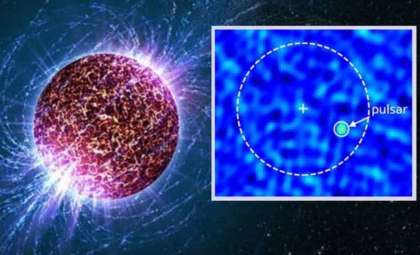
A team of astronomers has discovered a neutron star rotating at an astonishing speed of 716 times every second, making it one of the fastest rotators ever recorded.
By analyzing observations from NASA’s NICER X-ray instrument aboard the International Space Station, scientists have gained fresh insights into the extraordinary nature of neutron stars, some of the densest objects known in the cosmos.
The Rapidly Rotating Neutron Star 4U 1820-30
The neutron star identified, called 4U 1820-30, is located in the Sagittarius constellation near the Milky Way's center, approximately 26,000 light-years from Earth. This neutron star is part of a distinctive X-ray binary system paired with a white dwarf. The white dwarf circles the neutron star every 11 minutes, making this the tightest orbit measured in any binary star system. “Our research originally focused on thermonuclear explosions within this system, and we detected vibrant oscillations indicating the neutron star spins around its axis at a phenomenal 716 rotations per second,” said Dr. Gaurava K. Jaisawal of DTU Space, Technical University of Denmark, and lead author of the paper.

Neutron stars are the compact cores left behind after massive stars explode as supernovae. Despite their small size—roughly 12 kilometers across—they contain around 1.4 times the mass of the Sun, compressed into a volume akin to a city. The immense spin rate observed for 4U 1820-30 results from the neutron star pulling matter from its white dwarf companion. This accretion process transfers angular momentum, causing the neutron star to speed up. Such settings provide a natural laboratory for exploring the complex physics governing neutron stars.
NICER Monitoring and Violent X-Ray Bursts
From 2017 to 2021, researchers employed NICER (Neutron star Interior Composition Explorer), enhanced with star-tracking technology from DTU Space, to observe the neutron star with high precision. Throughout this period, the team documented 15 powerful thermonuclear X-ray bursts—violent explosions triggered when material funneled onto the neutron star’s surface ignites nuclear fusion.
“During these bursts, the neutron star shines thousands of times brighter than the Sun, releasing an immense burst of energy,” noted Associate Professor Jerome Chenevez from DTU Space. One burst displayed strong oscillations at 716 Hz, matching the star’s spin frequency. This discovery ties 4U 1820-30 with the fastest neutron star known, PSR J1748–2446ad.
Implications for Neutron Star Physics
The newly measured spin frequency of 716 Hz challenges existing limits on how fast neutron stars can rotate before centrifugal forces cause them to break apart. As these stars spin more rapidly, the competing forces of gravity and rotation approach an equilibrium that dictates their maximum rotation speed. Dr. Jaisawal emphasized, “If subsequent data verify this rate, 4U 1820-30 ranks among the universe’s swiftest rotating objects.”
Since neutron stars are incredibly dense—where a mere teaspoon of material weighs billions of tons on Earth—studying them offers vital clues about matter under extreme pressures and densities. These insights could deepen our understanding of nuclear physics and conditions in the most compact cosmic environments.
Looking Forward: Continuing the Exploration
The scientists stress the need for ongoing observations to confirm the neutron star’s spin rate and explore the factors controlling such rapid rotations. Future discoveries may reveal whether other neutron stars push beyond this spin threshold, shedding light on the dynamics of compact star systems and the lifecycle of exotic stellar remnants.
With advancements in space-based observatories and technology, researchers anticipate unveiling new facets of neutron star behavior and the fascinating phenomena they present, pushing the boundaries of astrophysics even further.
- Categories:
- Astronomy ,
- News






0 comments
Sign in to Comment