
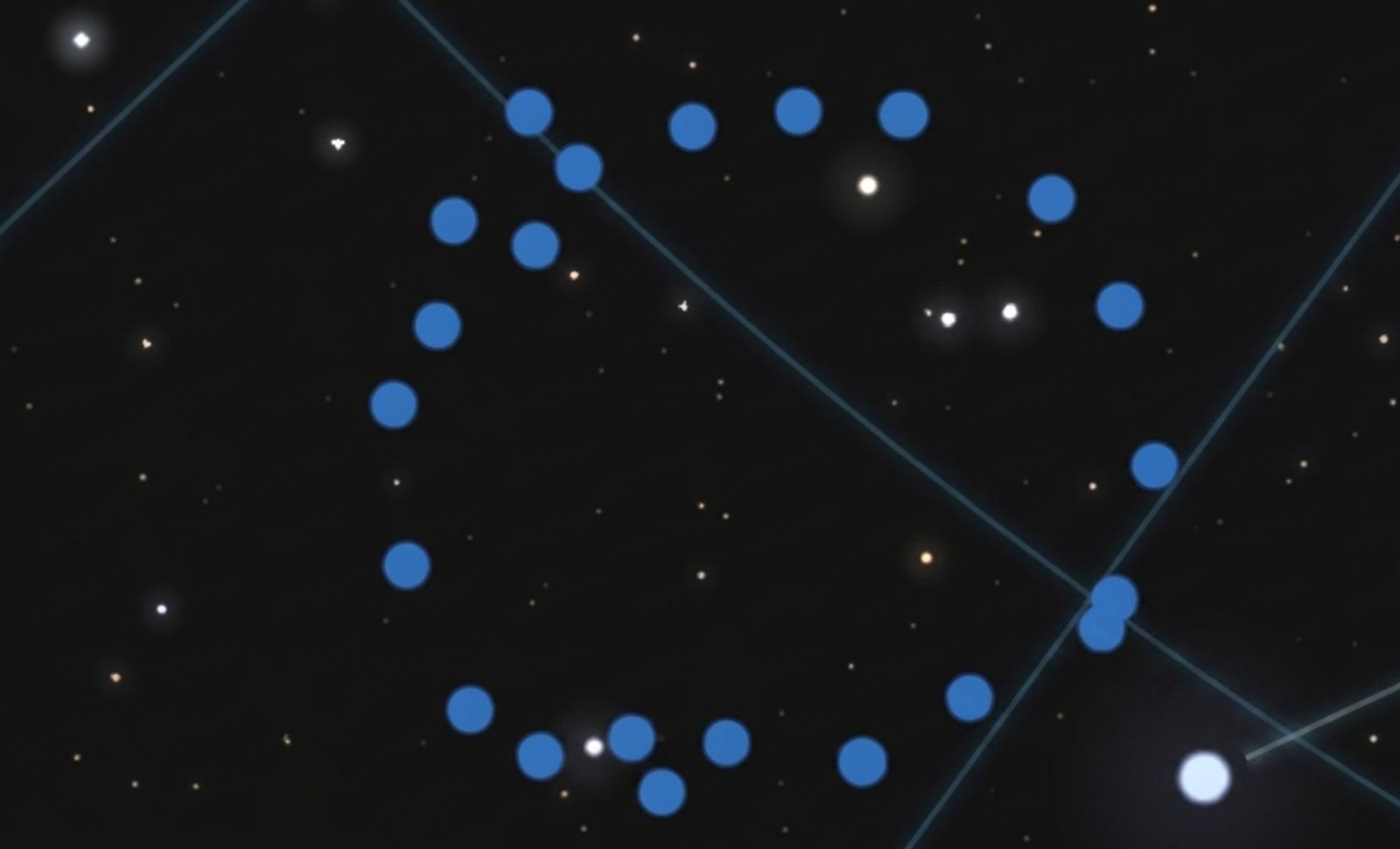
A newly uncovered colossal formation, dubbed the Big Ring, has been observed far out in space, spanning roughly 1.3 billion light-years. This massive structure calls into question prevailing theories about the universe’s large-scale matter distribution. The discovery, led by astronomer Alexia Lopez from the University of Central Lancashire, is located near another vast feature known as the Giant Arc. Both reside at similar distances, deepening the cosmic enigma.
The light reaching us from this area has traveled about 6.9 billion years, allowing a glimpse into a remote period of cosmic evolution. At such enormous scales, the cosmos is expected to display a fairly uniform appearance, without persistent, sharply defined structures spanning great expanses.
This assumption relates to the cosmological principle, which predicts that when viewed on very large scales, the universe should look roughly the same in all directions. Observations of structures exceeding these scales demand reconsideration of both data interpretation and theoretical frameworks.

A Structure Defying Simple Explanation
The Big Ring emerged from extensive galaxy mapping led by Alexia Lopez and was unveiled at the 243rd American Astronomical Society meeting, with findings published in the Journal of Cosmology and Astroparticle Physics.
Stretching around 1.3 billion light-years, this near-circular galaxy formation stands out in three-dimensional cosmic maps. Lopez remarked on the challenge it poses to existing theories in a statement from UCLan:
“Neither of these two ultra-large structures is easy to explain in our current understanding of the universe.”
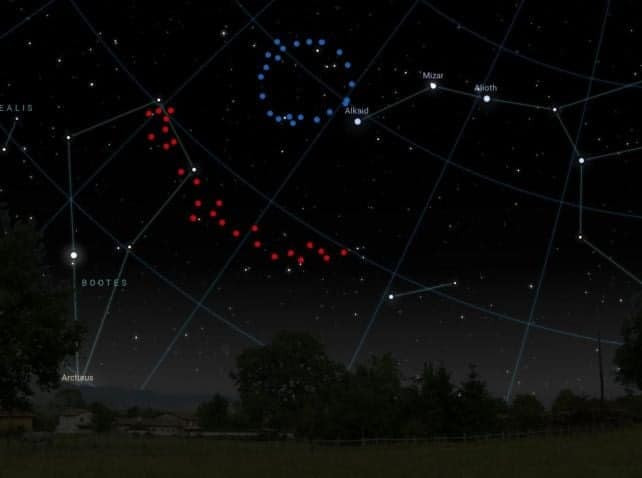
The Big Ring is accompanied by the similarly distant Giant Arc, first discovered by the same team in 2021. Their coexistence in the same sky region has drawn considerable interest from cosmologists probing the universe’s grandest formations.
Observations Versus Established Theory
Conventional cosmology forecasts that matter distribution should homogenize beyond certain vast distances. Theoretical calculations cited place the maximum size for coherent cosmic structures near 1.2 billion light-years.
At roughly 1.3 billion light-years, the Big Ring surpasses this limit, with the Giant Arc spanning even greater distances. Both challenge the expected disappearance of irregular patterns on the largest scales.
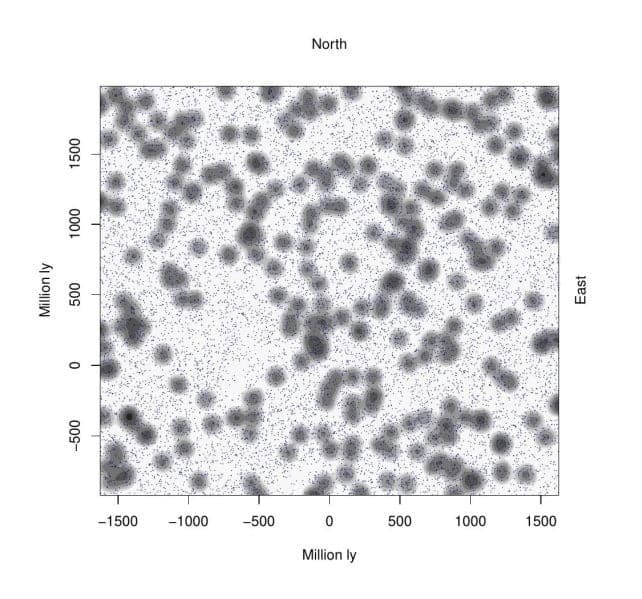
For context, the baryon acoustic oscillations (BAO) create spherical galaxy patterns from primordial pressure waves and are well understood within existing models. The Big Ring, however, does not align with the BAO signature. It may instead represent a more intricate shape, with its ring-like form potentially a projection of a three-dimensional structure.
Ongoing Theoretical Interpretations
Researchers have yet to reach a definitive explanation for the Big Ring. One possibility is it represents a statistical anomaly, a rare galaxy alignment visible only on immense scales.
More speculative theories invoke concepts such as cosmic strings, theoretical spacetime irregularities from the universe’s earliest moments that might affect matter distribution across vast distances.
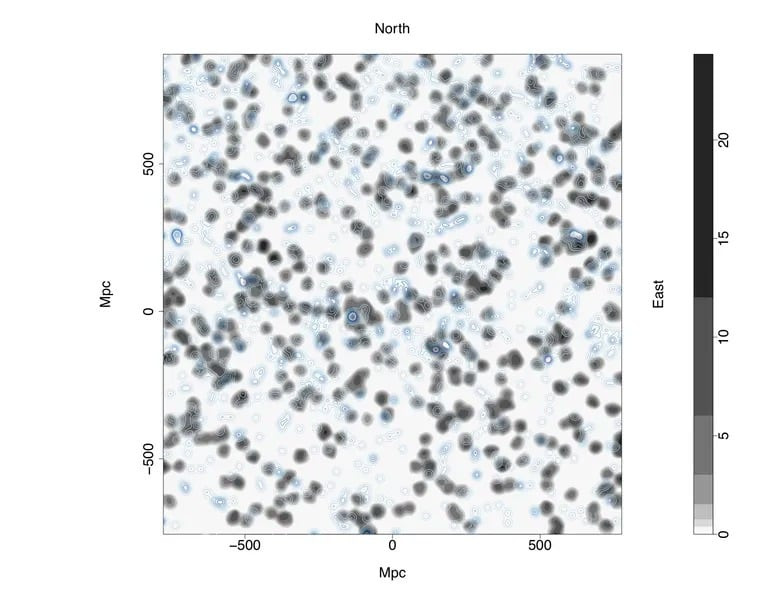
The concept of conformal cyclic cosmology, introduced by Roger Penrose, proposes a universe undergoing endless expansion and renewal cycles. This model could allow for large-scale ring-like structures under specific conditions, though it remains contentious and not widely embraced. Lopez and collaborators highlighted that such extensive formations were not anticipated by current cosmological limits.
“From current cosmological theories we didn’t think structures on this scale were possible. We could expect maybe one exceedingly large structure in all our observable universe. Yet, the Big Ring and the Giant Arc are two huge structures and are even cosmological neighbours, which is extraordinarily fascinating,” she said.
The occurrence of both the Big Ring and the Giant Arc in the same cosmic vicinity introduces an additional puzzle that standard cosmological frameworks struggle to explain.
- Categories:
- Astronomy







0 comments
Sign in to Comment