
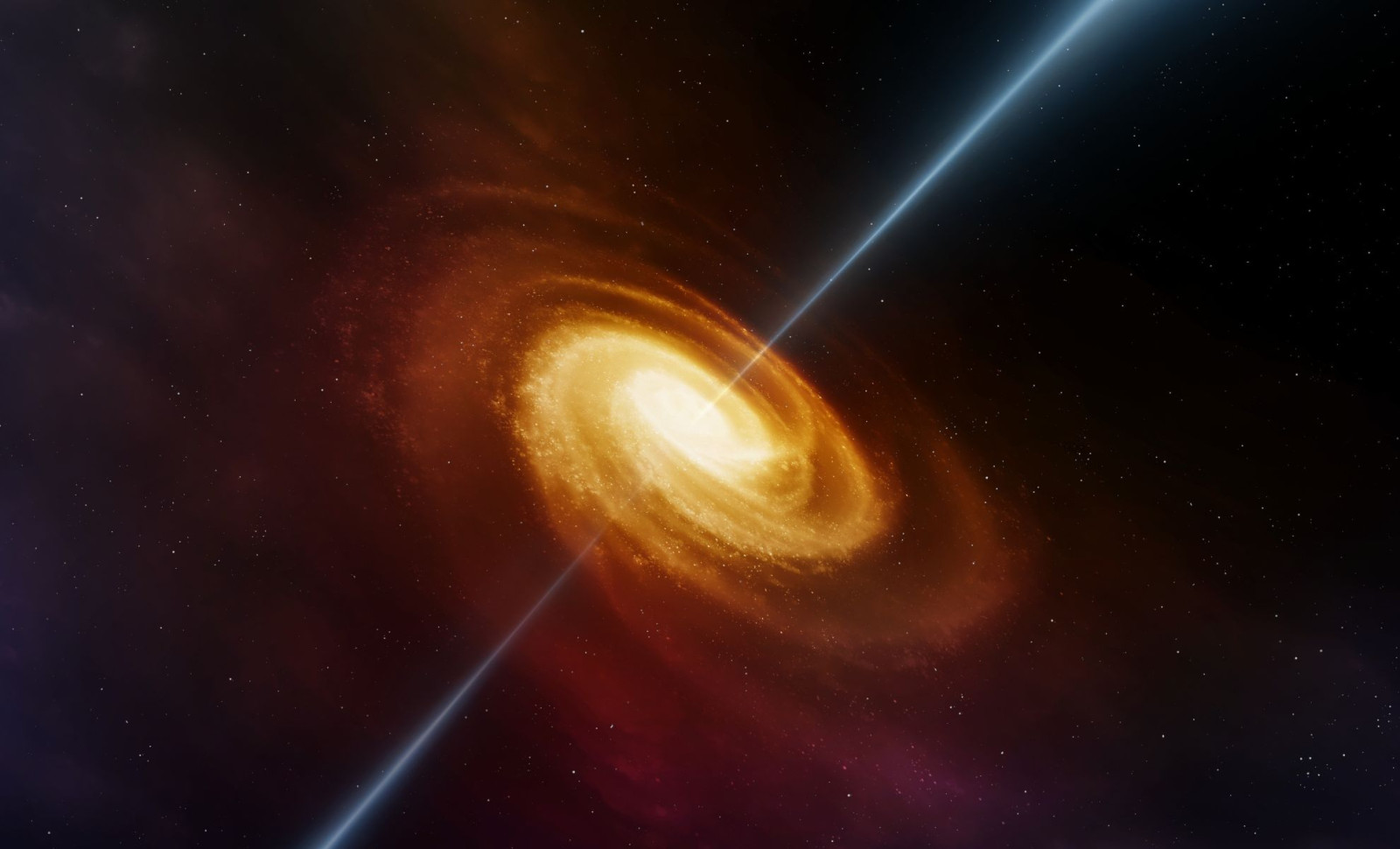
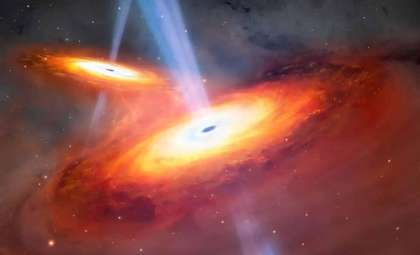
Astronomers have uncovered 77 previously undetected heavily dust-enshrouded quasars, bright cosmic beacons veiled behind thick layers of interstellar dust. These quasars are energized by supermassive black holes at the cores of galaxies.
The immense energy released as matter spirals into these black holes illuminates quasar activity across billions of light-years. Yet, the presence of dust can obscure much of this radiation, making such objects challenging to observe.
The objects uncovered belong to a class called heavily reddened quasars (HRQs), whose light is substantially reddened by dusty material along the line of sight. Investigating them helps astronomers explore black hole growth phases otherwise hidden from conventional observations.

Significant Increase in Known Dust-Obscured Quasars
Utilizing infrared data coupled with spectrophotometric measurements from NASA’s SPHEREx, a team led by Matthew Stepney from the Center of Excellence in Astrophysics and Related Technologies in Chile substantially expanded the catalog of heavily reddened quasars.
The study, accessible via arXiv, reports the identification of 77 new dust-obscured quasars, more than doubling the population previously documented.
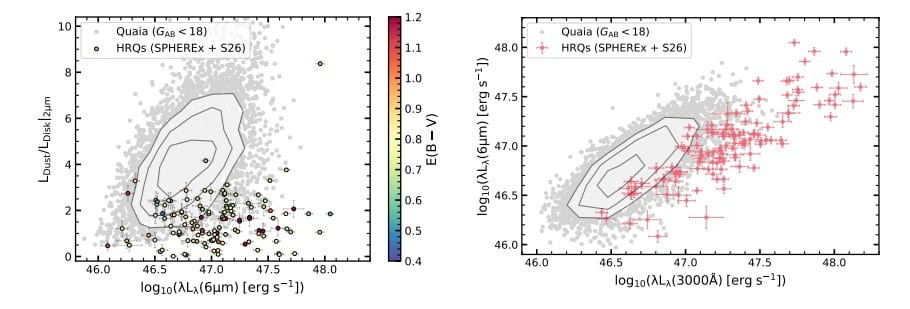
Their existence dates to when the universe was between 1.6 billion and 4.3 billion years old. Notably, seven HRQs were found at redshifts greater than 3, representing the earliest examples detected within the first 2.1 billion years of cosmic history. This finding extends the observational window into the early growth stages of supermassive black holes, illuminating populations that have been mostly hidden until now.
Revealing a Surprising Dust Pattern
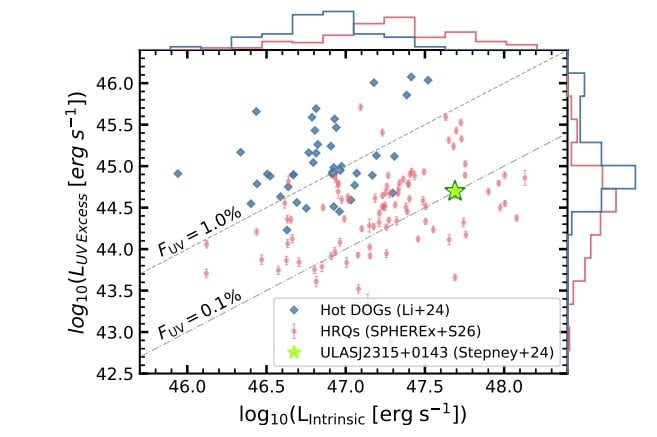
To understand these new objects’ traits, the team compared HRQs to two established quasar classes. One was Hot Dust-Obscured Galaxies (Hot DOGs), extreme examples of dust enshrouded systems emitting strong infrared radiation from heated dust.
The other comparison group was blue quasars, which are less shrouded and have dust that emits prominently in the infrared. The analysis indicated HRQs are intermediate in dust coverage between these two populations.
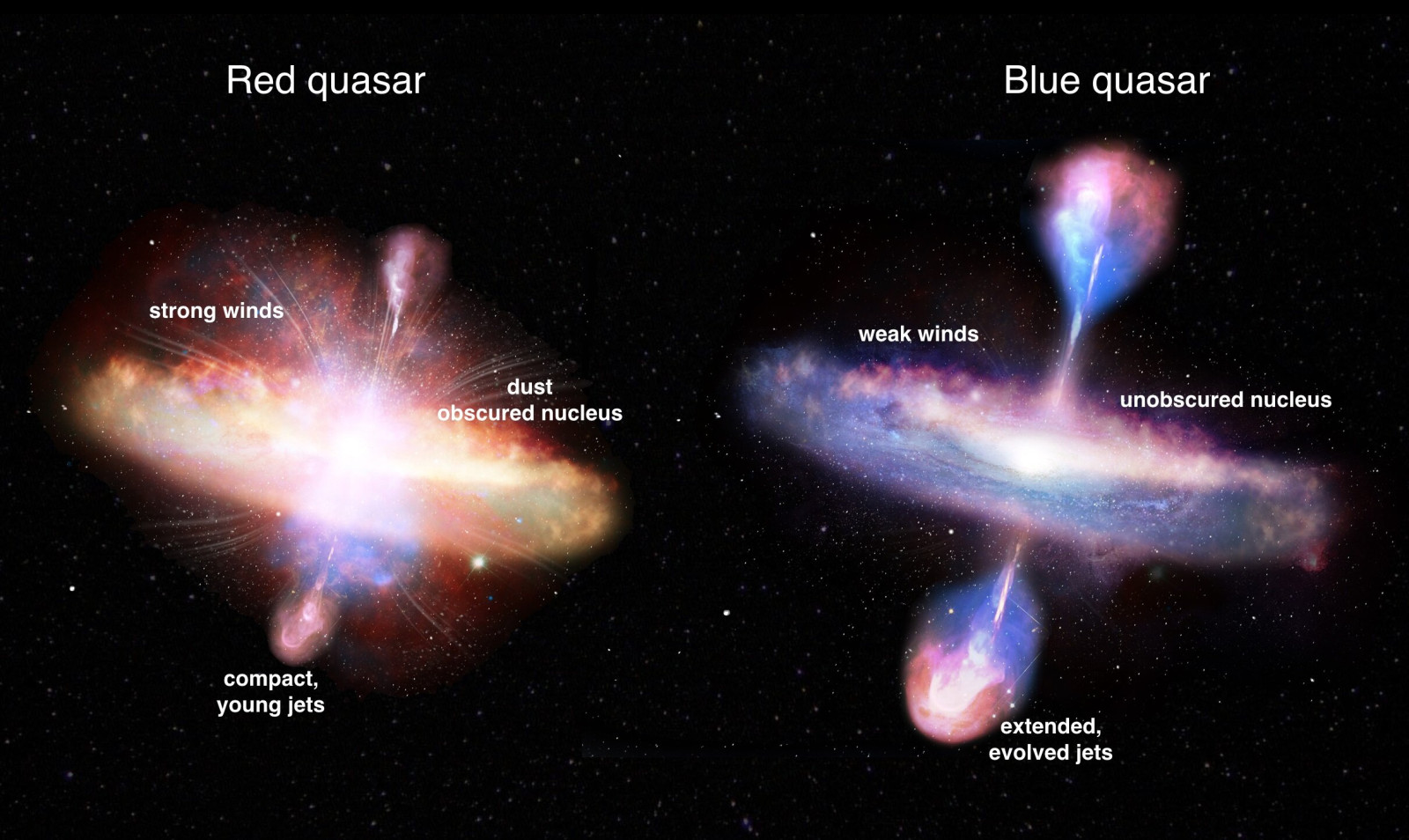
Unexpectedly, despite their heavy dust obscuration, HRQs exhibited less hot dust emission than blue quasars, which are thought to be less obscured. This contradicts assumptions based on their apparent brightness and dusty environments.
Insights Suggest Dust is Being Expelled
After adjusting for dust extinction effects, the researchers revealed that these newly found quasars rank among the most luminous ever recorded.
Simultaneously, they exhibited fainter infrared emissions than anticipated based on their dusty surroundings near the central black holes.
The team suggests this pattern reflects a fleeting but intense period called the "blow-out" phase, during which powerful black hole feedback forces gas and dust outward from the galactic nucleus.
“This combination of depleted torus-scale dust reservoirs and higher luminosities compared to Hot DOGs and blue quasars supports a scenario in which HRQs represent a blow-out phase when strong feedback has begun to clear the central regions of obscuring material,” as the authors explained.
Additionally, the team discovered that approximately 75% of these quasars displayed excess ultraviolet emission. They propose this could originate from quasar light escaping through gaps in the dust, though ongoing star formation within the host galaxies might also contribute significantly, possibly dominating in some cases.
- Categories:
- Space







0 comments
Sign in to Comment