
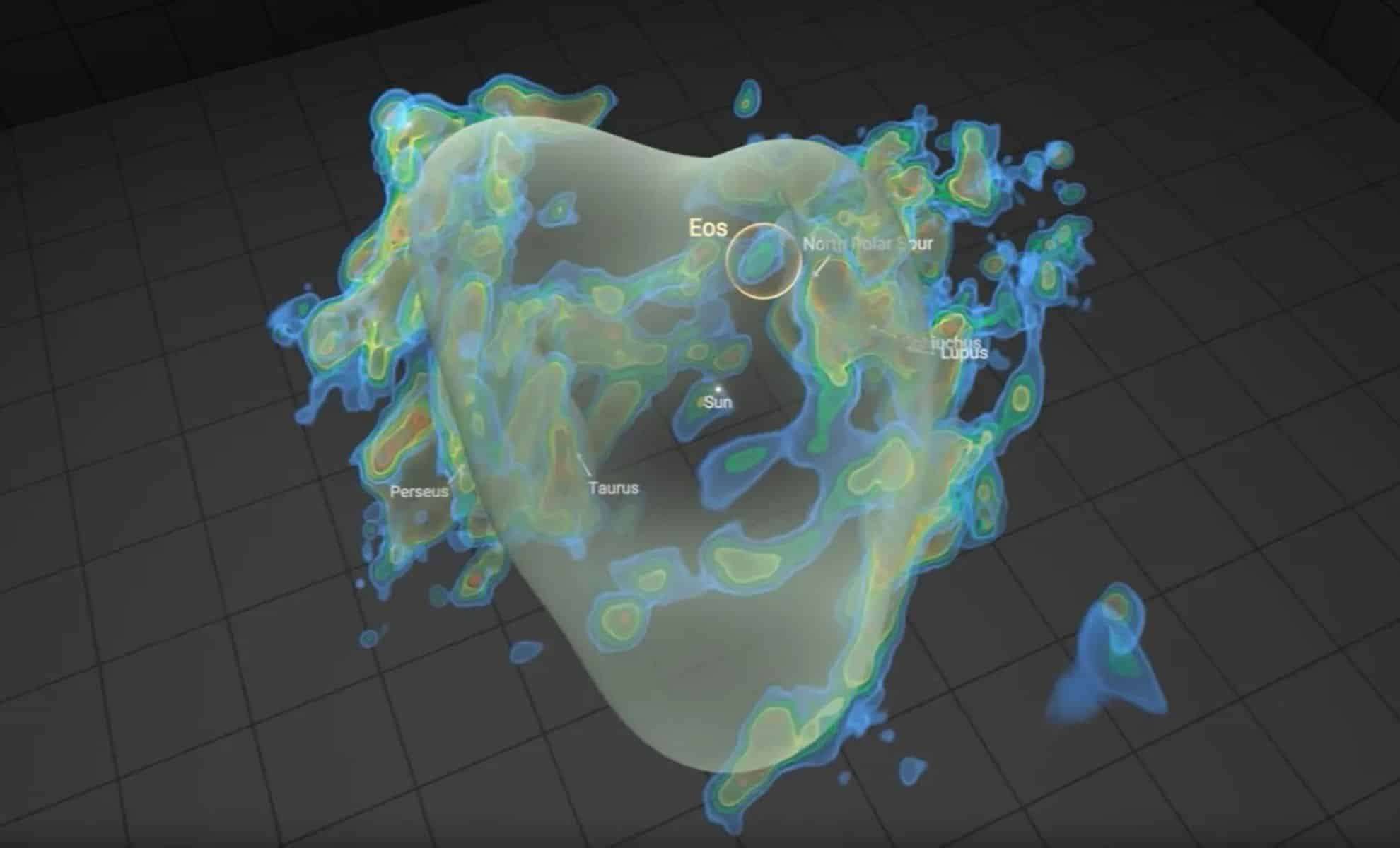
Astronomers have made a remarkable finding with the identification of an immense molecular cloud just 300 light-years away from our Solar System. Named Eos, this enormous formation ranks among the largest observable structures in the sky and is poised to provide fresh perspectives on how stars and planets come into existence. Spanning an area equivalent to about 40 full moons as seen from Earth, Eos primarily consists of molecular hydrogen, the essential component for star and planet creation. Its closeness offers astronomers an extraordinary chance to investigate the early phases of stellar development firsthand.
The details of this discovery are presented in a Nature journal article, marking a key advancement in understanding molecular clouds and their influence on star formation. Since Eos is one of the nearest star-forming regions to us, it opens a valuable window into the birth processes of stars and planetary bodies within our local galaxy.
Eos: An Exceptionally Large Nearby Molecular Cloud
Eos stands out for multiple reasons, chiefly its sheer size and its unusually close proximity to the Solar System, making it an exceptional target for detailed study. Occupying a region approximately 40 times wider than the diameter of the full moon, the cloud resides in the interstellar medium, the vast expanse of gas and dust separating stars.

Shaped somewhat like a croissant, Eos is predominantly made up of molecular hydrogen—the vital ingredient for star and planetary formation. Detecting molecular hydrogen is notoriously challenging; historically, scientists have relied on indirect signals from radio or infrared wavelengths for such observations. However, Eos was discovered due to its luminescence in the far-ultraviolet spectrum, highlighting a novel means of detection.
The cloud’s remarkable size and composition provide astronomers with an opportunity to explore the environmental factors essential for new stars and solar systems to emerge, offering insights into the early stages of stellar evolution.
Unlocking Secrets of Star Birth
While Eos is among the nearest molecular clouds to our Solar System, it also ranks as one of the largest and most dynamically active. This proximity allows for comprehensive studies of molecular hydrogen with unprecedented precision, which may reveal critical information about how stars ignite and planets develop from surrounding material.
Highlighting the significance of the find, Blakseley Burkhart, an associate professor at Rutgers University, remarked, “This cloud is literally glowing in the dark,” emphasizing the unique detection method of Eos. Observing molecular hydrogen via far-ultraviolet emissions could transform researchers’ grasp of molecular clouds and their vital role in the cosmic cycle.
A Timeline Linking Hydrogen to the Big Bang
The identification of Eos not only deepens our understanding of molecular clouds today but also connects us to the universe’s distant past. The hydrogen molecules composing this cloud have existed since the Big Bang, traversing the cosmos before congregating in our sector of the galaxy.
This ancient hydrogen offers a compelling link between the early universe and the Milky Way’s current molecular clouds. It demonstrates that the fundamental elements responsible for forming stars and life have been journeying through space for billions of years, eventually gathering to spark new cosmic beginnings.
Broad Implications for Cosmic Research
The relevance of Eos extends past its direct role in star formation, affecting broader astronomical investigations and enhancing our comprehension of the cosmos. Insights from studying this molecular cloud could help scientists better understand the composition and dynamics of gas clouds in distant galaxies and the interactions occurring between them.
Alongside Eos, the powerful James Webb Space Telescope (JWST) continues to examine molecular hydrogen in remote galaxies beyond the Milky Way, further expanding our knowledge of this fundamental cosmic ingredient. This growing perspective is critical for piecing together the universe’s structure, from its origins to the present day.
- Categories:
- News



0 comments
Sign in to Comment