
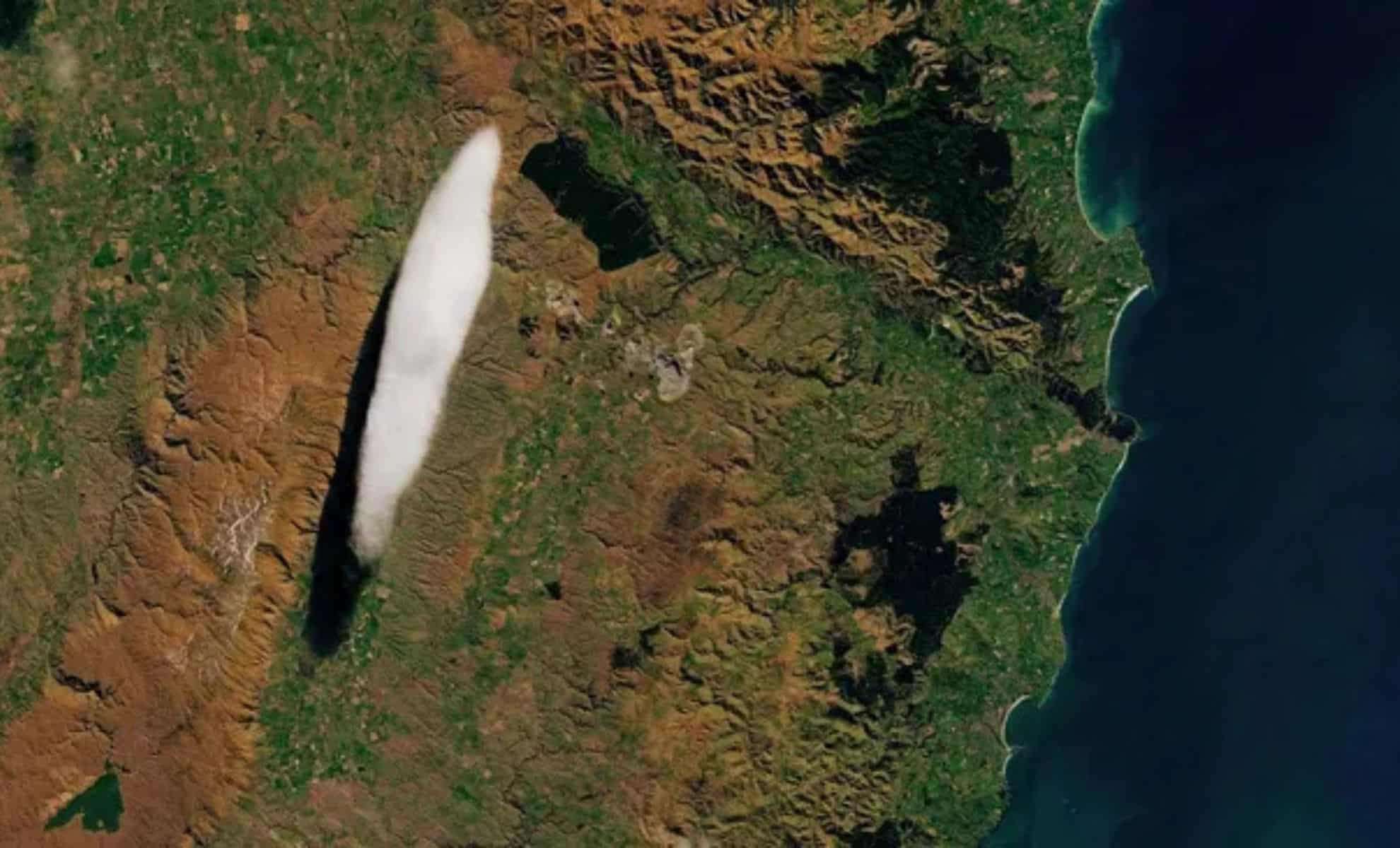
NASA’s satellite recently captured a remarkable image of the Taieri Pet, a distinctive lenticular cloud frequently observed above the Strath-Taieri area in New Zealand’s South Island.
Known locally as the “pet cloud,” this atmospheric formation appears stationary atop the Rock and Pillar Range, featuring a smooth, multi-layered structure reminiscent of a classic flying saucer.
The formation’s unusual shape and static nature result from the interaction between strong winds and the mountainous terrain, making it a spectacular and consistent sight in the New Zealand sky, as well as an important atmospheric indicator.

The Formation Process of the Taieri Pet Cloud
Classified as an altocumulus standing lenticular cloud (ASLC), the Taieri Pet forms when stable, moist air flows over mountain ranges, generating large atmospheric waves. As these waves reach their peaks and cool, water vapor condenses, creating cloud layers that conform to the wave shapes. What sets the Taieri Pet apart is its apparent immobility. Though winds constantly move through it, the cloud remains largely fixed in place, giving it an almost otherworldly presence above the mountains.
John Law, a meteorologist from New Zealand’s MetService, describes the process: “as the cloud forms on the crest of this wave, it remains almost stationary in the sky and is shaped by the strong winds blowing through it.” The stable standing wave over the Rock and Pillar Range causes this lenticular cloud to have sharply defined boundaries that echo the wave’s form. These clouds are somewhat rare, requiring specific wind and moisture conditions, and their side profiles often resemble stacked plates, which have historically led to UFO speculations.
Taieri Pet as a Meteorological Signal
Beyond its striking appearance, the Taieri Pet plays a vital role in weather observation. Lenticular clouds commonly indicate vigorous high-altitude wind patterns and can signal turbulence in the upper atmosphere. Although these clouds are not rain predictors, they often precede changes in weather and heightened winds, serving as important warnings for aviators regarding possible turbulence. According to NASA, such formations frequently emerge before atmospheric shifts, offering valuable data on regional weather dynamics.
The consistent formation of the Taieri Pet owes to the unique topography and typical wind flows across the Strath-Taieri region. Its regular appearance has entrenched it deeply in local culture, where it is affectionately regarded as a “pet” of the skies, inspiring myths and becoming a regional emblem, much like other beloved natural features.
Capturing the Taieri Pet through Satellite Technology
Recently, NASA’s Landsat 8 satellite photographed the Taieri Pet, showcasing the satellite’s ability to monitor Earth’s surface and atmosphere in fine detail. Landsat 8’s imagery reveals the cloud’s crisp, layered formation from an overhead perspective, providing researchers with insights into how atmospheric waves interact with landforms. This perspective highlights the influence of geological features like the Rock and Pillar Range on atmospheric movements.
NASA’s data aids the study of transient weather phenomena, enhancing our grasp of how localized geography affects climate patterns. The striking layers of the Taieri Pet, visible even from space, exemplify the intricate connections between topography and atmospheric dynamics, offering both scientists and locals a deeper appreciation of Earth's complex weather systems. Viewing such formations via satellite technology advances the monitoring of how landscapes shape atmospheric processes.
An Emblem of Atmospheric Intrigue
For both residents and weather experts, the Taieri Pet transcends a mere cloud—it embodies the subtle atmospheric forces sculpted by the Earth’s surface. Lenticular clouds not only enchant with their distinctive shapes but also act as indicators of strong airflows and turbulence in elevated air layers. The persistence of the Taieri Pet has made it a treasured natural icon, symbolizing the persistent influence of mountains on cloud development.
NASA’s imagery celebrates the beauty and enigma of this cloud, demonstrating how modern satellite technology enables the observation of natural phenomena that might otherwise be overlooked. Serving as a symbol of the dynamic relationship between Earth's terrain and atmospheric forces, the Taieri Pet represents how environmental elements shape climatic and weather events. To the people of Strath-Taieri and atmospheric scientists worldwide, this cloud remains a captivating manifestation of our planet’s meteorological wonders.






0 comments
Sign in to Comment