
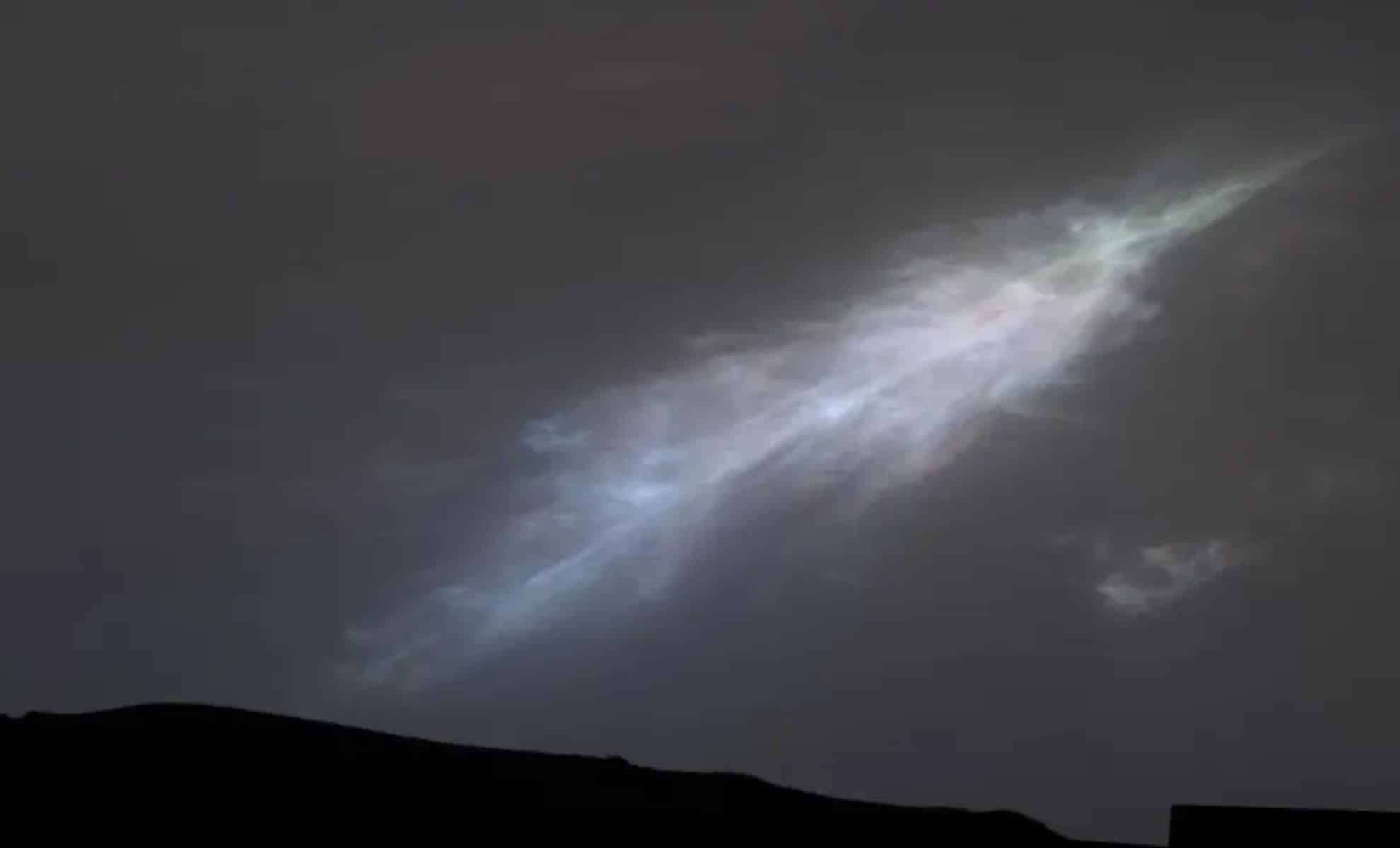
NASA’s Curiosity rover has unveiled stunning visuals of iridescent clouds gracefully moving across the Martian atmosphere, showcasing a rare and captivating planetary phenomenon. Formed from frozen carbon dioxide ice, these clouds shimmer with striking colors including reds, greens, and pearly whites, resembling Earth's shimmering mother-of-pearl clouds. Captured during Martian twilight, the images highlight the intricate dance between sunlight and ice crystals in Mars’ thin atmosphere, providing valuable insights into the planet's atmospheric dynamics.
On January 17, 2025, Curiosity’s Mastcam recorded these breathtaking views of noctilucent clouds, or “night shining” clouds, which form at high elevations and remain visible after sunset. This marks the fourth Martian year where Curiosity has witnessed these clouds, confirming a pattern that certain seasonal atmospheric conditions consistently favor their appearance.
Spectacular Light Phenomena High Above the Red Planet
Appearing at altitudes of 37 to 50 miles (60 to 80 kilometers), these clouds differ from the typical water-ice clouds that drift lower in Mars’ atmosphere. Instead, their makeup of frozen carbon dioxide, or dry ice, forms under extreme climatic conditions specific to Mars. Some clouds appear as dense white streaks descending before dispersing near 31 miles (50 kilometers), thanks to warming air layers.

Data from Curiosity has established that these iridescent clouds follow a reliable seasonal cycle, enabling researchers to anticipate their return. Mark Lemmon, a lead researcher at the Space Science Institute in Colorado, shared thoughts on this phenomenon:
“I’ll always remember the first time I saw those iridescent clouds and was sure at first it was some color artifact,” Lemmon said. “Now it’s become so predictable that we can plan our shots in advance; the clouds show up at exactly the same time of year.”
The consistent appearance of these clouds hints at the influence of Mars’ intricate atmospheric cycles, presenting an opportunity to deepen our understanding of seasonal atmospheric changes and climate development on the planet.
Exploring Martian Cloud Phenomena
Mars’ clouds have intrigued scientists for decades, forming under conditions starkly different from those on Earth. With a thin atmosphere that is roughly 100 times less dense than Earth’s, the Red Planet experiences distinct weather patterns, including global dust storms and atmospheric gravity waves unpredictable in nature.
Recently, the European Space Agency’s Mars Express orbiter assembled the most comprehensive cloud atlas of Mars yet recorded, exposing an array of cloud structures markedly different from Earth’s. Daniela Tirsch, a planetary geologist at the German Aerospace Center, emphasized the surprising variability of these formations:
“Clouds on Mars are just as diverse and fascinating as those we see in our skies on Earth,” she said.
Curiosity’s new imagery enriches this dataset by revealing how the Martian atmosphere interacts with local geography.
Unraveling the Puzzle of Selective Cloud Formation
Although Curiosity and other missions have recorded these iridescent clouds, scientists remain puzzled as to why they form only in certain regions. For example, the Perseverance rover, which landed in Jezero Crater in 2021, has yet to observe such twilight clouds, despite being positioned in Mars’ northern hemisphere. Curiosity itself only detected them starting in 2019, even though it has been stationed in Gale Crater since 2012.
This uneven distribution raises important questions about the precise forces behind their emergence. One hypothesis involves atmospheric gravity waves, which may induce localized cooling that facilitates carbon dioxide ice formation. However, as Lemmon points out, definitive explanations remain elusive:
“Carbon dioxide was not expected to be condensing into ice here, so something is cooling it to the point that it could happen,” he said.
“But,” he added, “Martian gravity waves are not fully understood and we’re not entirely sure what is causing twilight clouds to form in one place but not another.”
Each new capture adds another piece to the complex climate puzzle of Mars, helping refine models of extraterrestrial weather and better understand atmospheric behavior on other worlds.
The Significance of Iridescent Clouds for Mars Exploration
Beyond their aesthetic appeal, these shimmering clouds act as crucial indicators of Mars’ atmospheric makeup, seasonal cycles, and long-term climate trends. Insights from their study could shed light on historical planetary conditions, such as when Mars possessed a denser atmosphere and surface water.
Understanding these cloud formations also carries practical benefits for upcoming Mars missions. Accurate knowledge of Martian weather patterns will be vital for the success of human expeditions, influencing safe landing procedures, navigation, and habitat safety as NASA and other agencies prepare for interplanetary exploration.
Continuing its remarkable decade-long journey, Curiosity remains a cornerstone of Martian research, persistently unveiling new aspects of the planet’s mysteries. As the rover traverses Gale Crater, the scientific community eagerly anticipates further awe-inspiring discoveries from the Martian skies.
- Categories:
- News






0 comments
Sign in to Comment