
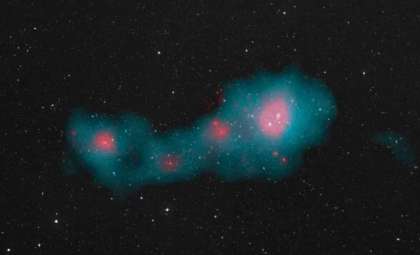
Within the expansive halo of the Milky Way, scientists have identified a subtle and mysterious stellar stream that could transform current models of galactic development. Named C-19, this newly recognized stream of stars extends widely across the celestial sphere, carrying an ancient cosmic narrative. The recent study shared on arXiv unveils this stream as a relic of a forgotten galaxy, offering fresh insights into the Milky Way’s formative epochs and the elusive dark matter influencing its growth.
Unveiling C-19: A Window into the Galaxy's Past
For decades, researchers have hypothesized about the remnants of early galaxies and star clusters dotted throughout the Milky Way’s distant outskirts. These remnants form stellar streams when small galaxies or globular clusters are gravitationally disrupted by the Milky Way, dispersing stars along their orbits. The identification of C-19 represents a significant breakthrough, marking the presence of an incredibly metal-poor stellar stream located 58,700 light-years from Earth.
What sets C-19 apart is its remarkably low metal content, with metallicity values falling below -3.0 dex. This distinguishes it as the most metal-deficient star population ever found, allowing astronomers to probe the earliest phases of galaxy assembly and the effects of dark matter with unprecedented clarity. Stretching over 650 light-years and covering an arc exceeding 100 degrees in the sky, C-19 ranks among the most extensive stellar streams detected so far.

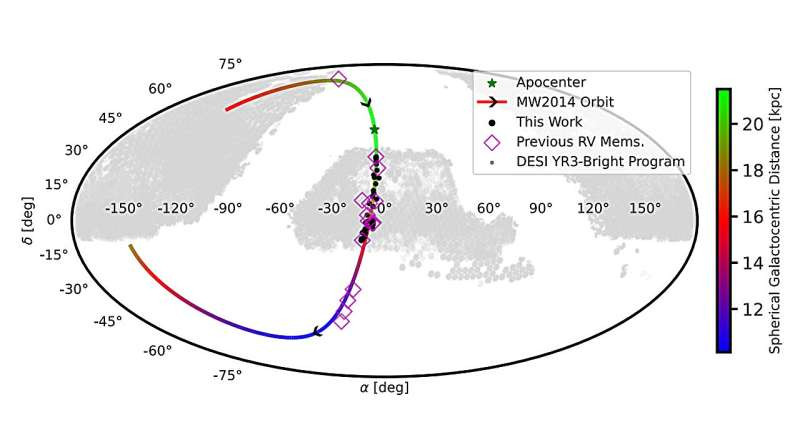
Weighing between 40,000 and 50,000 times the mass of the Sun, the stream’s mass reminds scientists that even small, remote structures can carry vast archives of cosmic history.
DESI’s Role: Cutting-Edge Tools Reveal Stellar Mysteries
To thoroughly characterize C-19, the research team, led by Nasser Mohammed at the University of Toronto, utilized the powerful Dark Energy Spectroscopic Instrument (DESI) mounted on the Mayall 4-meter telescope at Kitt Peak National Observatory. DESI’s advanced spectrograph technology enabled examination of radial velocities and metallicities for over 10 million stars, penetrating deeper into the Milky Way’s stellar population than previous surveys.
“Using DESI, which provides radial velocities and metallicities for over 10 million stars reaching significantly fainter magnitudes than comparable surveys, we employ a mixture model approach to jointly characterize stream populations in proper motions, radial velocities, and metallicities against a Milky Way halo background,” the researchers explain.
This extensive data set was critical in unraveling the origins and makeup of C-19.
Details from the March 11 arXiv preprint indicate that C-19 exhibits a notably high velocity dispersion of 7.8 km/s, markedly exceeding typical values for streams linked to globular clusters. Such a "kinematically hot" state reflects rapidly moving stars within the stream and, coupled with the presence of an unusual "spur"—a group of stars offset from the main stream—suggests complex dynamical processes influence C-19’s formation.
Decoding the Spur: Insights Into C-19’s Past
A striking feature of C-19 is a spur-like extension located about 1,000 light-years away from the main stream, spanning roughly 3,000 light-years in length. This assemblage of stars differs in both movement and position, hinting at a more intricate evolutionary trajectory than simple tidal stripping.
The spur’s characteristics challenge the notion of a straightforward globular cluster origin, raising the possibility that C-19 may instead derive from a disrupted dwarf galaxy. The stream’s extremely low metallicity points toward a cluster origin, but the extended spur structure lends weight to the idea of a dwarf galaxy as the progenitor.
Thus, rather than a mere stellar relic, C-19 could represent the remnants of an ancient galaxy, offering a direct window into the chaotic early history of the Milky Way’s assembly.
Origins Under Review: Is C-19 From a Dwarf Galaxy?
Despite these exciting insights, the precise genesis of C-19 is still under investigation. Its metal-poor nature combined with the unusual spur phenomenon opens the possibility of a dual heritage—either from a globular cluster or a dwarf galaxy. Compared to clusters, dwarf galaxies typically display higher velocity dispersions and intricate structural features like the observed spur.
Ongoing analysis aims to determine whether this peculiar feature points to a once-active galaxy torn apart by the Milky Way’s gravity, leaving behind the stellar fingerprint we now call C-19. Uncovering this origin story will not only illuminate the Milky Way’s past but may also enhance our understanding of the dark matter halo enveloping our galaxy.
- Categories:
- Astronomy




0 comments
Sign in to Comment