
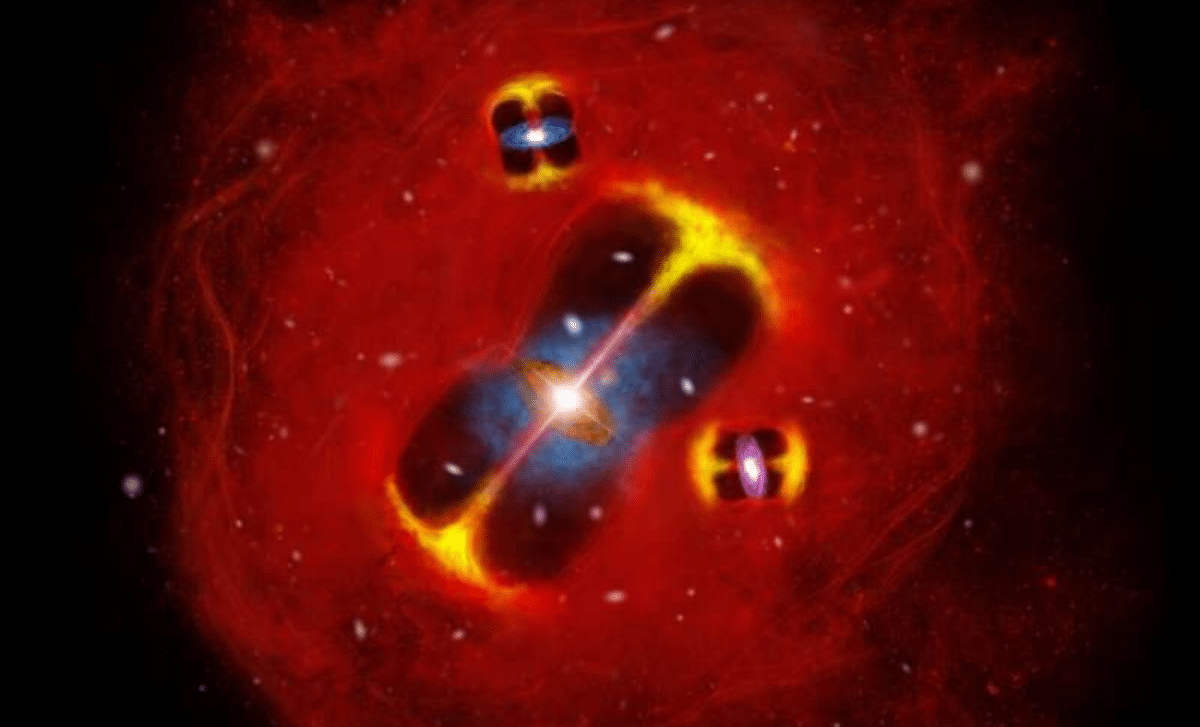
A recently identified galaxy cluster is emitting unexpectedly high-temperature gas just 1.4 billion years after the Big Bang, prompting experts to reconsider the conditions of the early cosmos. The study, featured in Nature, unveils thermal characteristics that defy conventional cosmology theories, hinting at intense early processes shaping colossal structures much sooner than anticipated.
Record-Breaking Heat in an Early Cosmic Cluster
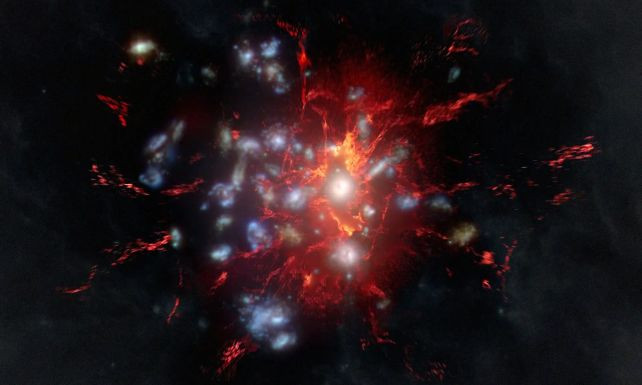
In a remarkable astrophysical finding, scientists have detected a galaxy cluster with gas temperatures dramatically exceeding what models predict for its young cosmic age. The cluster, named SPT2349-56, is located roughly 12 billion light-years away, allowing astronomers to examine it as it existed when the universe was merely 1.4 billion years old. Utilizing data from the Atacama Large Millimeter/submillimeter Array (ALMA), a sophisticated telescope partially developed by Canada’s National Research Council, the team observed the Sunyaev-Zeldovich effect, revealing hot ionized gas permeating the space between galaxies.
The lead researcher, Dazhi Zhou, a doctoral student at the University of British Columbia, conveyed his astonishment upon reviewing the findings:

“We didn’t expect to see such a hot cluster atmosphere so early in cosmic history,” he said. “In fact, at first I was skeptical about the signal as it was too strong to be real. But after months of verification, we’ve confirmed this gas is at least five times hotter than predicted, and even hotter and more energetic than what we find in many present-day clusters.”
These unexpected results challenge existing models of galaxy cluster formation, which suggest such elevated temperatures are usually found in much more mature clusters, several billion years further into cosmic evolution.
Supermassive Black Holes as a Heating Source
The team suggests that the extraordinary heating likely stems from three newly detected supermassive black holes located within the cluster. These colossal objects seem to have been actively releasing energy early in the universe’s history, injecting significant heat into the intracluster medium. Co-author and Dalhousie University professor Dr. Scott Chapman remarked that such energetic phenomena at this epoch were unforeseen. “This tells us that something in the early universe, likely three recently discovered supermassive black holes in the cluster, were already pumping huge amounts of energy into the surroundings and shaping the young cluster, much earlier and more strongly than we thought,” he noted.
The presence of these active black holes might account for the rapid evolution of protoclusters like SPT2349-56. It is home to over 30 actively star-forming galaxies, collectively producing stars at a pace 5,000 times greater than the Milky Way, all within a region about 500,000 light-years wide. These observations imply that clusters can form and experience intense heating far earlier than standard cosmological simulations predict, necessitating updates to prevailing models of cosmic structure growth.
Transforming Our Understanding of Cluster Formation
This breakthrough, detailed in Nature, represents a major leap in our comprehension of galaxy cluster development. Traditionally, clusters were believed to slowly gather gas via gravity, with temperatures rising over billions of years through mergers and accretion shocks. However, the extreme heat and dense core of vigorous galaxies in SPT2349-56 suggest that internal processes such as AGN feedback from supermassive black holes play a dominant role earlier than expected.
“Understanding galaxy clusters is the key to understanding the biggest galaxies in the universe,” said Dr. Chapman. “These massive galaxies mostly reside in clusters, and their evolution is heavily shaped by the very strong environment of the clusters as they form, including the intracluster medium.” The application of the Sunyaev-Zeldovich effect offers a powerful method to investigate such environments, even at vast distances and ancient epochs.
These insights grant astronomers an early look at the intricate physics behind cluster formation and highlight the crucial role of multi-wavelength observations and international efforts in exploring the universe’s infancy. As advanced instruments like ALMA continue to expand observational capabilities, additional surprising discoveries are anticipated.
Insights into a Dynamic Early Cosmos
The SPT2349-56 cluster offers a glimpse into a turbulent and energetic young universe far different from previous assumptions. Instead of gradual structure formation, the data point to intense localized heating and accelerated star creation fueled by powerful central black holes. This discovery not only revises the timeline for cluster maturation but may also impact how scientists estimate early galaxy masses, ages, and evolution.
It remains uncertain how widespread such extreme systems are. If SPT2349-56 is unique, it stands as a captivating cosmic anomaly. On the other hand, the identification of similar clusters in future observations could lead to a fundamental rewriting of the rules governing large-scale structure formation following the Big Bang. As research advances, one certainty remains: the early universe was vastly more energetic and dynamic than once believed.
- Categories:
- Astronomy




0 comments
Sign in to Comment