
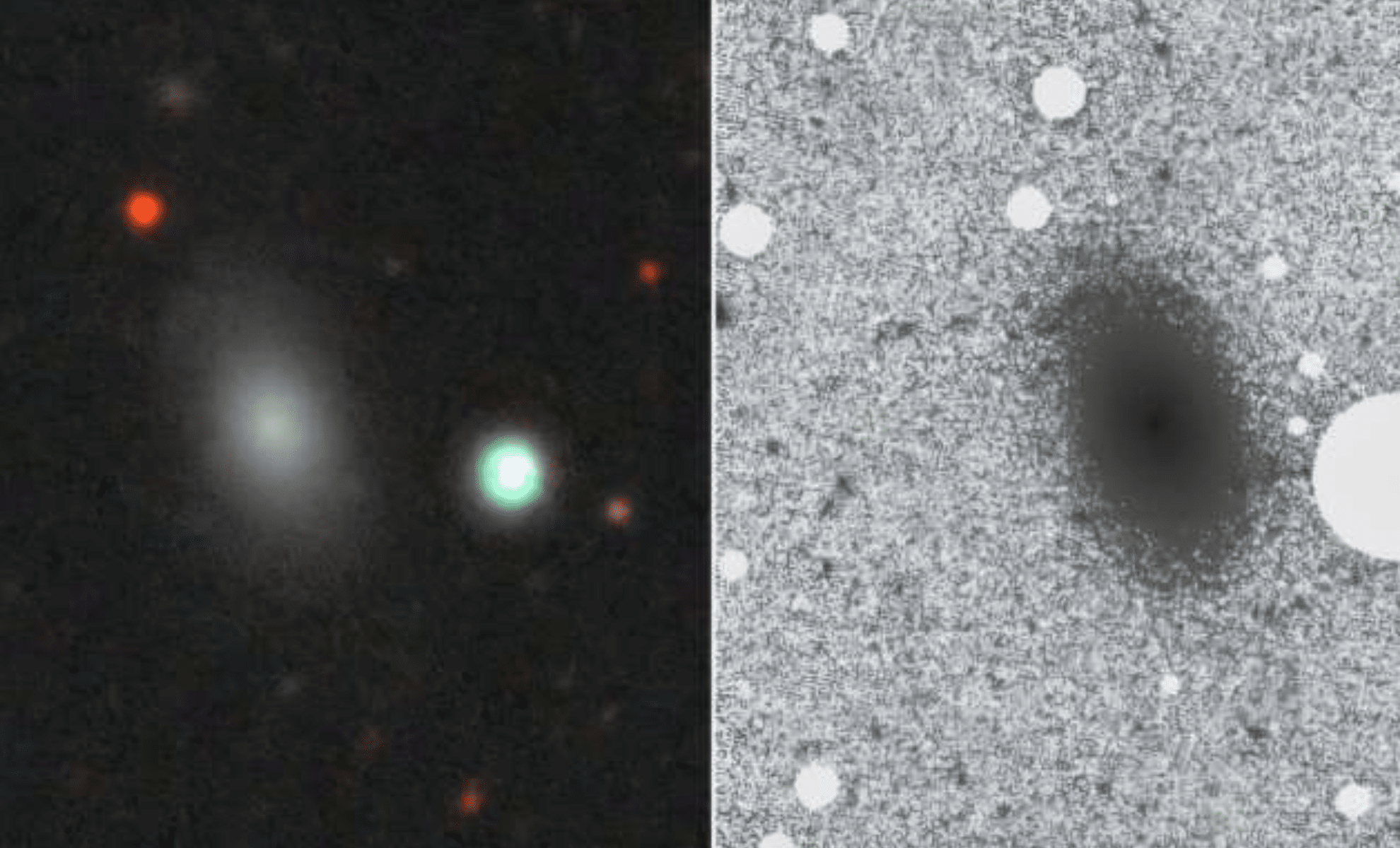
A collaborative group of researchers from Yonsei University and partner institutions has identified an early-type dwarf galaxy that appears to have been expelled from its original galactic group billions of years ago. Their findings, released on August 28, 2025, in a preprint on arXiv, highlight the intriguing characteristics of this uncommon quiescent dwarf galaxy, designated SDSS J011754.86+095819.0 (dE01+09), offering new insights into how interactions with their surroundings influence the development and destiny of small galaxies.
An Exceptional Discovery: A Silent Dwarf in Cosmic Isolation
The discovered galaxy dE01+09 resides almost 3.9 million light-years distant from the group it likely originated from, NGC 524. This distance places it far beyond the virial radius—the gravitational boundary of the galaxy group. Currently, it exists in a remarkably isolated environment, an unusual context for such a galaxy type. Early-type dwarf galaxies are usually confined to dense settings like galaxy clusters and groups, where gravitational effects are pronounced.
Led by Sanjaya Paudel, the team stated: “Our research uncovers a dE, SDSS J011754.86+095819.0 (dE01+09), situated at a significant distance from its host group.” Their work utilized deep optical images from datasets such as the Sloan Digital Sky Survey (SDSS) and the Legacy Survey, which were crucial for identifying the galaxy’s shape and characteristics.

This galaxy lacks signs of recent star formation in its core, confirming its status as a quiescent system. It features a uniform stellar population, indicating stars of comparable age and composition. Alongside its morphology and absence of gas, these traits classify it as a mature early-type dwarf galaxy that has likely ceased star formation after a prior active phase within a group.
Reconstructing the Past: From Group Resident to Cosmic Wanderer
Scientists propose that dE01+09 was once part of the NGC 524 galaxy group. Across billions of years, the galaxy might have orbited the group, undergoing environmental quenching—where gas depletion or removal suppresses star birth. Dense galactic neighborhoods often witness this through mechanisms like tidal forces and ram-pressure stripping caused by nearby massive galaxies.
They suggest that roughly 3.5 billion years ago, a strong gravitational encounter, possibly a close flyby with another galaxy, propelled dE01+09 at or above the group’s escape velocity, causing it to break free and drift into a more solitary region of space.
The researchers describe this event as a runaway galaxy phenomenon, akin to stars or black holes expelled from galactic centers due to dynamic interactions. Since then, dE01+09 has journeyed millions of light-years away from dense cosmic neighborhoods, evolving in relative seclusion.
The Importance of Isolated Dwarf Galaxies for Understanding the Universe
Locating dE01+09 in such a remote setting presents challenges to accepted galaxy evolution theories. Typically, early-type dwarfs develop their characteristics within clusters or groups, which trigger star formation shutdowns. Finding a quiescent dwarf so distant from any large host demands new considerations in modeling galactic lifecycle transformations.
With an effective radius of about 3,900 light-years and an estimated mass near 280 million solar masses, this galaxy displays a metallicity of approximately -1.19 dex, consistent with other aged dwarfs. Estimated to be about 8.3 billion years old, it stands as a medium-aged object formed during an early cosmic era.
This discovery supports the idea that not all galaxy evolution requires dense environments, allowing room for scenarios such as runaway dwarf galaxies or even in-situ formation of quiescent galaxies in sparse regions. While the ejection hypothesis is favored, further detailed observations are necessary to finalize the galaxy's orbital trajectory and origin.
Future Directions: Probing the Relics of Cosmic Encounters
The research team highlights the scientific potential of studying galaxies like dE01+09. These galactic outliers offer natural laboratories to investigate gravitational interactions, environmental influences, and group dynamics. Upcoming observatories such as the Vera C. Rubin Observatory and the forthcoming Euclid mission could reveal additional similar galaxies, enriching our understanding of how galaxies traverse the cosmic landscape.
Examining runaway dwarfs provides valuable insights into the occurrence rates of galactic ejections, a subject still poorly understood in astrophysics. By tracking these celestial loners, astronomers can illuminate the often-hidden effects of gravitational disturbances over billions of years.
- Categories:
- News







0 comments
Sign in to Comment