

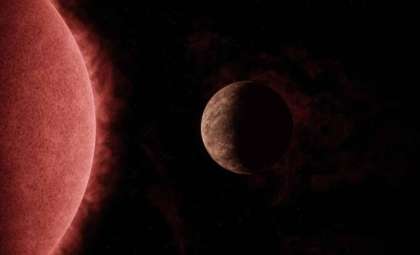
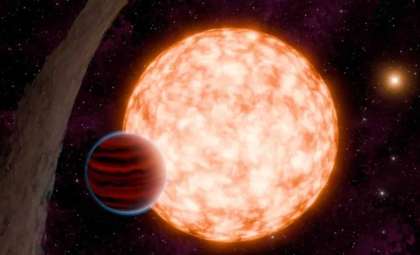
Scientists have identified a previously undetected companion planet orbiting the star Komondor (HAT-P-12) by meticulously examining irregularities in the transit schedule of its known exoplanet Puli (HAT-P-12b). This finding, published on arXiv, highlights how subtle shifts in a planet’s transit timeline can expose elusive worlds in distant solar systems.
How Transit Timing Variations Expose Hidden Planets
Detecting exoplanets frequently depends on observing the small dips in starlight when a planet crosses its host star. In the case of Puli, a “sub-Saturn” sized planet about 463 light-years away in the constellation Canes Venatici, scientists noted considerable transit timing variations (TTVs). Instead of appearing on schedule, Puli’s transits occurred as much as two minutes ahead or behind expected times.
These irregularities are key signals suggesting gravitational effects from an unseen object influencing the orbit of the known planet. Led by Kaviya Parthasarathy from National Tsing Hua University in Taiwan, the research team analyzed 46 transit light curves spanning several years, incorporating observations from ground telescopes and NASA’s Transiting Exoplanet Survey Satellite (TESS). Their objective was to pinpoint the source of the transit timing anomalies.

Exploring Orbital Theories to Decode Timing Shifts
The study tested four orbital scenarios against the TTV data to identify the best fit. The basic linear model, assuming consistent orbital intervals, did not correspond with the observations. An orbital decay scenario, proposing the planet’s orbit is shrinking due to tidal interactions with its star, was also inconsistent with the data.
Another approach considered orbital eccentricity, suggesting Puli’s orbit might be elliptical and thus influence transit timings via apsidal precession. While this model aligned better than the first two, it was insufficient to fully explain the timing deviations.
The most compelling explanation was a sinusoidal model representing the gravitational effects of a second, undetected planet. This model indicated a companion orbiting roughly every 6.24 days with a mass close to 2% of Jupiter’s. The predicted timing fluctuations of about 2.6 minutes closely matched what astronomers observed.
- Categories:
- News










0 comments
Sign in to Comment