
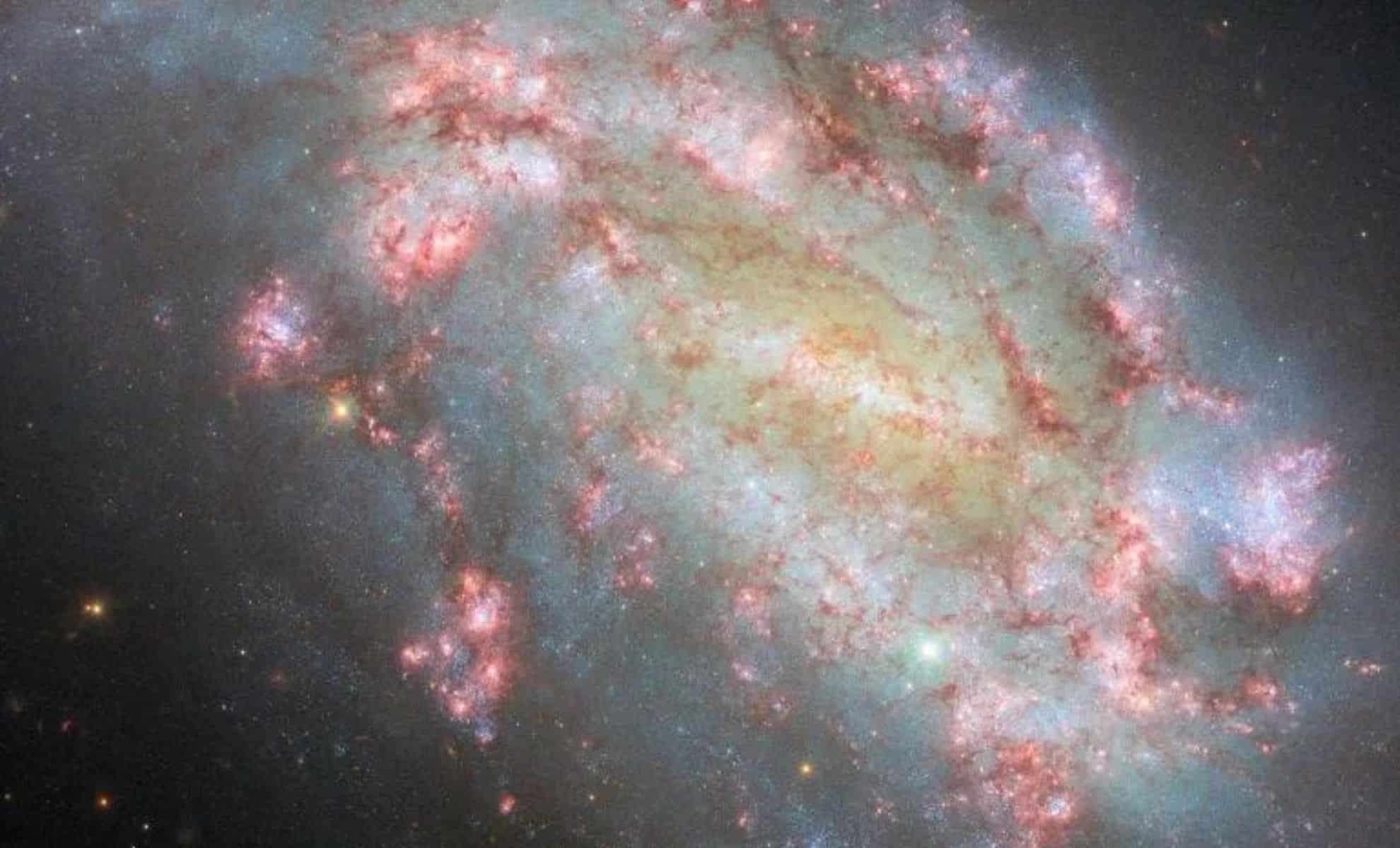
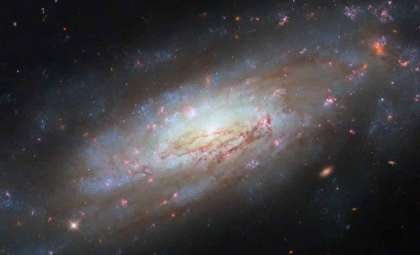
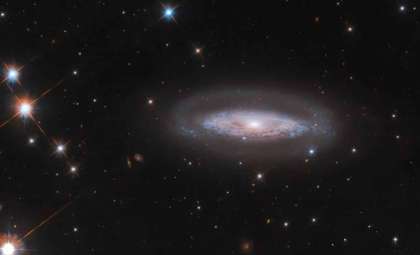
The Hubble Space Telescope has unveiled an exquisite image capturing the barred spiral galaxy NGC 1559, situated roughly 35 million light-years away in the southern Reticulum constellation.
This detailed composite was assembled from ten individual exposures taken by Hubble, highlighting the galaxy’s vibrant star-forming regions. The image provides astronomers and space enthusiasts alike with a deeper understanding of stellar formation dynamics in distant galaxies.
Illuminating Star Formation Within NGC 1559
The stunning image of NGC 1559 showcases Hubble’s remarkable capacity to gather light across a vast spectrum. By combining ten images filtered to capture wavelengths spanning from ultraviolet at 275 nanometers to near-infrared at 1600 nanometers, scientists can uncover crucial details about astrophysical mechanisms at play.

Prominently visible are vibrant red and pink zones indicating intense star formation. These hues represent emissions of H-alpha light, generated by ionized hydrogen gas and pinpointing H II regions—stellar nurseries where new stars ignite. As NASA/ESA states, “filtering to detect only this light provides a reliable means to detect areas of star formation… shown in this image by the bright red and pink colors of the blossoming patches filling NGC 1559’s spiral arms.” Identifying these regions sheds light on how stars and galaxies evolve over time.
Thanks to Hubble’s high resolution, researchers can chart these stellar nurseries in exquisite detail. Newly formed stars within dense molecular clouds, rich in hydrogen gas, emit intense ultraviolet radiation, which causes the nearby gas to glow in H-alpha light, marking active star-forming sites.
Decade-Long Collaborative Research Efforts
The breathtaking portrayal of NGC 1559 stems from over ten years of data collection, contributed by six distinct observing initiatives spanning from 2009 through 2024. These campaigns, led by diverse teams of astronomers, aimed to study aspects such as ionized gas, star birth, supernova remnants, and variable stars. They also play a key role in refining values for the Hubble constant, vital for understanding cosmic expansion.
What makes this work even more impactful is the availability of the data within the Hubble archive. This publicly accessible repository enables researchers and the wider public to utilize the observations for ongoing studies and for creating impressive images like this. According to the report, “the data from all of these observations live on in the Hubble archive, available for anyone to use—not only for new science but also to create spectacular images like this one.” This open access exemplifies the cooperative nature of contemporary astronomy.
Complementary Insights from the James Webb Space Telescope
Alongside Hubble’s striking image, scientists are extending their analysis of NGC 1559 through the advanced James Webb Space Telescope (JWST). JWST’s focus on near- and mid-infrared wavelengths enhances understanding of the galaxy’s structure by penetrating dust clouds that limit optical observations.
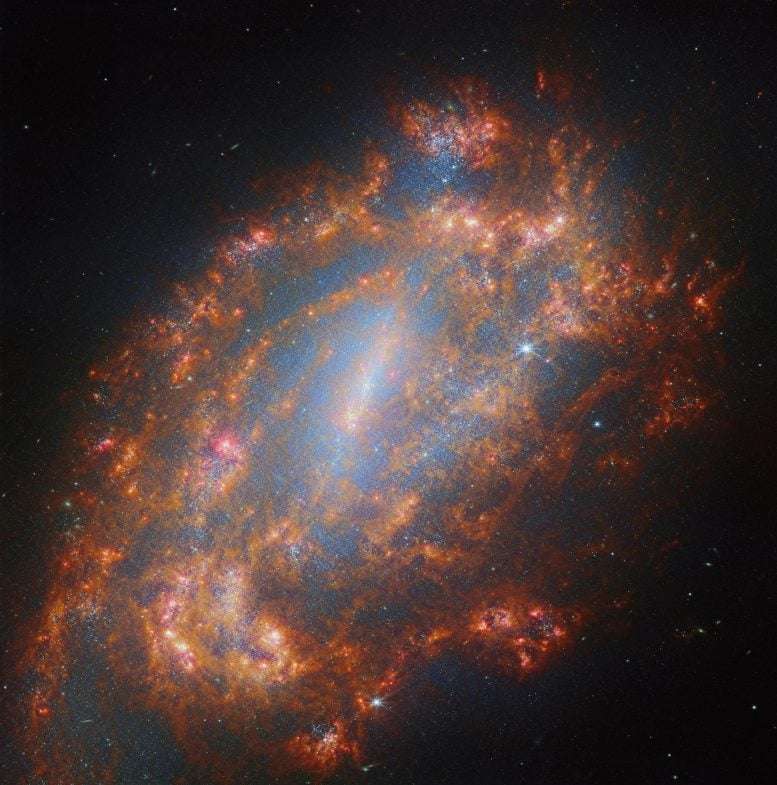
Images captured by Webb highlight features of the barred spiral’s core, revealing distributions of stars, gas, and dust invisible to Hubble’s ultraviolet and optical instruments. As noted by NASA and ESA, combining data from Hubble and JWST is revolutionizing our perception of galaxies like NGC 1559, providing a thorough picture of their evolution and inner workings.
This ongoing synergy between these two cutting-edge observatories empowers astronomers to probe galaxies more deeply than ever, continually advancing comprehension of the universe’s grand design.
- Categories:
- Astronomy ,
- News ,
- Space ,
- Nasa



0 comments
Sign in to Comment