
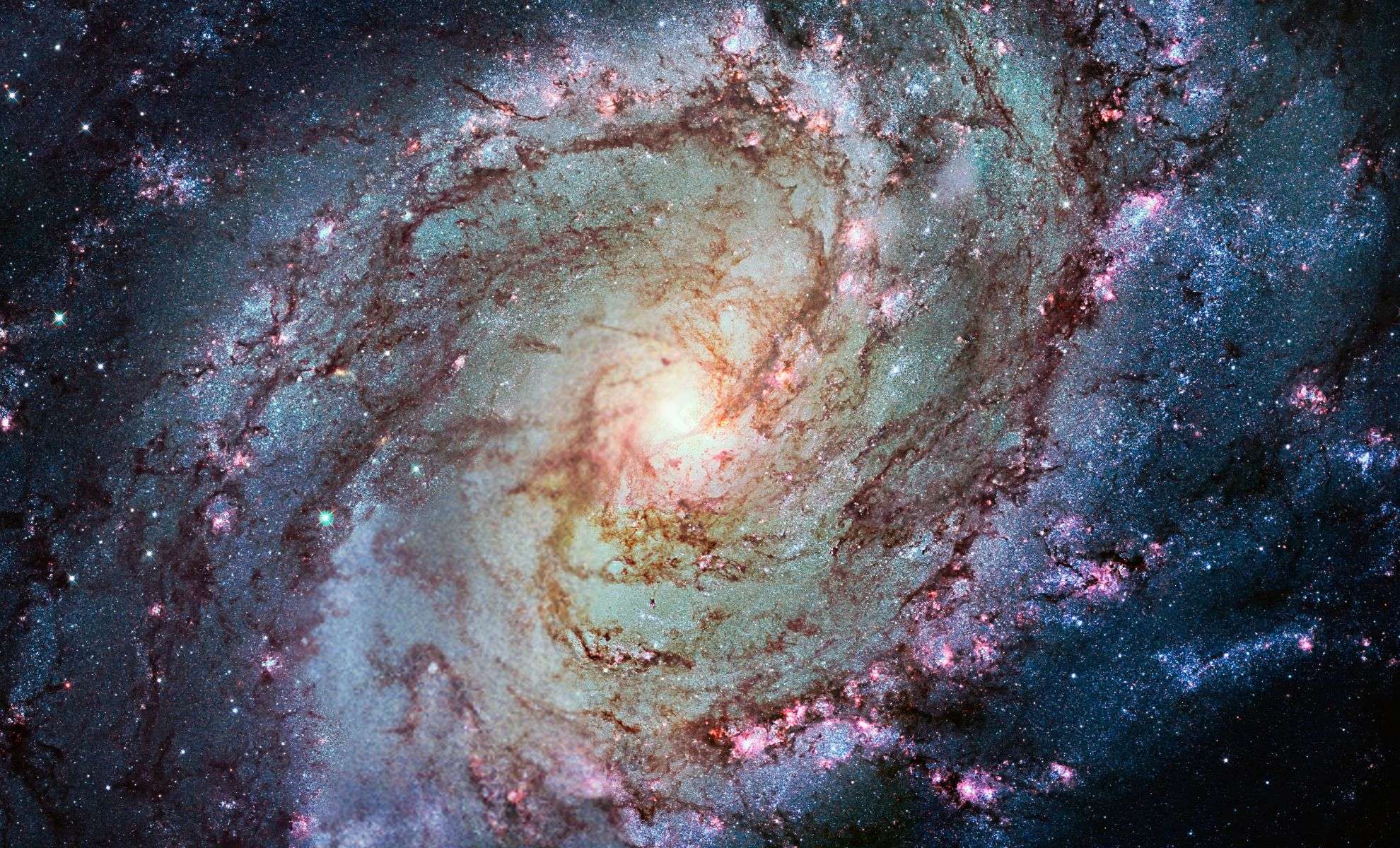
A recent breakthrough detailed in The Astrophysical Journal reveals the presence of rapidly moving gas clouds in the vicinity of the M83 spiral galaxy. These swift gas formations, referred to as high-velocity clouds (HVCs), exhibit speeds and trajectories that markedly contrast with the usual rotation of the galaxy. This finding provides vital clues about how galaxies like the Milky Way sustain star production across billions of years despite running low on their own gas reservoirs.
This research builds on earlier studies examining how galaxies accumulate mass, highlighting the possible significance of external gas infall in maintaining ongoing star formation. Detecting these HVCs sheds light on the intricate relationship between galaxies and their environment, suggesting a potential link to the genesis of new stars. This investigation contributes to answering a pivotal cosmic query: how do galaxies continue generating stars over immense timescales?
Revealing High-Speed Gas Clouds: An Emerging Galactic Phenomenon
The research team, headed by Maki Nagata from the University of Tokyo’s Institute of Astronomy, tackled a longstanding puzzle in galaxy evolution—how do galaxies keep producing stars when their internal gas supplies dwindle? They proposed that continuous inflows of external gas might be supplying the fuel needed for star formation. To explore this, they focused on detecting HVCs, gas clouds that travel at velocities and paths not matching the standard rotation of their host galaxy.

“Gas clouds are ubiquitous in galaxies. Among these, high-velocity clouds have unusual speeds and movement orientations that don't match typical galactic rotation,” Nagata commented. “These distinctive traits made us consider HVCs as possible carriers of external gas replenishing the galaxies.”
Tracking Potentially Extraterrestrial Origins of HVCs
The analysis revealed several high-velocity gas clouds near M83 moving at speeds differing by over 50 kilometers per second relative to the galaxy’s rotational motion, highlighting their probable external origin. Nagata noted, “This difference alone doesn’t confirm an outside source; some clouds might stem from supernova ejecta. Nonetheless, our detailed approach enabled us to discern which HVCs could truly originate beyond the galaxy.” Differentiating genuine cloud signals from background interference was key to accurately measuring these clouds’ velocities and energetic properties.
Studying M83: A Window into Galactic Dynamics
One major obstacle to fully understanding how external gas shapes galactic growth is accurately measuring characteristics like distance, mass, and movement, especially within our own Milky Way. By investigating M83, a nearby spiral galaxy akin to ours, scientists gain valuable insights into how outside gas inflow influences galactic evolution. The discovery of these HVCs near M83 serves as a powerful analog for our galaxy’s history and future, providing a peek into how galaxies feed and sustain star creation.
“Our findings confirm that galaxies continuously engage with their cosmic surroundings,” said Nagata. “Seeing high-velocity clouds falling into M83 demonstrates that galaxies grow by accreting gas from nearby space, possibly from smaller satellite galaxies or the intergalactic medium. This gas inflow is likely essential to nurturing star formation over astronomical timescales.”
Molecular Gas Clouds as Catalysts for Stellar Formation
What intrigued the researchers most was the composition of these high-speed clouds. Although HVCs are often assumed to be diffuse atomic hydrogen, the clouds found around M83 were instead dense and compact, filled with molecular gas. Molecular gas is the primary ingredient for birthing stars, indicating that these fast-moving clouds could be directly fueling new stellar development. This suggests that incoming external gas not only contributes to galactic growth but may also actively trigger star formation.
“Typical HVCs contain low-density atomic hydrogen, but here we identified compact clouds rich in molecular gas, the exact gas required for making new stars,” Nagata explained. “This strongly supports the idea that these inflows could be intimately connected to future star creation.”
- Categories:
- News



0 comments
Sign in to Comment