
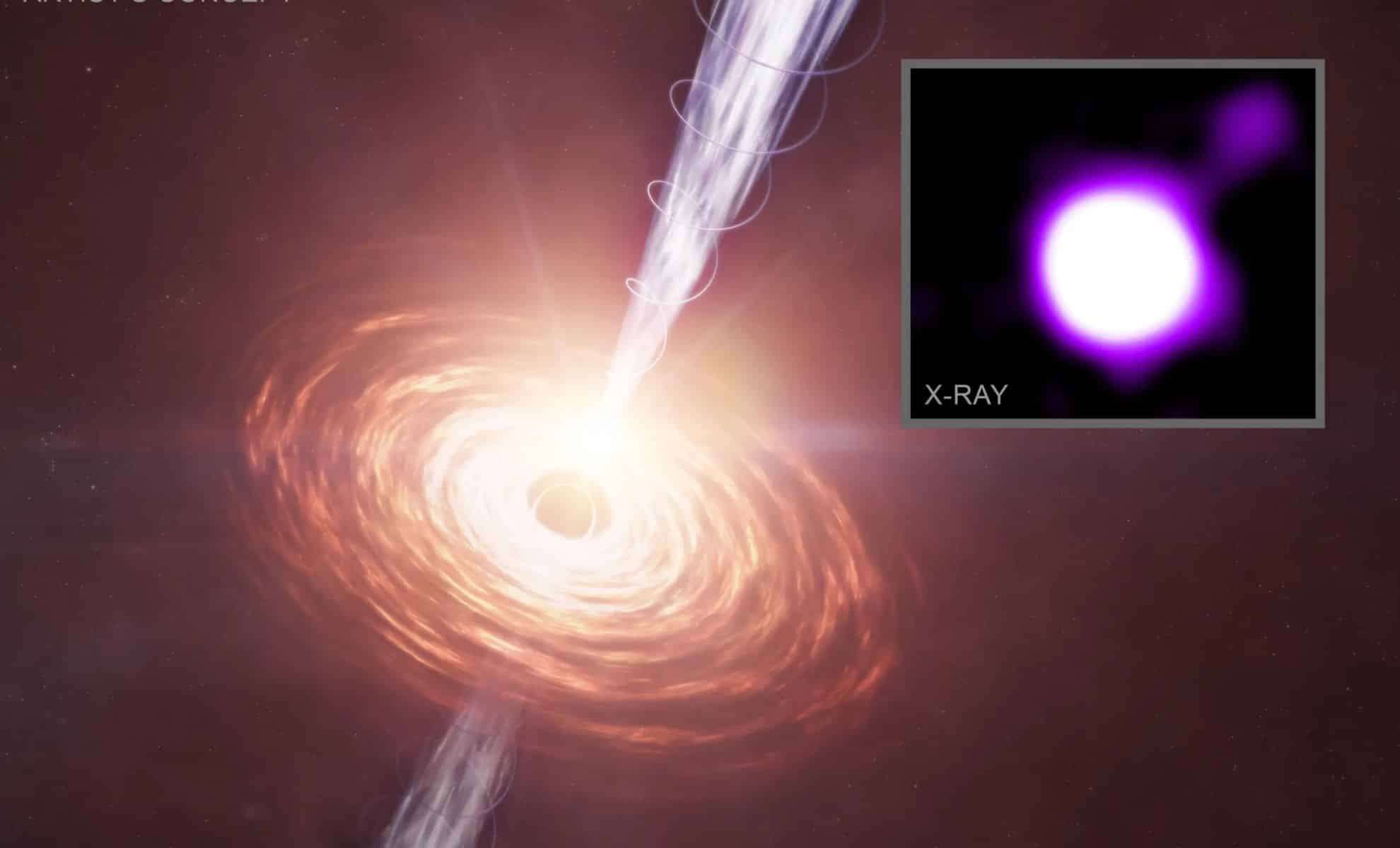
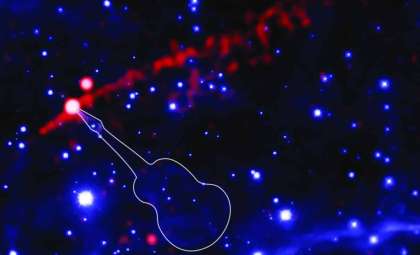
A recent investigation using NASA’s Chandra X-ray Observatory has uncovered an extraordinarily powerful jet from a distant black hole. This discovery highlights a dramatic cosmic event during "cosmic noon," a critical era about three billion years post-Big Bang, when galaxies and supermassive black holes experienced vigorous growth. Detailed in NASA’s official publication, the work provides fresh perspectives on how supermassive black holes evolved and energized the early universe. Leveraging data from both Chandra and the Karl G. Jansky Very Large Array (VLA), astronomers have advanced our knowledge of the energetic mechanisms shaping the young cosmos.
Understanding Cosmic Noon: A Milestone in Cosmic History
"Cosmic noon" describes a pivotal phase roughly three billion years after the universe's origin, marked by rapid expansion of galaxies and accelerated growth of their central supermassive black holes. During this interval, these colossal black holes were not only increasing in mass but also launching powerful jets that could stretch over enormous distances. Such jets are vital to unraveling the interactions between black holes and their cosmic environments, including influences on the cosmic microwave background (CMB) radiation that traces back to the Big Bang.
At this stage, the universe was significantly younger and the CMB, the leftover glow from the Big Bang, was denser than what we observe now. This density was crucial in identifying a particularly strong jet originating from a black hole 11.6 billion light-years away. The breakthrough was achievable thanks to Chandra’s high-energy X-ray detection capacity, enabling observation of such distant and energetic phenomena.

The Astonishing Force of Black Hole Jets During Cosmic Noon
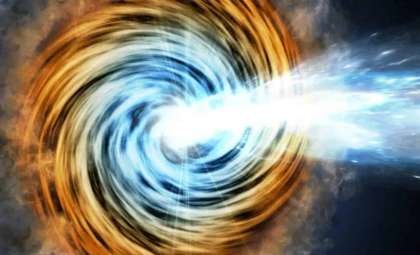
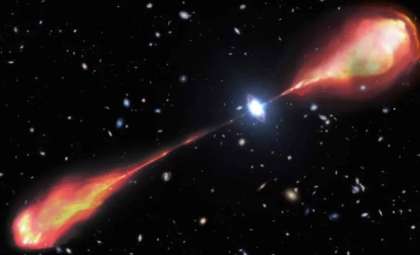
The black hole jet studied is remarkable not only for its staggering energy output but also for propelling particles at velocities nearing the speed of light. Researchers found that particles in the jets of two supermassive black holes, identified as J1405+0415 and J1610+1811, were moving at speeds between 92% and 99% of light speed. This finding highlights the extraordinary power of these jets, which can span up to 300,000 light-years, ranking them among the universe’s most potent energy sources.
Particularly striking was the jet from J1610+1811, which emitted energy equating to nearly half of the intense light produced by the hot gas circling the black hole. These discoveries imply that jet energy output rivals the energy from the accretion disks typically present around supermassive black holes, deepening understanding of black hole energetics.
The Influence of Cosmic Microwave Background Radiation
A key element in detecting this jet’s power is the interaction between jet particles and the cosmic microwave background radiation. As the jet particles move outward, they encounter CMB photons—a resting trace of the Big Bang—which boosts the photons' energy into the X-ray spectrum. This shift allows detection by the Chandra Observatory.
The early universe’s elevated CMB density amplified these interactions, enabling astronomers to observe photons from a source 11.6 billion light-years distant. This mechanism is fundamental for comprehending energy propagation across the cosmos and the observable effects of black hole phenomena over vast scales.
Overcoming Challenges in Determining Jet Speed and Direction
Accurately gauging the exact speed and angle of black hole jets poses significant challenges. Special relativity effects mean jets directed toward Earth appear brighter, biasing detection toward jets aligned with our viewpoint. To counteract this, the research team devised a novel statistical approach to adjust for these relativistic biases.
By factoring in how jet velocity and orientation influence brightness, scientists refined their estimates for the jets’ true viewing angles. The analysis suggests probable angles of 9 degrees for J1405+0415 and 11 degrees for J1610+1811. This advancement enhances astronomers' ability to interpret observations and deliver more precise evaluations of black hole activities in the early universe.
- Categories:
- News


0 comments
Sign in to Comment