

Researchers have unveiled an extraordinary find in the cosmos: TIC 120362137, an exceptionally dense quadruple star system detailed in Nature. This unique arrangement is the closest packed “3+1” type quadruple star system ever recorded, offering new perspectives on how stars interact and evolve within intricate orbital frameworks. The investigation, orchestrated by scientists at the University of Szeged in Hungary, uncovers a fascinating stellar ensemble that fits entirely within the orbital space between Jupiter and the Sun, shedding light on star formation and orbital longevity.
Introducing the Ultra-Compact Quadruple System TIC 120362137
TIC 120362137 represents a major milestone in the study of multi-star systems. According to Tamás Borkovits, leader of the Hungarian research team, this system features a closely-knit trio of stars orbiting each other, accompanied by a fourth star farther out. Remarkably, the trio lies within a spatial scale smaller than Mercury’s orbit, turning previous ideas about multi-star compactness and genesis on their head. The system opens a novel window into the gravitational forces sculpting such cosmic arrangements.
Originally thought to be a standard eclipsing binary—a pair of stars whose orbits cause periodic light dimming—this system surprised scientists during early observations. Borkovits commented,

“By a simple inspection of the early TESS data, we realized that TIC 120362137 is a compact, tight, triply eclipsing triple star system.”
At first, the team noticed brightness dips every 3.3 days lasting for only an hour or two, a phenomenon common in many binary star systems. This initial data did not hint at the deeper complexities of TIC 120362137.
Uncovering the Hidden Fourth Star
Deeper analysis revealed additional light fluctuations lasting from one to two days and recurring every 25 to 26 days, implying a third star's presence orbiting roughly every 51 days. Borkovits explained,
“Then, we realized that there are extra one-to-two-day-long fadings every 25 to 26 days, which made it clear that there must be a third star also in the system, with an orbital period of around 51 days.”
Consequently, the realization dawned that TIC 120362137 was not a simple binary, but a rare triple star system exhibiting triple eclipses.
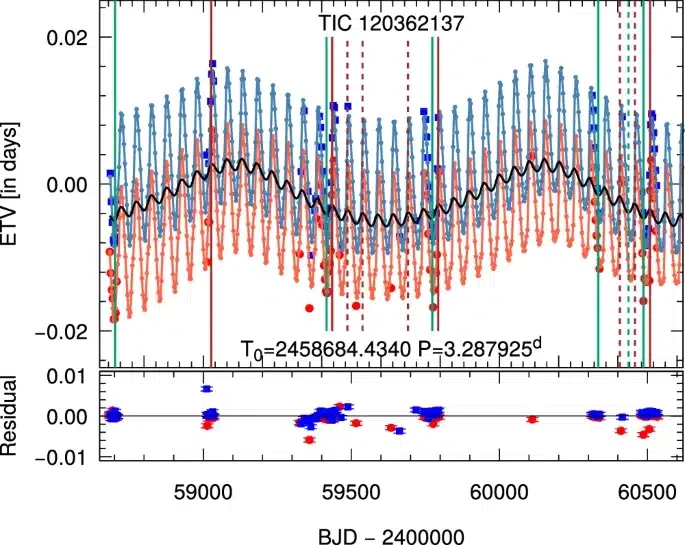
Further scrutiny and data from the Tillinghast Reflector Echelle Spectrograph (TRES) at Arizona’s 1.5-meter Tillinghast telescope confirmed the presence of a fourth, more remote star in this compact stellar family.
“TIC 120362137 is a record-holder in the sense that we found that the outermost star has an orbital period of only around 1,046 days, which is the shortest amongst all the currently known 3+1 quadruple stars by far,” Borkovits explained.
With an outer star orbiting in just under three years, TIC 120362137 stands out as the most tightly bound 3+1 quadruple star system identified so far.
The Difficult Quest to Detect Such Compact Systems
Discovering multi-star systems of this nature is a formidable task. Detecting the furthest companion often demands long-term monitoring that can span decades. Borkovits highlighted the challenge,
“The discovery of such systems, however, is very, very difficult. To discover a fourth, most distant component by checking eclipses in the same way as the inner system requires much more time, maybe even several decades or longer.”
The rare chance to pinpoint the outer star in TIC 120362137 emphasizes the exceptional nature of this astronomical find.
The Evolutionary Destiny: From Stars to White Dwarfs
The research team also modeled how TIC 120362137 will evolve over millions of years, as reported in Nature. Their simulations predict that the system will ultimately transition into a pair of white dwarfs—stellar remnants that no longer sustain nuclear fusion.
“First, the most massive star, which is the primary component of the innermost binary, will reach the red giant state. In that state, it will merge with its mate, the secondary star of the innermost binary. We call this daughter stellar body A’,” Borkovits said.
This initiates a series of merges, with the newly formed star subsequently combining with the third star after approximately 276 million years.
As these mergers proceed, the quadruple star system will condense into two white dwarfs orbiting each other every 44 days. This endpoint offers a valuable model for the long-term fate of similar multi-star systems.
- Categories:
- Astronomy













0 comments
Sign in to Comment