
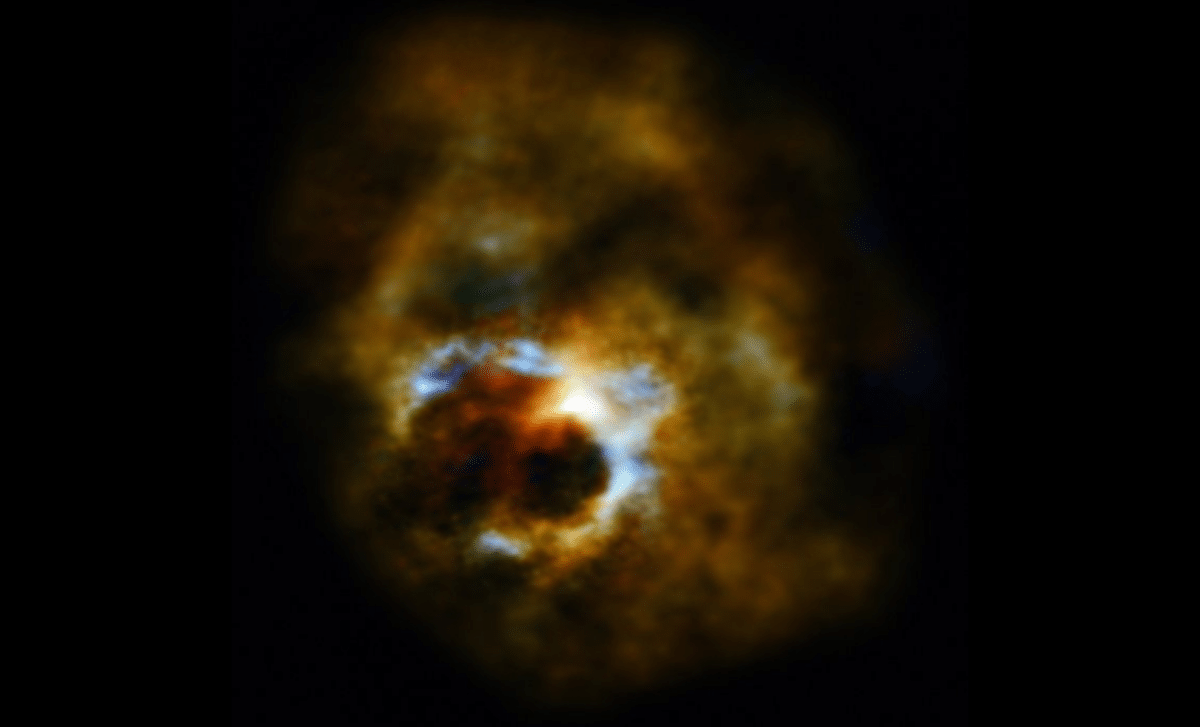
Scientists have uncovered a striking heart-shaped cloud of gas and dust originating from the star Mira A, situated roughly 300 light-years away from Earth. This remarkable phenomenon was detailed in a recent study led by Theo Khouri, an astronomer at Chalmers University of Technology. The findings, available on the arXiv preprint repository and soon to appear in Astronomy & Astrophysics, reveal that Mira A has expelled a vast cloud of material, about seven times Earth’s mass, challenging existing ideas about how aging stars lose mass.
An Unexpected Heart-Shaped Outflow
Mira A, a well-studied red giant nearing the end of its life cycle, is known for sporadic ejections of gas and dust. Yet the discovery of a heart-shaped gas formation enveloping the star surprised the scientific team. Khouri’s group found this outburst to be approximately one hundred times larger than prior estimates, showcasing extraordinary stellar activity. This phenomenon represents a striking case of unusual mass ejection from dying stars. Their comprehensive analysis spanning eight years uncovered both the peculiar shape and massive size of the expelled gas cloud.
“We were very surprised to see this structure. We also see that the star’s illumination of the surrounding dust varies in an unexpected way, which implies that the star acts like a lighthouse—illuminating its environment unevenly,” says Khouri.
Add Cosmo Herald as a Preferred Source

This discovery prompts a reevaluation of the processes at work during Mira A’s late evolutionary stages and offers fresh perspectives on how stars lose their mass as they age.
Deciphering the Gas and Dust Distribution
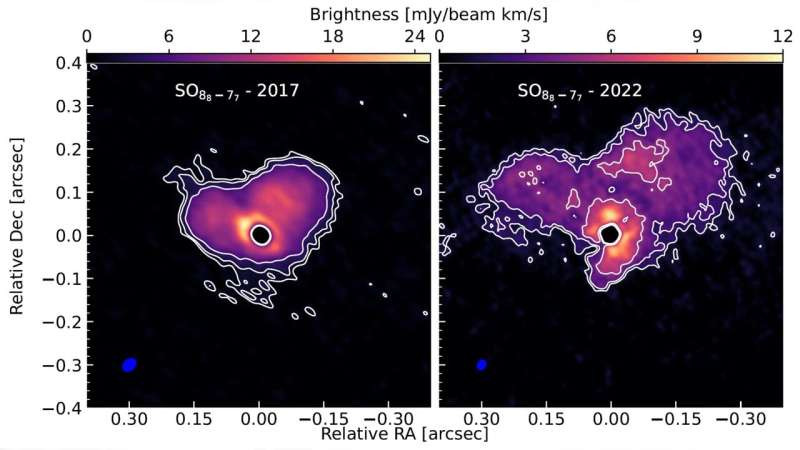
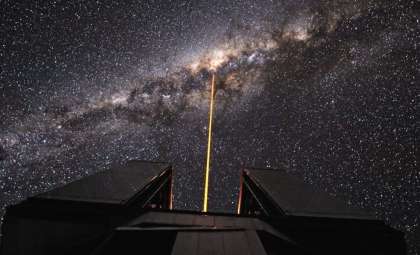
The distinct heart-shaped feature around Mira A not only captures attention visually but also provides key insights into the star’s mass-loss dynamics. Utilizing data from the Very Large Telescope (VLT) and the Atacama Large Millimeter/submillimeter Array (ALMA) in Chile, the team examined the star's emissions in visible and radio wavelengths. Their observations showed that gas occupies the inner region of the heart-shaped volume, while dust is predominantly located along the edges, creating a luminous boundary. This layout indicates that stellar winds may be pushing dust farther out than the gas, influencing the cloud’s shape.
The study, accessible on the arXiv preprint server, points to the star’s changing brightness as a possible cause of the uneven dispersal of gas and dust. Khouri states, “Stars like Mira lose mass as part of their aging, but the scale and suddenness of this release far surpassed expectations,” shedding light on the episodic nature of mass ejection in red giants.
Repercussions for Stellar Evolution Research
The heart-shaped ejection from Mira A marks a pivotal advancement for understanding stellar life cycles. When red giants like Mira shed their outer layers, they enrich interstellar space with materials that eventually form new stars and planets. Insights into these sporadic and massive outflows reveal how chaotic the final stages of stellar evolution can be. The event also reaffirms the complexity of mass loss mechanisms, which had often been assumed to be gradual.
Notably, the irregular distribution and sheer amount of expelled matter emphasize the unpredictable aspects of cosmic phenomena. As Khouri explains,
“We will keep monitoring the expanding cloud around Mira A, as it is becoming so large that it may start to affect its companion star, the white dwarf Mira B. It is already gathering some of the material ejected by Mira A.”
Continuous Observation of Mira A
The growth of this heart-shaped gas cloud presents an ongoing opportunity for astronomers to observe its evolution, especially concerning the relationship between Mira A and its companion, the white dwarf Mira B. As Mira B begins to accrete some of the expelled matter, the interaction between these two stars may alter their behavior. Researchers intend to monitor these developments closely to understand their impact on both stars and their cosmic neighborhood.
Tracking the dynamics between Mira A and its companion star enriches our knowledge of how stars nearing the end of their lives influence the space around them. Continuous observation promises to reveal more details about the intricate interactions between aging stars and the matter they release. Khouri underscores the significance of this research by emphasizing continued vigilance around this impressive celestial event.
- Categories:
- Astronomy





0 comments
Sign in to Comment