
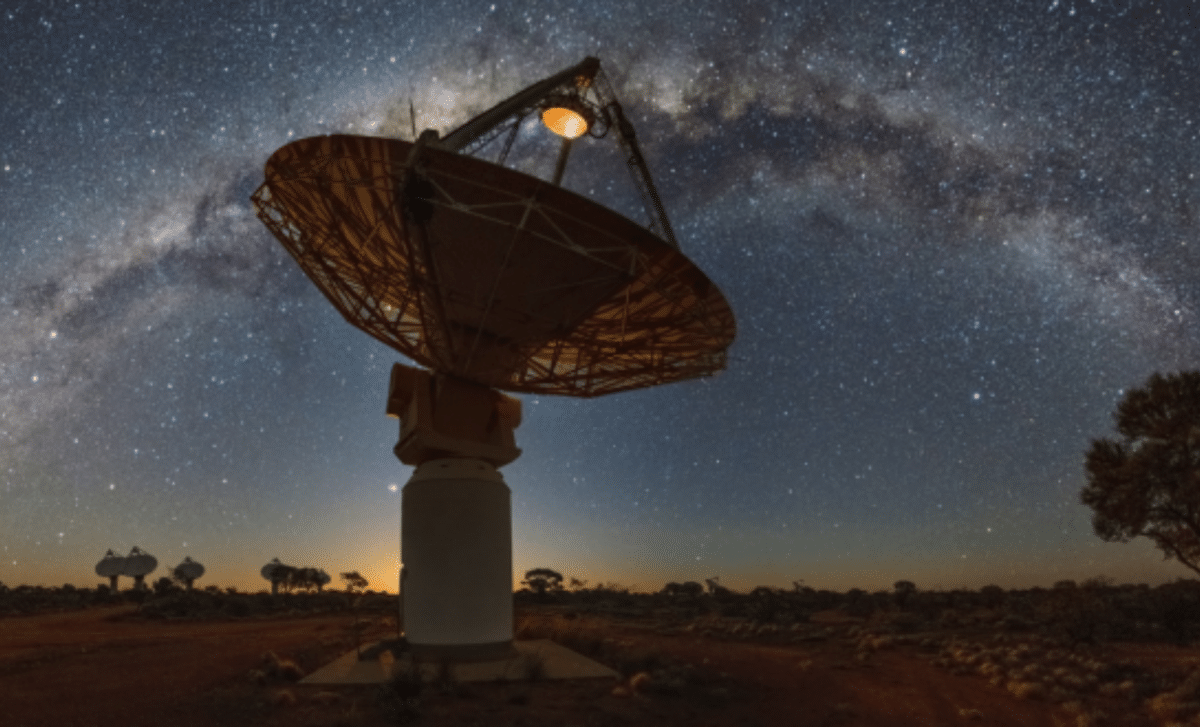
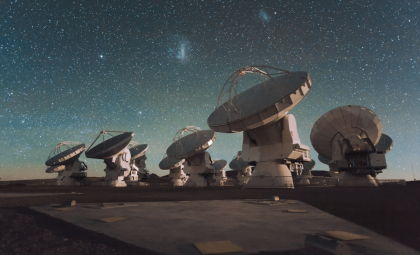
A team of astronomers from the University of Sydney has identified the source of a rare and enigmatic category of cosmic radio signals called long-period radio transients, an achievement published in Nature Astronomy. Utilizing the ASKAP radio telescope operated by CSIRO, the researchers discovered a distinctive binary star system poised to transform our comprehension of extreme stellar phenomena.
Unique Binary Star System Sheds Light on Cosmic Enigmas
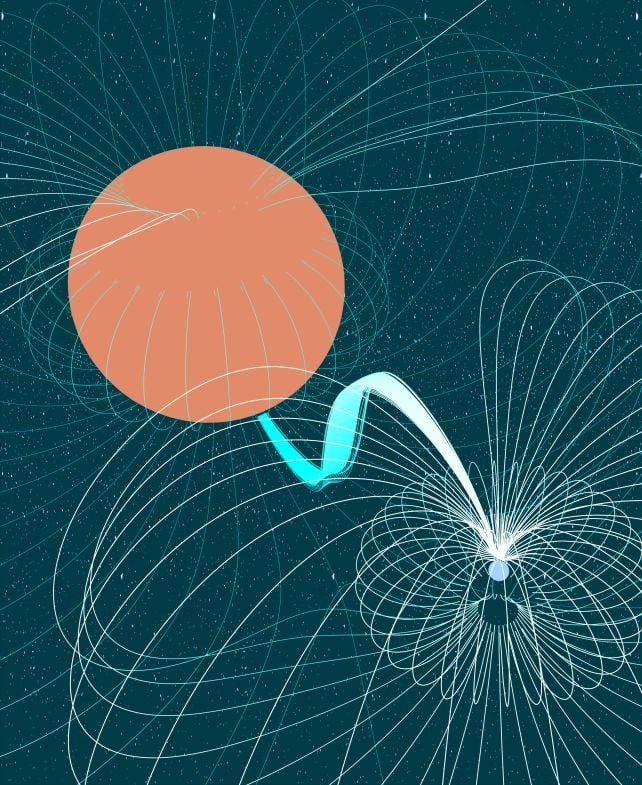
The star system known as ASKAP J1745−5051 features a white dwarf—a compact stellar core about the size of Earth but nearly as massive as the Sun—paired with a red dwarf star possessing roughly a tenth of the Sun's mass. These two stars orbit each other in just over an hour, engaging in a gravitational interaction where matter streaming from the smaller red dwarf accretes onto the white dwarf, heating up and generating bursts of radio waves alongside X-rays.
“For the first time we have pinpointed the origin of these signals, confirming the source to be a ‘cataclysmic variable,’ or an accreting white dwarf star,” said Ph.D. student Kovi Rose, lead author. “Long-period radio transients have puzzled astronomers for years. We’ve only found about a dozen, and their origins have been unclear. Now, we’ve been able to show that the source for one of these transients comes from a white dwarf actively pulling material from a companion star.”
Add Cosmo Herald as a Preferred Source

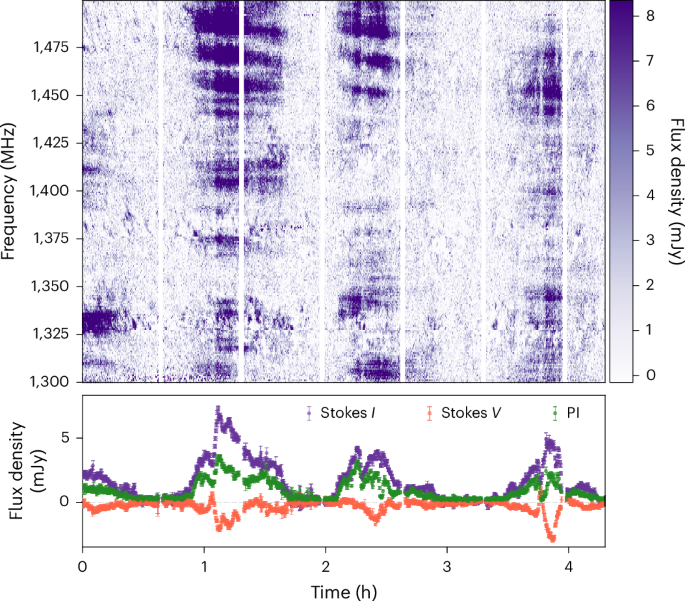
The emissions from ASKAP J1745−5051 are synchronized with the stars' orbital period. Yet the offsets between the peak radio and X-ray signals reveal that these radiations originate from separate zones within the system. “The orbital motion drives all these emissions,” Mr. Rose explained, “but the difference in timing between radio and X-ray peaks suggests distinct production regions.”
Combining Multi-Wavelength Data to Crack the Code
Long-period radio transients were once thought to be linked to slowly rotating neutron stars called pulsars. However, theoretical models failed to account for the characteristics of these signals, prompting a search for alternative origins. The discovery of ASKAP J1745−5051 confirms that certain binary star systems involving white dwarfs are responsible for some of these bursts.
“Some similar objects had been linked to binary systems before, but this is the first one where we can clearly see both stars and the accretion process in action,” said Professor Murphy, Head of School at the University of Sydney and Chief Investigator at OzGrav.
Moreover, ASKAP J1745−5051 is among the very few known long-period radio transients that emit regular X-rays, and it is the first for which the cause of this periodicity has been firmly determined.
The unprecedented sensitivity, resolution, and extensive field of view of ASKAP enabled the detection of these signals, uncovering emissions otherwise too faint to detect. Researchers describe ASKAP J1745−5051 as a crucial ‘stellar Rosetta Stone’ guiding the interpretation of other enigmatic radio transients.
“This system gives us a way to decode these signals. It could help us determine whether other long-period transients are more like pulsars or like white dwarf systems, acting like a stellar Rosetta Stone,” Mr. Rose said.
An Astrophysical Laboratory for Extreme Phenomena
Aside from demystifying these cosmic signals, ASKAP J1745−5051 acts as a natural experimental setting for studying intense plasma processes, magnetic fields, and gravitational forces. Observing how matter behaves in these fierce environments provides insights unattainable in Earth-based labs.
“These systems are natural laboratories,” said Mr. Rose. “They allow us to test our understanding of how matter behaves in strong magnetic fields and under intense gravitational forces.” The discovery highlights the potential of such rare binary systems to advance not only radio astronomy but also our fundamental knowledge of astrophysical phenomena.
Broadening Our Horizon on Cosmic Transients
The international research collaboration is poised to continue investigations using an array of radio, optical, and X-ray observatories to explore the mechanisms behind these bursts and to establish whether similar processes underlie the population of long-period radio transients.
“Every new piece of data adds to the overall picture,” Mr. Rose noted. “We are at the dawn of comprehending this intriguing class of cosmic phenomena.” This collaborative effort spans continents—including Australia, the US, China, Canada, Spain, and Israel—and the findings, now published in Nature Astronomy, represent a major advancement in unraveling the universe’s most elusive signals.
- Categories:
- News










0 comments
Sign in to Comment