

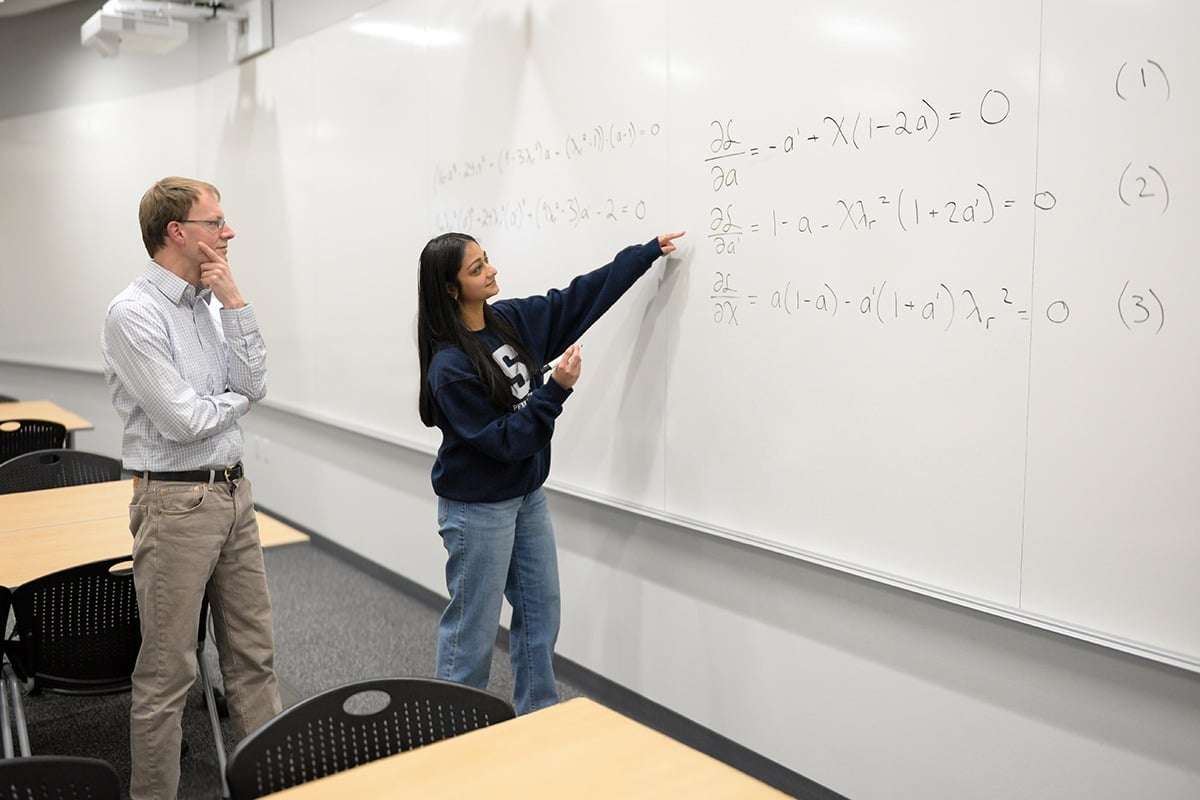
A major advancement by Penn State graduate student Divya Tyagi has breathed new life into a mathematical puzzle over a hundred years old, presenting a novel solution poised to transform wind turbine engineering and enhance renewable energy technologies. Tyagi, specializing in aerospace engineering, improved a formula originally conceived by British aerodynamicist Hermann Glauert, potentially redefining the wind energy landscape.
Updating a Century-Old Mathematical Model
Glauert's early 20th-century formula was pioneering in predicting the maximum energy output achievable by a wind turbine. Yet, as Tyagi points out, "Glauert’s model overlooked the comprehensive force and moment coefficients exerted on the rotor... critical factors that turbines must endure." These forces include crucial elements such as axial thrust and bending moments impacting turbine blades. By integrating these considerations, Tyagi has devised a more thorough framework for crafting turbines that are both efficient and resilient.
Her research, featured in Wind Energy Science, fills these gaps decisively. "I developed an extension to Glauert’s problem that defines optimal aerodynamic performance by solving for ideal flow dynamics," Tyagi explained. Leveraging sophisticated mathematical approaches, she expanded on Glauert’s initial model, making it more practical for engineers advancing renewable technologies.

An Elegant Mathematical Breakthrough
Tyagi’s technique stands out for its clarity and elegance. Employing the “calculus of variations,” a tool commonly used in optimization, she formulated a solution that combines mathematical rigor with ease of application for wind turbine design.
Her advisor, Sven Schmitz, remarked, "Tyagi's streamlined addendum opens doors to unexplored avenues in turbine design." By extending Glauert’s equation to factor in additional forces, her work enables more precise calculation of the optimal aerodynamic states for turbines, leading to stronger, more efficient blades.
Impacting the Future of Renewable Power
Even marginal gains in wind turbine efficiency carry significant consequences for energy output. Tyagi’s findings indicate that a modest 1% boost in the power coefficient—the efficiency ratio of wind to electricity conversion—could markedly increase energy production. "A 1% rise in power coefficient can substantially enhance a turbine’s total energy output, potentially energizing a whole community," she noted. Scaled across multiple turbines, this improvement has considerable economic and environmental implications.
Furthermore, Tyagi’s model provides pioneering insights into how turbines can be engineered to withstand the mechanical stresses encountered during operation. Schmitz added, "The biggest advance lies in guiding the next wave of turbines with these new findings." This knowledge promises more cost-efficient wind power solutions, accelerating the shift towards sustainable energy sources.
Award-Winning Research and Expanding Horizons
Tyagi has earned the distinguished Anthony E. Wolk Award, recognizing the top aerospace thesis at Penn State. Schmitz, who has long studied Glauert’s problem, praised her work, saying, "There was a simpler path all along—Divya discovered it." Her innovation has captured the attention of both scholars and energy professionals, positioning her research as fundamental for future turbine technologies.
Currently pursuing her master’s degree, Tyagi is broadening her expertise into computational fluid dynamics, analyzing airflow around helicopter rotors. Supported by the U.S. Navy, her efforts aim to enhance aviation safety and operational performance, demonstrating the wide-ranging influence of her skillset.
Tyagi’s progress from resolving a century-old mathematical conundrum to influencing tomorrow’s wind energy advancements exemplifies how academic dedication can drive meaningful change in critical renewable sectors.
- Categories:
- News











0 comments
Sign in to Comment