
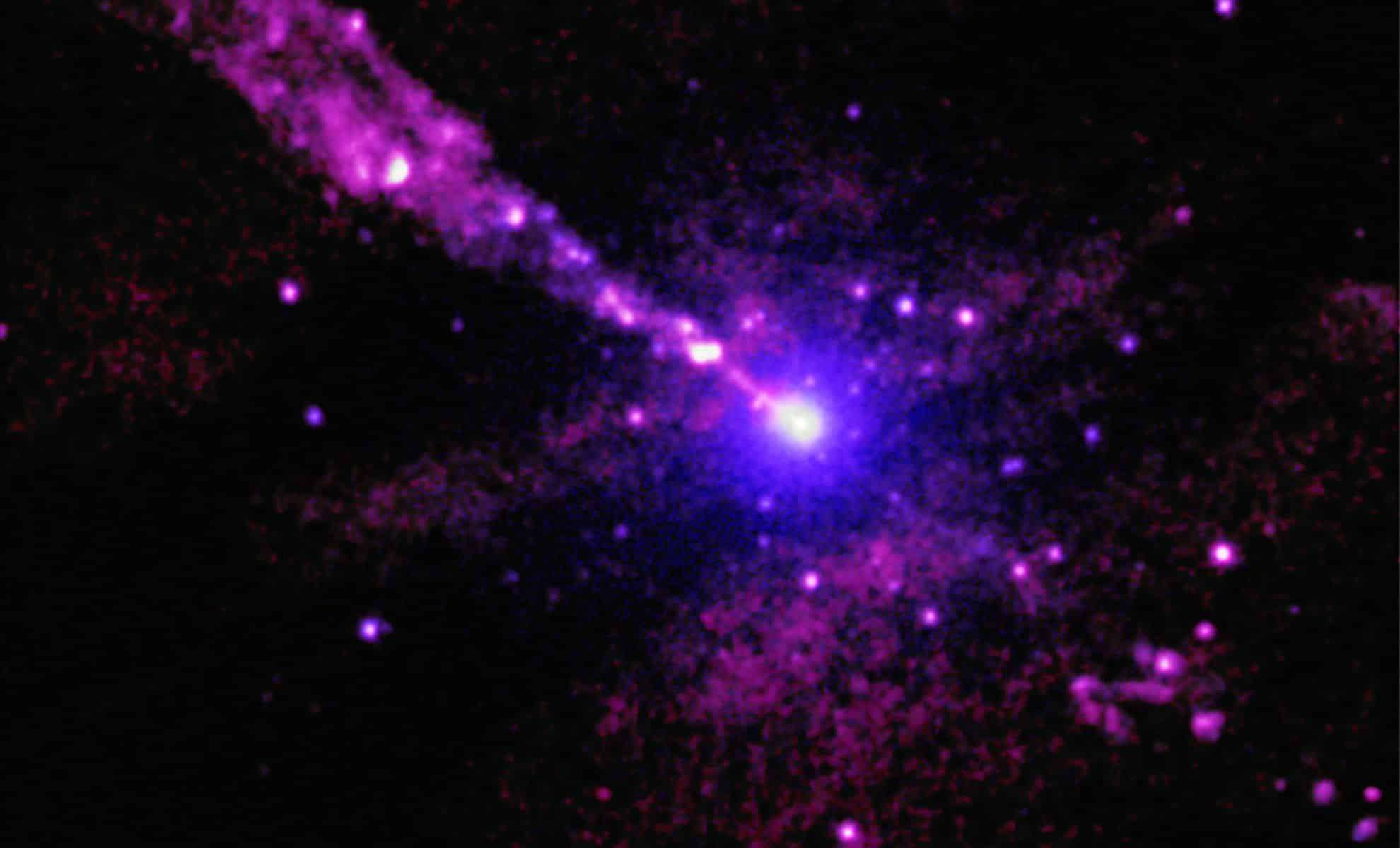
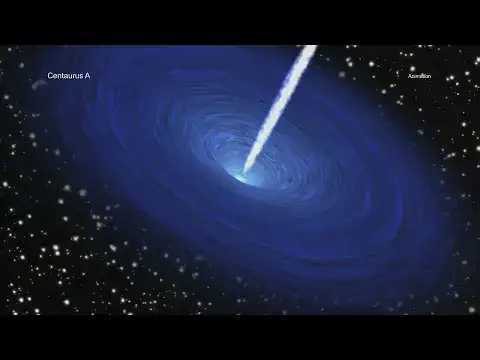
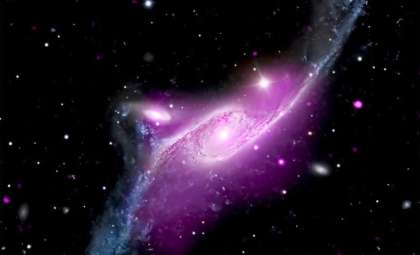
Astronomers are captivated by a surprising phenomenon captured by NASA’s Chandra X-ray Observatory within the distant galaxy Centaurus A. Situated roughly 12 million light-years from our planet, this galaxy hosts a supermassive black hole whose powerful gravitational and magnetic influences drive jets of energetic particles across vast distances. Although jets from black holes are familiar to scientists, a new observation unveils a remarkable event: one of these jets crashing into a enigmatic cosmic body, resulting in an extraordinary V-shaped X-ray emission. This unprecedented sight is captivating the scientific community and providing fresh clues about the intricacies of our cosmos.
Celestial Powerhouse: The Black Hole Jet of Centaurus A
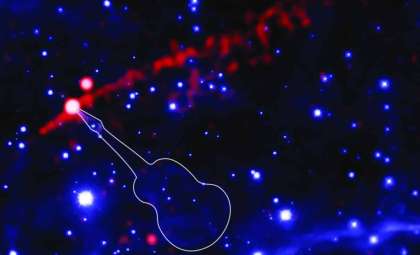
At Centaurus A’s core lies a supermassive black hole, a colossal entity whose immense forces influence everything around it. These forces accelerate particles to near-light speeds, generating jets that extend extensively. Using its cutting-edge instruments, the Chandra X-ray Observatory recently captured the deepest high-energy X-ray image yet of this galaxy, revealing a seldom-seen event: a jet from the black hole colliding with an unidentified object and creating an extraordinary V-shaped X-ray formation.
This jet, traveling at tremendous velocities, represents one of the galaxy’s most impactful forces. Yet this discovery adds complexity to our understanding. While interactions between jets and obstacles have been spotted before, this particular impact yields a distinctive V-shaped X-ray signature that has astounded researchers, prompting new investigations into the jet’s target and the resulting phenomenon.

The Curious Case of the X-Ray Source C4
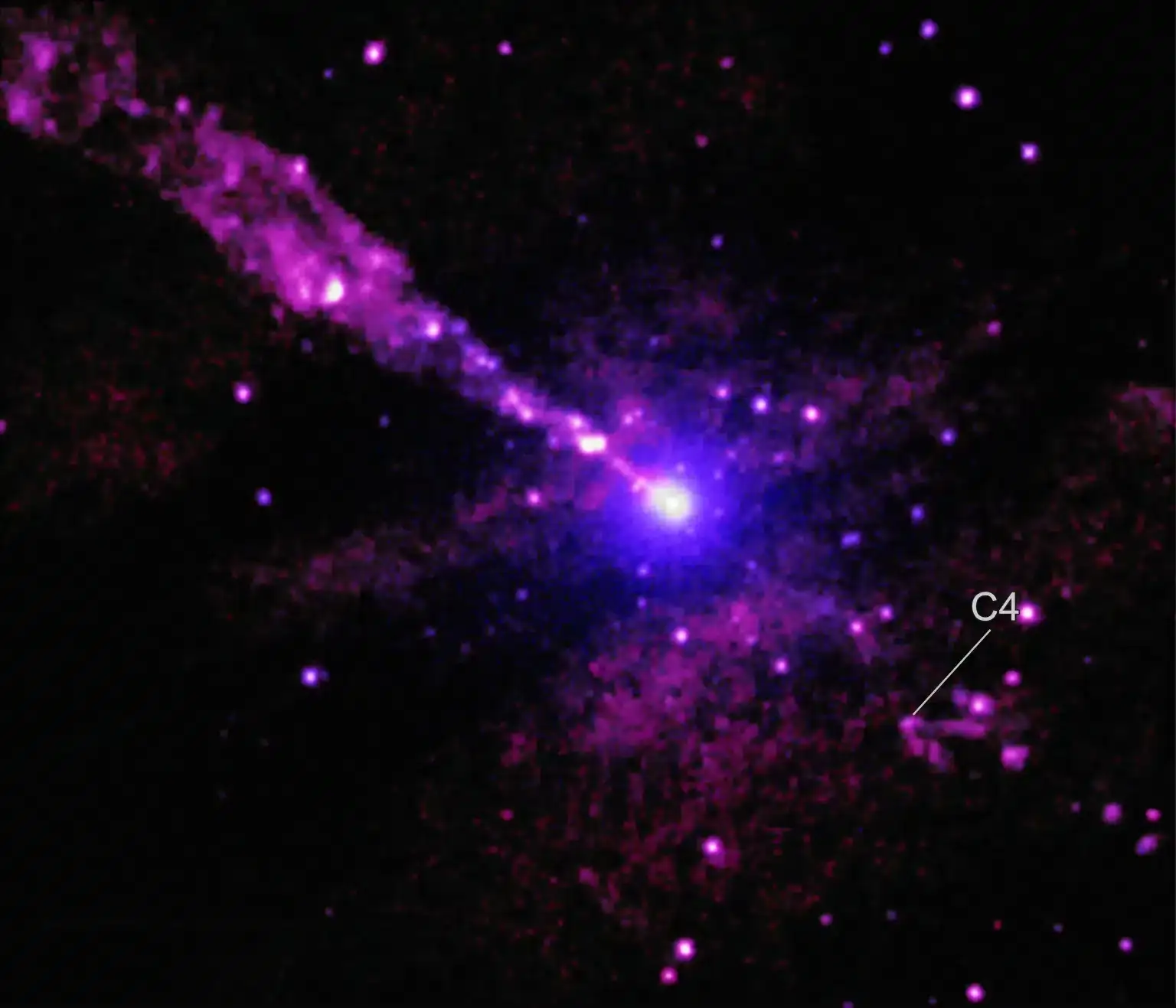
The puzzling X-ray glow observed in Centaurus A is linked to an object dubbed C4, a luminous X-ray source positioned near the jet’s trajectory. This source emits a V-shaped pattern stretching approximately 700 light-years, a vast scale that dwarfs nearby stars such as the Sun, which is just 4 light-years away, emphasizing the enormity of this emission.
Scientists theorize that this source might be a massive star, potentially isolated or part of a stellar pair. One hypothesis suggests that particles from the jet collide with gas expelled by the star’s powerful wind, stirring turbulence that produces the detected X-ray emission. Although this theory aligns with observations from Chandra, the true nature of C4 remains uncertain.
Interactions Between Jet Particles and Gas
The V-shaped X-ray feature offers insight into the dynamic exchange between the jet and its surrounding medium. Researchers propose that the jet’s particles impact gas emitted by a neighboring star, leading to turbulent regions with enhanced gas density. This interaction may be responsible for the X-rays spotted by Chandra. One arm of the V aligns with the jet itself, indicating the turbulence stems from this collision.
The other arm presents more of a puzzle, as it tilts sharply away from the jet’s path. Scientists are exploring whether this could be due to the jet striking additional objects, such as a dense gas cloud, or whether alternative explanations may account for this odd angle. The exceptional shape of this emission stands out compared to previous jet collisions, generating important questions about the physical mechanisms involved.
A Remarkable Discovery in Black Hole Research
Jet collisions with cosmic objects are known phenomena, but Centaurus A’s X-ray pattern is entirely novel. Past encounters typically produced elliptical blobs in X-ray images, whereas here, the V-shaped signature is an unprecedented observation, highlighting one of the most distinctive findings in recent astrophysics. Only Chandra possesses the capability to record such intricate high-energy details.
This breakthrough holds promise for enhancing comprehension of supermassive black holes’ surrounding environments and their jets' behavior. Ongoing studies aim to decode the mystery, potentially uncovering new facets of extreme cosmic phenomena.
The Enigma of the Mysterious C4
Despite the tantalizing data, the exact identity of C4 remains elusive. Is this source a colossal star or something more extraordinary? Researchers believe the answer lies in thoroughly investigating how the jet interacts with its target. Whether the collision involves a star or a gas concentration remains debated. Continued surveillance of Centaurus A by Chandra is expected to provide further understanding, possibly resolving this cosmic mystery.
Detailed in The Astrophysical Journal, this research stems from global collaboration among scientists at institutions including the University of Michigan, University of Maryland, and Penn State University. As analysis progresses, the secret behind C4 may soon emerge, offering new insights into black holes and the universe’s complex workings.
- Categories:
- Astronomy ,
- News ,
- Nasa




0 comments
Sign in to Comment