
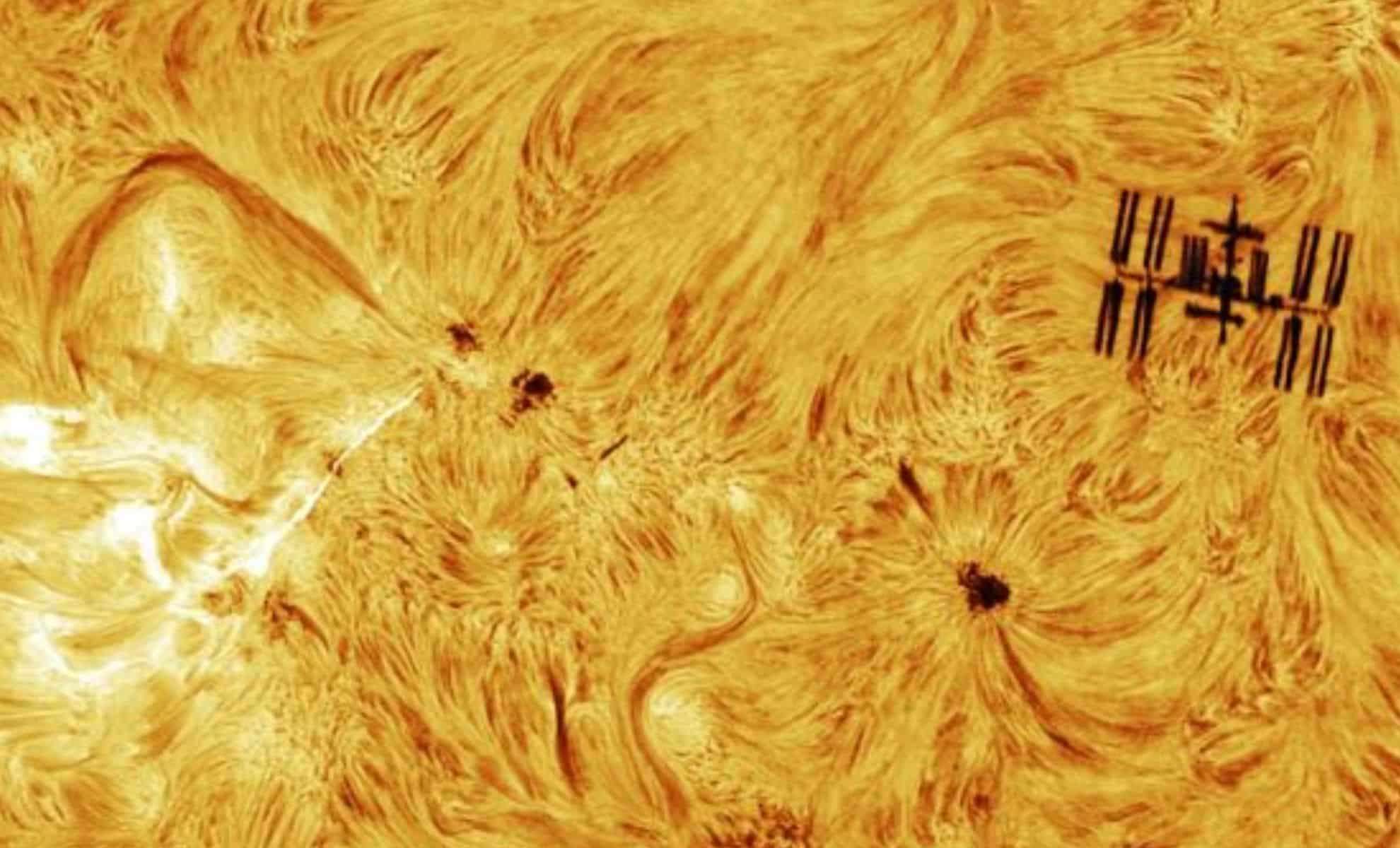
Astrophotographer Andrew McCarthy from Arizona has achieved a remarkable feat by capturing the International Space Station (ISS) as it crossed directly in front of the Sun. Adding to the rarity of this moment, a solar flare can be seen erupting in the background, producing a truly exceptional image. Shot in the Sonoran Desert, this photo highlights the powerful and radiant Sun alongside the sleek silhouette of the orbiting ISS during a perfectly timed celestial event. Known for his precision and dedication to capturing cosmic phenomena, McCarthy combined expert timing with a bit of luck to document this spectacular cosmic coincidence.
Describing the photo as one of his all-time favorites, McCarthy emphasized the fortunate timing needed to record such an event. The presence of the striking solar flare adds intensity and depth to the scene. While the flare’s brilliance is captivating, it poses no immediate danger to the ISS, which maintains a safe orbit around Earth. However, solar flares are known to elevate radiation levels in space, potentially impacting spacecraft electronics and astronauts, making this image not just captivating but a vivid reminder of the complex space environment.
The Challenge of Photographing an ISS Solar Transit
Capturing the ISS as it briefly transits across the Sun is a demanding task for space photographers. Given its rapid orbit—completing a trip around Earth every 90 minutes—the station’s alignment with the Sun or Moon happens only fleetingly. Photographers must be precisely ready to seize the moment when the ISS silhouette crosses the Sun, leaving little room for error. Accurate timing combined with technical skill is essential to achieve such a clear and perfectly framed image, especially when solar activity is constantly shifting.

McCarthy’s process for this shot involved carefully preparing his equipment under the intense desert heat. To keep his telescopes cool, he used ice packs and coolers, ensuring optimal performance during the shoot. On Instagram, he shared that the final photo is a composite mosaic created from hundreds of images taken before and after the transit, allowing him to depict the Sun’s surface in extraordinary detail. The final image demanded not only photographic expertise but also intensive post-processing to bring out the intricate features of solar activity.
Visualizing Humanity’s Future Through Celestial Photography
Beyond its technical brilliance, McCarthy’s photograph carries a deeper narrative. He named the piece “Kardashev Dreams,” referencing the Kardashev scale—a framework introduced by Soviet astronomer Nikolai Kardashev for classifying civilizations based on energy use. This title reflects McCarthy’s thoughts on humanity’s potential progress in space exploration, symbolizing a hopeful vision of technological growth and cosmic discovery.
The name “Kardashev Dreams” embodies McCarthy’s anticipation of humankind’s expanding role beyond Earth. The ISS, an emblem of global collaboration and space exploration, traveling in front of the Sun serves as a poignant emblem of both achievements and future aspirations. McCarthy also highlighted how the image’s composition was deliberately designed to enhance this storytelling. He explains that some negative space in the photo, featuring elements borrowed from the 2024 eclipse, transitions the fiery chromosphere into darkness, reinforcing the narrative of solar phenomena and space exploration as interconnected steps toward a more advanced civilization.
- Categories:
- News










0 comments
Sign in to Comment